Bernadette Amani reflects on her journey and growth as a player at Bayern Munich, highlighting the challenges faced at the Women's Africa Cup of Nations.
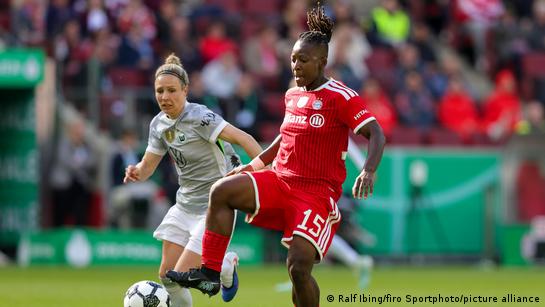
Bernadette Amani is making her mark in women's soccer, entering her inaugural full season with Bayern Munich after a successful stint that began in January. The 28-year-old midfielder’s journey from rural Ivory Coast to the heights of German football showcases her determination and talent. Winning both the Bundesliga and the German Cup in her first half-season, Amani has quickly solidified her place at the club.
"It's a dream come true for me to be here, and I'm living my dream to the full," Amani shared in an exclusive interview. She elaborated on her experiences at Bayern Munich, expressing gratitude for the opportunity to play for such a prestigious team. The difference in professionalism between her previous club, CD Tenerife Femenino in Spain's Liga F, and Bayern has been eye-opening for her.
"In Spain or the Ivory Coast, the coaching structure might involve just five or six staff members. Here, we have eight to ten, which allows us to up our game significantly," she explained. Amani's positive experiences in Munich illustrate her rapid development as a player, enhancing her understanding of the game and refining her skills.
Pivotal Moves and Discoveries
Amani's path to Bayern Munich wasn't straightforward. Growing up in Dougbafla, she initially played soccer with local boys without envisioning it as a career. Her parents prioritized education over sports, prompting her move to Abidjan. This relocation proved vital as she discovered the women's football league and was inspired by the intensity and skill of the players.
Once she moved to Abidjan, Amani became immersed in the culture of competitive women’s soccer. She witnessed players who had made significant progress, some even competing in Europe. This exposure transformed her perspective: "I saw that some players were competing in Europe, and it made me realize that I could make a living from what I love," Amani recalled. She didn’t just see role models; she felt a budding ambition turning into a tangible goal.
The acknowledgment of her talent was nearly instantaneous, leading to a trial with the club Onze Soeurs de Gagnoa, where she secured a position. This initial success was merely a stepping stone. Amani's rapid rise propelled her from local play to competing in Spain’s third tier and ultimately in Liga F with Eibar and Tenerife, each experience enriching her skills and confidence. The combination of local talent development and exposure to international play effectively prepared her for the challenges at Bayern Munich.
The Challenge of Retaining Form
As the Women’s Bundesliga season prepares to kick off with Bayern defending their title against Union Berlin, Amani is back in Munich following the Women’s Africa Cup of Nations. Regrettably, the tournament ended in disappointment for her and the Ivory Coast team, which aimed to at least match their previous third-place finish but fell short, losing 2-1 in the quarterfinals to Algeria.
The weight of national aspirations fell heavily upon Amani’s shoulders, especially given the team’s previous successes on the continent. In a further setback, Ivory Coast's aspirations for a spot in the Women’s World Cup were dashed after a loss to Ghana in the playoff matches. It’s a tough realization for any athlete to face. But when you’re at this level, setbacks are part of the journey. Amani’s resilience is commendable; despite the heartache of the national team’s exit, she wasted no time in returning to club duties. She participated in a DFB Supercup victory over Wolfsburg just two days after the tournament, showcasing her commitment and readiness to contribute.
Amani is aware that succeeding at Bayern comes with its own pressures. "People outside see it as an achievement to get here, but those in football know the real challenge is maintaining that position," she said. Her eyes are set on continuous improvement, both personally and for the team, as they aim to reclaim the Bundesliga title. Success at Bayern isn’t just about filling a roster spot; it involves stepping up to expectations, both internal and external.
Implications for Women’s Soccer
The trajectory of Bernadette Amani’s career speaks volumes about the growing opportunities for women in professional soccer. Her story isn't just inspiring; it reflects broader shifts within the sport, particularly in regions previously overlooked. As women's soccer gains traction globally, players like Amani are at the forefront of a transformative wave. With skilled coaches and enhanced infrastructure, the game is evolving rapidly, challenging established norms and pushing the boundaries of what female athletes can achieve.
What this means for you, if you're working in this space, is multifaceted. The influx of talent from diverse backgrounds is enriching the competitive nature of leagues and tournaments. It drives interest, boosts viewership, and, perhaps most importantly, creates pathways for aspiring young athletes. As competition intensifies, so does the need for continuous development, not just on an individual level but across teams and organizations.
Moreover, as players like Amani raise the bar, the pressure on clubs to provide adequate support structures—coaching, training facilities, and mental health resources—intensifies. If clubs want to attract and retain top talent, they'll need to reflect on what they value in terms of player development. The stakes are high. And the future of women’s soccer hangs in the balance.
Ali Farhat contributed to this article.
This article was originally published on July 28, 2026. It was updated on August 20, 2026 to reflect developments at the recent WAFCON tournament.
Edited by: Matt Pearson
Discussion
Sign in to join the discussion.