Recent experiments reveal unexpected behavior in particle collisions, suggesting a crucial transition point in nuclear matter's transformation.
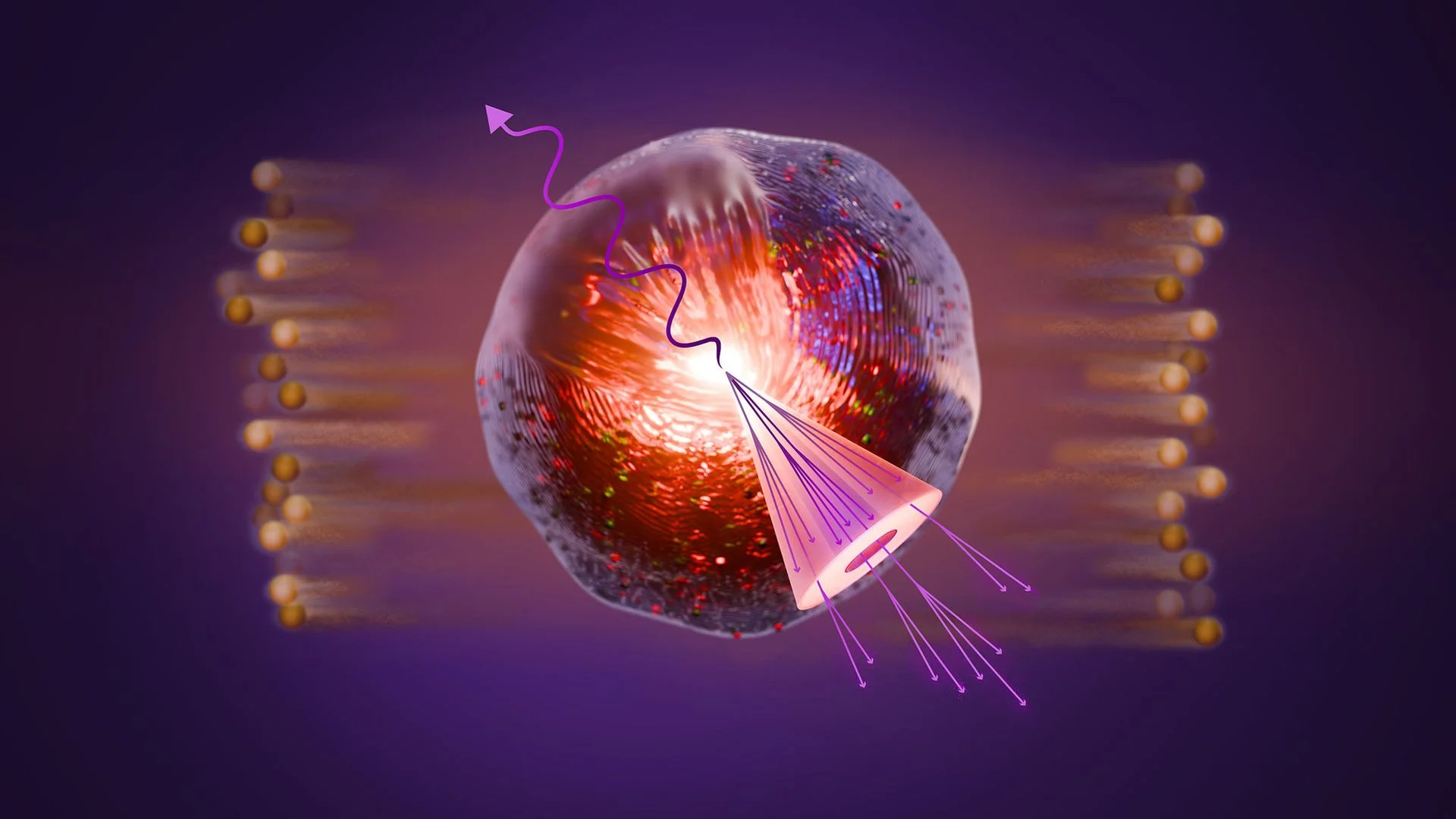
Physicists at the Relativistic Heavy Ion Collider (RHIC) have recently discovered an intriguing phenomenon while colliding gold nuclei at near-light speeds. In the aftermath of these collisions, a peculiar trend emerged in the patterns of particles ejected from the collisions. This finding is pivotal as it could illuminate the processes that governed the transformation of a hot, primordial soup of quarks and gluons into the matter we encounter today—protons and neutrons.
Mapping Nuclear Matter Transitions
Nuclear matter, comprised of protons and neutrons, consists of even smaller particles called quarks, which are held together by gluons via the strong force. Under high temperatures and densities, such as those present in the early universe just microseconds after the Big Bang, this matter transitions to a free state termed quark-gluon plasma. Researchers aim to decode how this transition occurs to better understand the universe's evolution.
The concept of a "critical point" in nuclear matter is particularly significant. This point would represent a shift in the state of nuclear matter, similar to how the transition between water and steam becomes aberrant at high temperatures. Physicists speculate that at extreme densities, the phase transition from ordinary matter to quark-gluon plasma becomes abrupt, thus creating a unique set of conditions that merits further investigation.
Experimental Findings and the Unexpected Dip
The STAR collaboration at RHIC aimed to probe this critical point by manipulating collision energies, which directly affect the compression of the colliding matter. By using a range of energies from 3 to 7.7 GeV for collisions—significantly lower than RHIC's maximum of 200 GeV—scientists were able to study how particles were expelled from the collision fireball, an indication of the conditions generated during the event.
As expected, charged particles were ejected sideways, and the intensity of this ejection varied from one collision to another. Physicists anticipated a smooth trend in these variations as energy levels shifted. Surprisingly, however, the results revealed a dip in the fluctuations—an anomaly that diverges from established expectations and suggests the presence of a critical transition.
This dip, with a statistical significance of 5 sigma, indicates that, if the trend were truly smooth, a similar deviation would occur only once in 3.5 million random trials. Continued analysis showed that the observed dip aligned poorly with existing simulations that lacked a critical point, further implying that this phenomenon may highlight new physics at play.
Caution in Interpretation
While the dip offers compelling hints of a potential critical point, researchers urge caution in interpretation. Rutik Manikandhan, a postdoctoral researcher involved in the study, emphasized that the observations are nuanced and not definitive proof. Other influences unrelated to the critical point may also contribute to the observed fluctuations in the data.
The team plans to follow up this promising lead by exploring the specific heat of the hot matter created in these collisions. They will benchmark these findings against simulations to deepen understanding of quark and gluon interactions under such extreme conditions. Furthermore, they aim to inspect other measurements, including fluctuations in particle production, to better assess whether this critical point exists.
Broader Implications and Future Research Directions
This research not only advances our grasp of phase transitions in nuclear matter but also enriches the broader field of cosmology. By creating conditions analogous to the early universe, scientists can trace how quarks and gluons formed the foundational building blocks of ordinary matter. This might shed light on the processes underlying cosmic evolution.
As the STAR experiment continues its work, physicists are keenly aware that understanding these fluctuations could lead to greater insights about both the universe's history and the fundamental nature of matter under extreme conditions. Ensuring that multiple measurements converge on a conclusion will be key to validating the existence of the critical point suggested by recent data.
As future data emerge, the scientific community remains poised at this frontier of nuclear physics, hoping to unravel the complexities that shaped the universe itself.
Discussion
Sign in to join the discussion.