The unveiling of Poland's tallest Virgin Mary statue sparks debate on its significance for faith and community priorities in Konotopie.
Can a giant Madonna help slow secularization in Poland?
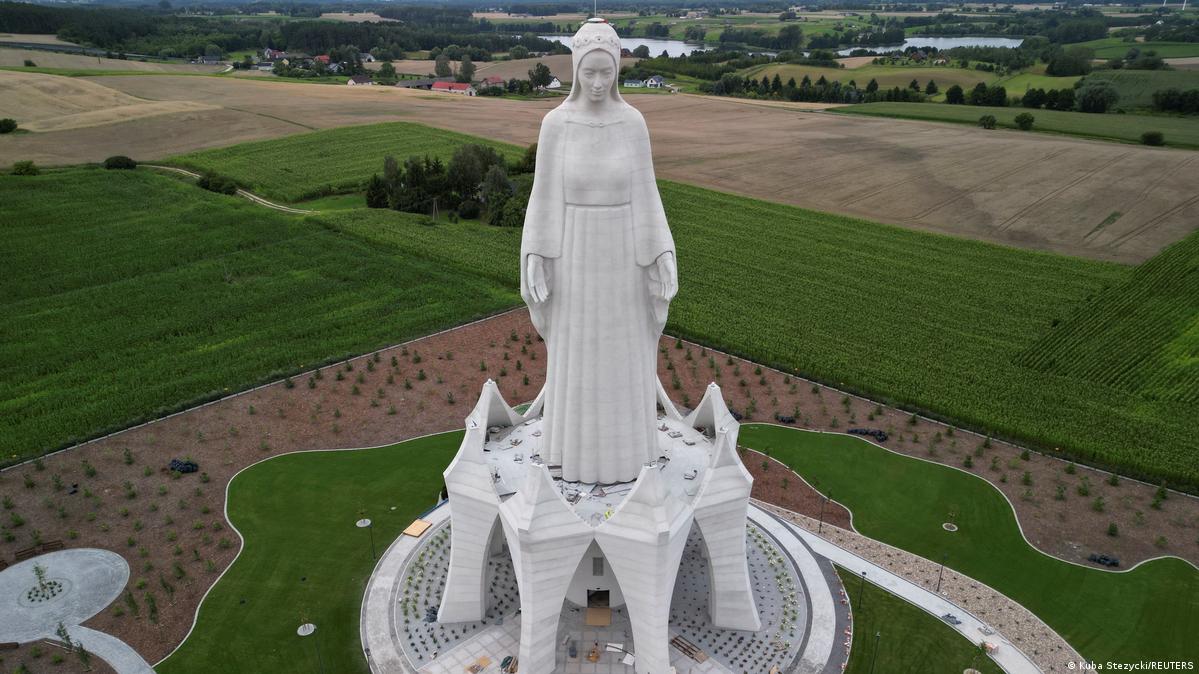
August 14, 2026In the lush countryside of Konotopie, a humble village in Poland, a gargantuan statue of the Virgin Mary now dominates the landscape. Standing at an imposing height of over 55 meters (180 feet), it is a striking structure that dwarfs even the iconic Christ the Redeemer statue in Rio de Janeiro, which is a mere 38 meters tall, including its base. The statue's development has made this tiny community of just 120 residents a focus of national and international media attention, raising questions about its cultural and spiritual significance.
The massive, white statue will be officially unveiled on August 15, coinciding with the Feast of the Assumption of Mary—an important date in the Catholic calendar. In the lead-up to its inauguration, thousands have already visited, eager to witness a monument that some hail as a "fantastic achievement," while others criticize it as merely a "pile of concrete." This polarization reflects broader tensions within Polish society regarding the role of religion and the orientation of community resources.
Divided Opinions
Public sentiment surrounding this monumental undertaking vividly illustrates the societal divides present in Poland today. Critics point out that the funds spent on this statue—speculated to be around €23 million—could have been directed to pressing community needs like education, healthcare, or local infrastructure. The arguments often hinge on a fundamental question about priorities: should faith manifest through grand structures or through meaningful contributions to the lives of citizens?
On the other side of the conversation, fervent supporters admire the statue's design and intent, viewing it as a powerful symbol of their enduring Catholic heritage. For them, it embodies not just religious devotion but also resilience against a backdrop of increasing secularization. This schism reveals deeper questions about identity and values in contemporary Poland, where traditional religion is grappled with modernity and the pressures of a globalized world.
The Visionary Behind the Statue
At the heart of this project is Roman Karkosik, one of Poland's wealthiest businessmen, often likened to Warren Buffett for his impact on the nation’s economy. With a fortune estimated at €442 million ($511 million), Karkosik has made significant contributions to the local community, including previously funding a church for pilgrims. His motivation for the Virgin Mary statue, described as a "gesture of gratitude," stems from personal experiences tied to illness and loss. This personal background adds layers to the project, positioning it as a blend of philanthropy and faith.
It's not just about personal redemption but also about community building. As Karkosik's vision comes to life, he's catalyzing discussions about the role of significant investments in local culture. Beyond religious fervor, the project signifies a battle for hearts and minds in a country wrestling with its identity.
Artistic Concerns
The sculptor, Adam Jakub Matejkowski, initially expressed doubts about how the massive statue would reflect his artistic vision. After worrying that it might not match his expectations, he ultimately found himself impressed by the completed work. He articulated that “the Virgin Mary appears to be welcoming us,” which underscores his intention for the statue to embody warmth and approachability through its human-like features. This perspective invites a conversation about the role of art in spirituality—can monumental structures truly embody the divine? Or are they mere reflections of human interpretation?
Economic Aspirations
In a region often overlooked economically, local leaders are optimistic that the statue could serve as a beacon for growth. Tourism has already started to spike as many see the potential to transform Konotopie into a pilgrimage site. This isn't just about faith; it’s about economic survival. Local businesses have reported revenue increases, driven by the influx of visitors eager to witness the statue. Restaurants and bars are already seeing more foot traffic, which raises broader questions about the sustainability of such growth and whether it will last beyond the initial hype.
The Bigger Picture: Growing Secularism
However, one pressing question looms: Can mere monuments counteract Poland's trend of rising secularization? With growing discontent directed at the Church, characterized by a notable decline in trust from 58% in 2016 to just 35% now, many remain skeptical about the statue's ability to rekindle faith. Once regarded as a stronghold of Catholicism, Poland now finds itself grappling with an identity crisis amidst shifting societal values and opinions.
And here’s the thing: while grand statues may make headlines, they hardly address the underlying issues faced by a more skeptical populace. If you’re working in this space, you'll find that mere symbols often lack the substance needed to effect real change, especially in a society where attendance at mass continues to dwindle. Even a towering Madonna might struggle to reverse the tide of secularization without a deeper commitment from religious institutions to engage meaningfully with changing perspectives.
Implications for Polish Society
The implications of this statue extend well beyond the immediate community of Konotopie. Its construction speaks to a larger narrative within Polish society—a narrative grappling with identity, faith, and the role of the Catholic Church in everyday life. As younger generations increasingly express disconnection from institutional religion, this monument can be viewed as both a rallying cry and a symbol of resistance to inevitable social changes.
In essence, the statue could serve as a mirror reflecting contemporary Polish society—an intricate blend of devotion and doubt. This ongoing dynamic may eventually determine whether the monument serves as a source of unity or division within a country facing profound transformations. Ask yourself: what might the future hold? This isn't just a local issue; it's a bellwether for Poland’s spiritual climate.
This article was originally written in German.
Discussion
Sign in to join the discussion.