The South Korean robot RAIBO2 completed a full marathon on one charge, marking a significant leap in quadruped robot endurance.
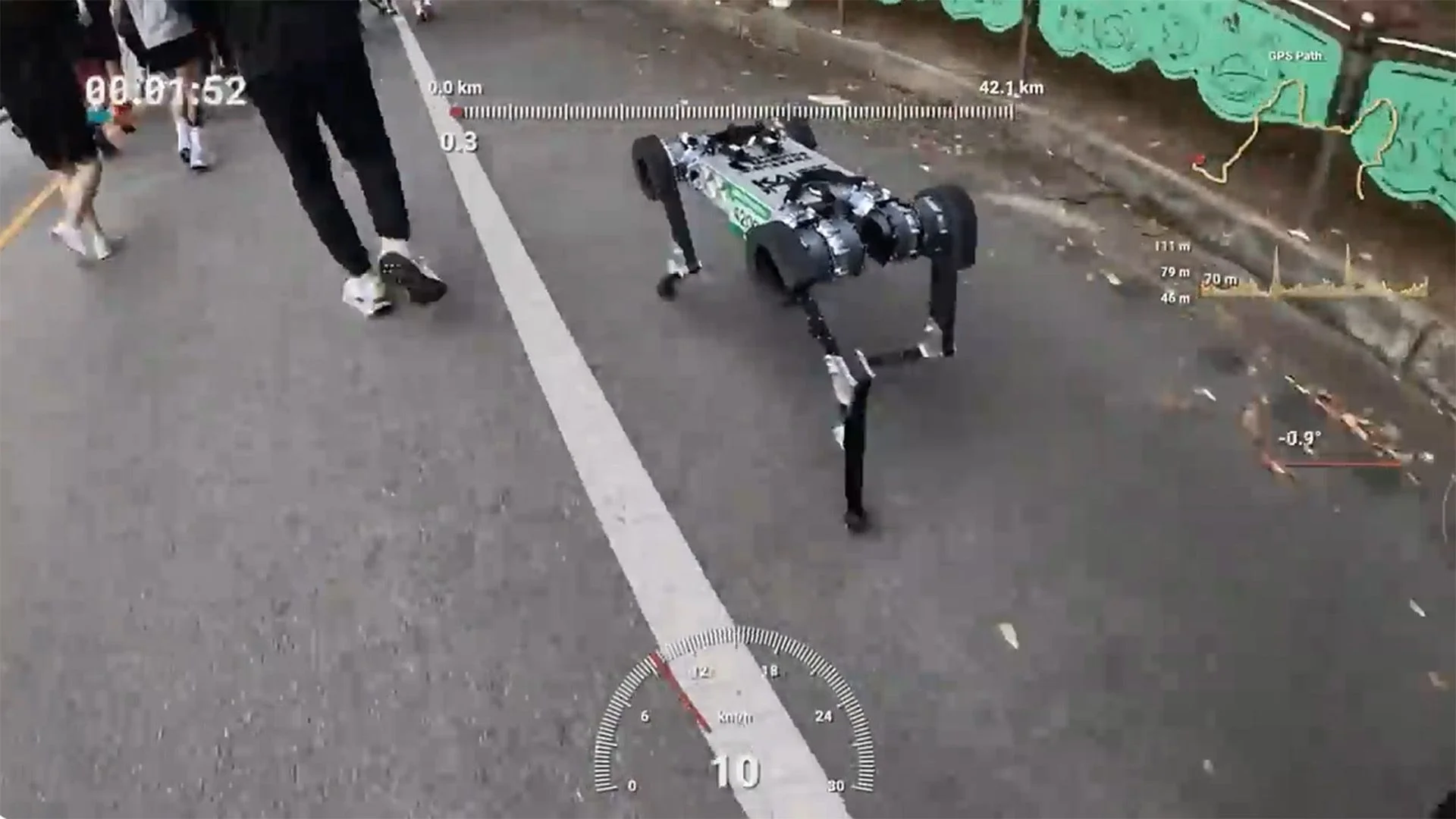
A four-legged robot named RAIBO2 has made headlines by running a full marathon—26.2 miles (42.2 kilometers)—on a solitary battery charge. This impressive feat took place at the 22nd annual Sangju Dried-Persimmon Marathon in South Korea on November 17, 2024, with the robot finishing the course in a time of just over 4 hours and 19 minutes.
Developed to resemble a dog in its movement with its four jointed legs, RAIBO2 is recognized as the first quadruped robot to successfully complete a marathon-distance event without requiring a recharge. Researchers recently published their findings about this accomplishment in the journal Nature on September 23, 2024.
Endurance Challenge
The testing environment for RAIBO2 was particularly demanding, as the marathon course included two significant elevation climbs of 50 meters (164 feet) each, with slopes reaching up to 10 degrees. Such gradients posed a strenuous challenge to the robot's energy resources, effectively pushing the limits of its battery management. Prior to this marathon, the robot had attempted a GPS-guided run of 26.7 miles (43 km) on a flat surface, completing it in 4 hours and 40 minutes. However, an earlier attempt on uneven terrain was halted around the 23-mile (37 km) mark when the battery depleted.
The fact that RAIBO2 not only completed a marathon but did so against challenging elevations highlights advancements in robotic mobility and energy management. Given the strenuous nature of the course, one might wonder how a robotic system can be made to withstand such physically taxing scenarios. The success of RAIBO2 demonstrates a leap forward in endurance for robotic systems, particularly when considering the previous attempts that ultimately failed due to battery limitations. Such achievements could pave the way for future projects aimed at not just distance but also adaptability to difficult environments.
Technical Enhancements
To improve RAIBO2's endurance for the marathon, developers increased the robot's battery capacity by 33% and refined its control systems. They particularly focused on implementing joint-stiffness control at the actuator level, enabling the robot to adjust its leg stiffness for better impact absorption and stable push-offs. As a result of these adjustments, RAIBO2 has a theoretical range of 41.6 miles (67 km) on flat terrain on a single charge.
The battery upgrades are critical; they reflect broader trends in robotics aimed at enhancing energy efficiency. Yet it’s not just the hardware that's improved. The developments in control systems illustrate how software plays an equally vital role in performance. The combination of mechanical advancements with refined algorithms demonstrates that the future of mobile robotics will likely hinge on integrated approaches rather than isolated enhancements. The ability to vary leg stiffness is particularly fascinating, as it mimics biological locomotion, a trait often overlooked in robotic designs—critically, this results in smoother motion and less energy expenditure.
Efficiency Metrics
The efficiency behind RAIBO2's marathon success involved a meticulous optimization of both software and hardware components. Its light mechanical parts allowed for effective kinetic energy transfer with minimal interference. Coupled with a low-loss motor-driving circuit, the robot's locomotion policy was also designed to be energy-efficient. Training simulations using RaiSim—an environment that models various terrains—also bolstered the robot's performance.
Similar to many electric vehicles, RAIBO2 can regenerate battery life by capturing kinetic energy, especially while descending. This feature aids in compensating for the energy expended while climbing, although it does not negate the additional challenges posed by hilly courses. The model’s efficiency compares favorably to other machines within its bracket, as its lower total cost of transport (0.25 vs. human average of 0.37) emphasizes significant advancements in design and engineering.
If you're working in this space, understanding how energy efficiency translates to performance is critical for future robotics applications. RAIBO2’s design serves not just as a technical marvel but also provides insights into developing other robots tasked with similar endurance feats.
Future Applications
With more than three times the travel range per charge compared to existing quadruped robots, and a total battery capacity of 2,016 watt-hours, RAIBO2's endurance represents a significant shift for this type of robotic technology. Researchers suggest that such improvements could expand the functionality of quadruped robots in various challenging environments, including disaster zones and rugged terrains where traditional wheeled robots struggle. With the ability to carry cameras, sensors, or communication equipment, RAIBO2 is poised to play an essential role in future applications that require agility across uneven landscapes.
This isn't just about marathons. The implications of RAIBO2's capabilities could extend to realms like search and rescue missions in disaster-stricken areas, where rugged terrains and obstacles often hinder rescue efforts. By deploying robots that can traverse these challenging landscapes, human rescuers could focus on critical tasks while machines handle the complicated access. The scalability of its battery technology may further inspire solutions in electric vehicle sectors looking to improve mileage or performance under challenging conditions.
Implications and Future Outlook
The successful completion of a marathon by RAIBO2 signals not just an engineering triumph but also a potential pivot point for robotics in practical applications. Quadrupedal robots have long struggled with endurance and energy management; RAIBO2 flips that narrative on its head. What this means for you as an observer of technology trends is considerable. Industries reliant on mobility and flexibility in their robotic deployments may soon consider quadrupedal designs not just as novelties but as essential tools in logistical and operational frameworks.
With further iterations likely in the pipeline, advancements like RAIBO2 may redefine our expectations of robotic endurance, opening doors to unforeseen applications in healthcare, delivery, and even personal assistance. As researchers and engineers build on this impressive groundwork, expect future robots to become even more integral to sectors demanding agility, efficiency, and robust performance across various environments.
Discussion
Sign in to join the discussion.