Delft researchers’ camera-guided drone won Abu Dhabi’s 2025 autonomous race, completing two laps faster than three former human world champions.
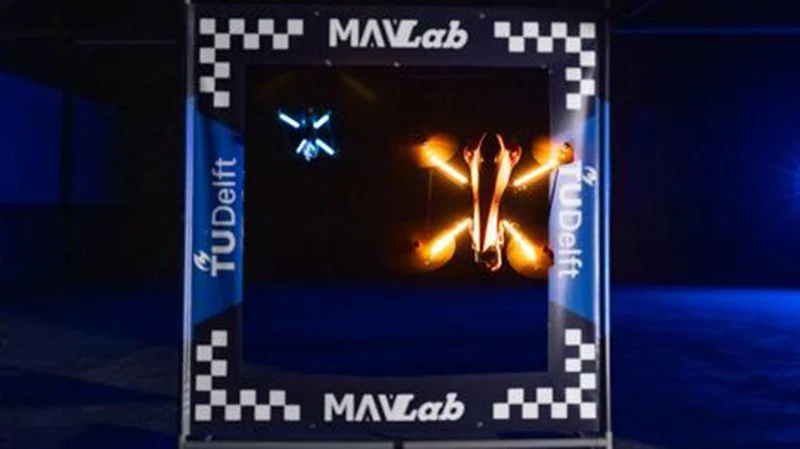
MonoRace’s result points to a practical shift in autonomous robotics: a small drone can race at more than 60 mph using onboard vision and a compact processor, without GPS or external tracking. Built at Delft University of Technology, the system won the 2025 Abu Dhabi Autonomous Racing League competition and recorded faster times than three former human world champions.
The team reported the results in a study published Oct. 14 in Science Robotics. On a course with 11 gates, MonoRace completed two laps in 16.56 seconds and reached approximately 63 mph (102 km/h). Those figures make the system’s minimal sensor setup as notable as its speed.
One camera, one onboard control loop
MonoRace uses a single forward-facing rolling-shutter camera and an inertial measurement unit (IMU), which records acceleration and rotation. It has no stereo cameras, preloaded course map, GPS, or motion-capture system. The camera helps the system identify gates, while the IMU supplies information about the drone’s movement.
A neural network turns those inputs into motor commands. The flight controller sends them to the four propellers 500 times per second, allowing the quadcopter to make rapid corrections as it passes through the course. The aircraft weighs 966 grams (2.13 pounds) and measures about 11.8 by 11 by 3.9 inches (30 by 28 by 10 centimeters). Its compact hardware keeps perception and control aboard the drone.
That constraint matters. Autonomous racing often depends on substantial external infrastructure or computing resources; MonoRace shows how much can be done with a lightweight platform and limited onboard sensing. The result is a specialized racing system, but its design also offers a useful test of how quickly a robot can perceive and respond in the physical world.
Training through simulated trial and error
The researchers trained MonoRace with reinforcement learning, letting the model improve through repeated attempts and feedback. Training took place in a physics simulator, where the system learned to fly from scratch over millions of trials. It first learned to avoid crashes and reach the opening gate, then gradually progressed farther and increased its speed.
Rather than tune the model for just one perfectly specified aircraft, the team varied properties including weight, battery voltage, drag, sensor noise, and propeller condition. That approach was intended to help the controller handle differences between drones and imperfections in real hardware.
Some footage accompanying the research uses computer-generated visuals. Study co-author Guido de Croon, a professor at Delft, said the only fully simulated imagery appears during the training segment, around the two-minute mark. “Here we show the gates in a visual simulator for the video but the real training happened in a stripped-down, pure physics simulator that ran really fast,” he told Live Science in an email.
De Croon added that the control network did not train on simulated camera images. It received an estimated state from a separate perception and state-estimation process. In the real-flight footage, visual overlays illustrate how the drone interprets its camera view: gate corners appear as small circles, gate edges as red lines, and a blue region marks where the system expects to find the next gate.
Beyond faster laps
MonoRace’s immediate achievement is speed, but the underlying control method could be adapted to other goals. De Croon suggested that a similarly sized neural network might be trained to minimize energy use instead of lap time. That could matter for everyday robots, which often run on small processors and conventional controllers.
He also sees potential value for human pilots: MonoRace could serve as a training reference, much as strong chess programs have influenced human play. The more consequential takeaway is that capable physical AI can run on a microcontroller-class chip. If researchers can transfer that level of fast perception and control to less demanding tasks, compact robots may become more efficient without requiring larger onboard computers.
Discussion
Sign in to join the discussion.