JWST observations reveal a young stellar ring, a nearby companion and evidence of a possible collision in galaxy GS18660, seen 2.1 billion years after the Big Bang.
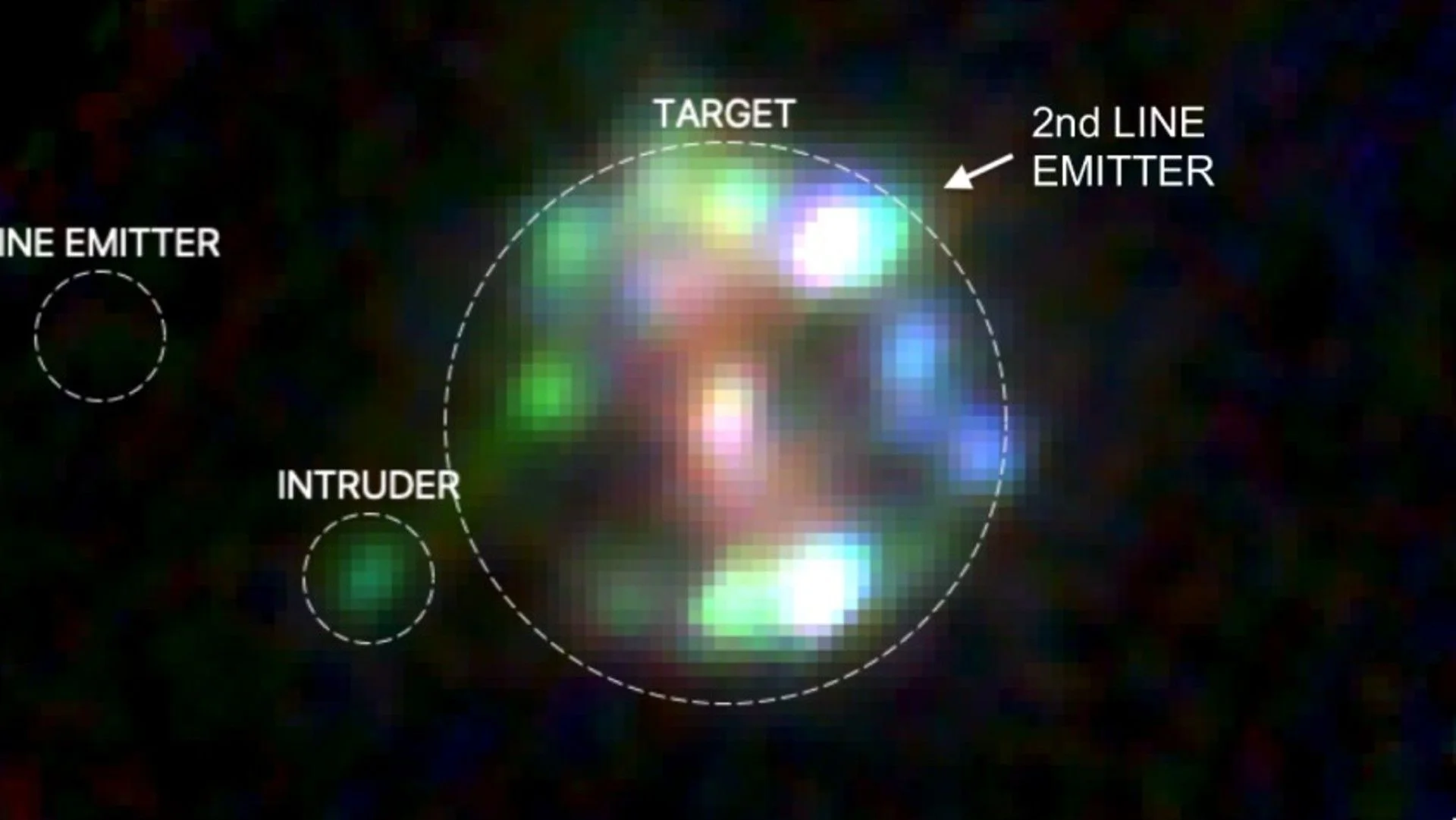
Galaxy GS18660 may preserve evidence of a collision that set off a burst of star formation in the early universe. James Webb Space Telescope observations show a ring of young stars, a nearby companion galaxy and a gas bridge between them. Together, those features make a head-on impact a plausible explanation for the ring, though the researchers say the evidence doesn’t settle the question.
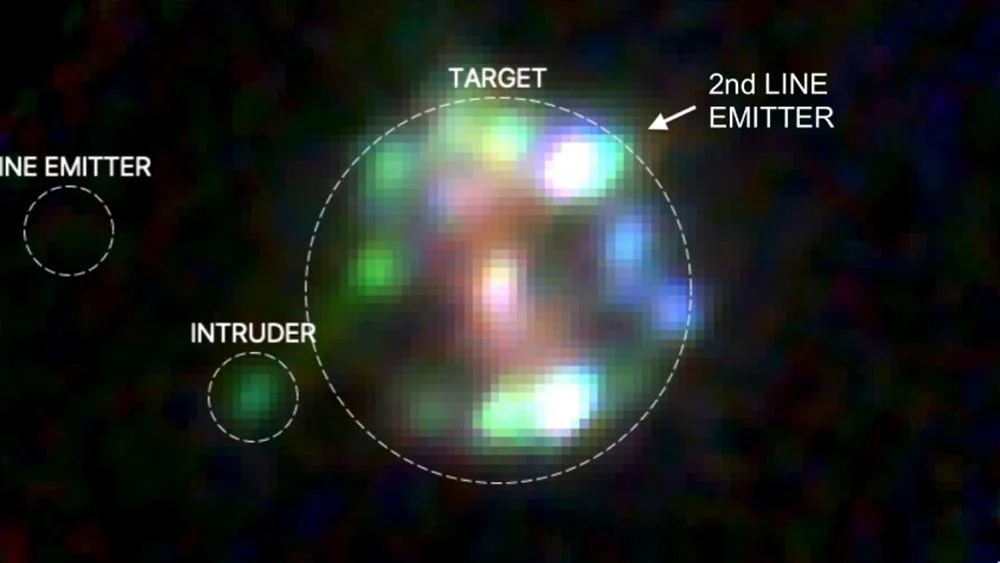
Seen as it was 2.1 billion years after the Big Bang, GS18660 is the most distant ring galaxy identified so far. The study, published Sept. 8 in Astronomy & Astrophysics, examines whether a smaller galaxy passed through its center and triggered the ring’s formation.
That possibility matters because ring galaxies are unusual, and confirmed examples in the distant universe are scarce. Christopher Conselice, a professor of extragalactic astronomy at the University of Manchester who wasn’t involved in the study, told Live Science that catching a possible merger at this stage is rare. Interactions may have been common among early galaxies, he said, but the conditions that produce rings are thought to be uncommon. He described GS18660 as a potentially unique system that could offer clues to early galaxy formation.
JWST revealed a ring the team wasn’t seeking
GS18660 first drew researchers’ attention because it looked elongated in older images from the Hubble Space Telescope. The team chose it for closer study based on that appearance, not because it had already been identified as a ring galaxy.
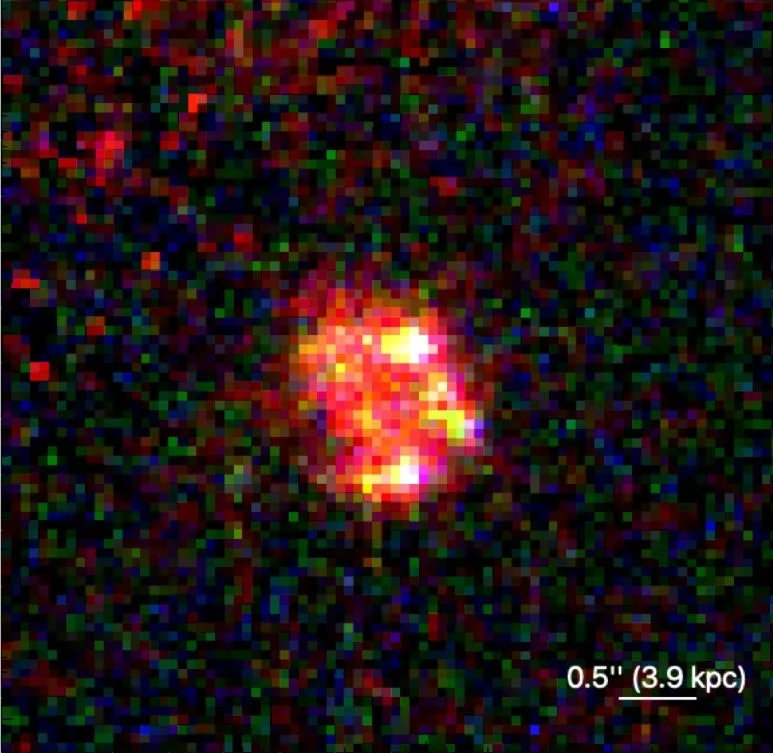
“We therefore did not target GS18660 specifically as a ring galaxy,” Michele Perna, a postdoctoral researcher at the Spanish Astrobiology Center and the study’s first author, told Live Science. JWST’s Near-Infrared Spectrograph provided a much sharper view, revealing the ring and allowing the team to study the galaxy in three dimensions.
The observations went beyond the galaxy’s outline. Researchers tracked the motion of its hot gas, measured the gas’s chemical properties and examined the history of star formation. That combination lets them compare the proposed collision with other clues in the system, including the companion galaxy’s position and the ages of stars in the ring.
A companion, a gas bridge and a recent burst of stars
In the collision scenario, a smaller galaxy plunges through the disk of a larger one. The passage sends a wave of dense gas outward, much like ripples spreading across water after a stone hits it. Gas collects along the wave and forms stars, creating a bright ring around the galaxy’s center.
The team found a small companion galaxy moving away from GS18660 at about 264 miles per second, or 425 kilometers per second. They also detected a bridge of gas connecting the two galaxies. The gas changes speed along the bridge, a pattern Perna said is consistent with an ongoing or recent interaction.
The companion’s location adds another piece of support. It lies roughly along GS18660’s minor axis, the direction in which a smaller galaxy might appear after passing through the disk in a near head-on collision. No single observation establishes that history, but the companion, the bridge and the ring’s shape fit together in a way that makes an impact plausible.
The researchers used the companion’s speed and distance to estimate when the proposed collision took place. Their rough calculation points to an impact about 17 million to 42 million years before the galaxy’s observed state. Conselice said that timescale seems reasonable. Dating an interaction directly is difficult, he explained, so researchers also look for signs that its timing matches a rapid episode of star formation and the ages of star clusters.
In GS18660, the team estimates that 10% to 20% of the galaxy’s stellar mass in the ring formed during the past few tens of millions of years. That recent activity could line up with the estimated collision window. Perna said the timing suggests that the impact and the burst of new stars may have shared a cause, while stressing that the star formation estimate alone doesn’t prove a collision.
“It is not, by itself, definitive proof of a collision, but together with the bridge and the ring morphology, it strengthens the case for a recent impact,” Perna said.
The ring may have another origin
The collision remains the team’s preferred explanation, rather than a confirmed account. Perna said the interpretation rests on several clues considered together, not on one decisive measurement. Conselice likewise sees the nearby companion and the observed light distribution as convincing evidence of a past interaction or merger.
There’s another possibility inside GS18660 itself. The galaxy has a bar-like feature running from north to south. Stellar bars can guide gas and stars into rings at particular distances from a galaxy’s center, so the ring might have formed through internal dynamics rather than an intruder’s passage.
The JWST team can’t yet determine whether that bar-like structure is a genuine stellar bar or a feature produced by the proposed interaction. Either interpretation would add to what astronomers know about how early galaxies developed organized shapes. JWST has already revealed barred galaxies in the early universe, including CEERS-2112, but researchers have yet to identify a clear example of a ring driven by a bar so early in cosmic history.
The distinction has wider implications for estimates of how often ring-forming collisions occurred. Earlier estimates put collisional rings in the early universe at roughly one in 10,000 galaxies, similar to their estimated frequency today. If further observations confirm GS18660 as a collision-made ring, that rate may need another look.
For now, GS18660 offers two connected research questions: did a companion galaxy punch through its disk, and how quickly were galaxies in the young universe developing rings and bars? As Perna put it, either a collision or internal dynamics would show that galaxies were already becoming structurally organized when the universe was only a few billion years old.
Discussion
Sign in to join the discussion.