2026 ED138 may be 600 to 1,500 kilometers wide. Follow-up observations will determine whether the distant object qualifies as a dwarf planet.
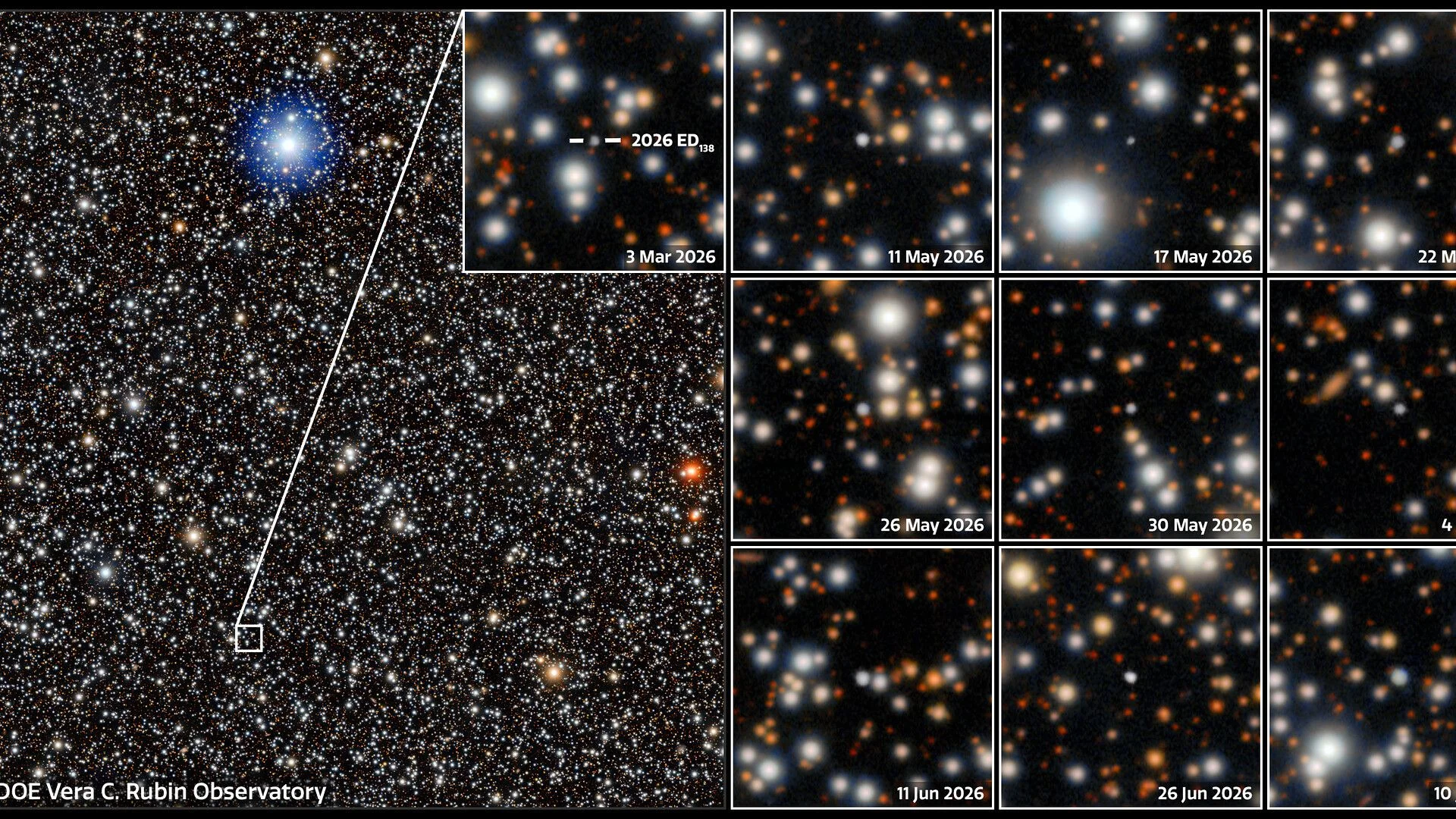
The Vera C. Rubin Observatory has spotted a Kuiper Belt object large enough to rank among the solar system’s biggest known bodies beyond Neptune. Named 2026 ED138, it could become the sixth dwarf planet officially recognized by the International Astronomical Union (IAU), though its size and shape still need to be measured more precisely.
The candidate stands out in part because it was hiding in a difficult patch of sky. Its orbit is tilted about 25 degrees from the plane of the solar system, and it passes in front of the Milky Way’s crowded inner region, where the light from millions of stars can obscure faint, slow-moving objects.
A moving target in a crowded sky
Rubin’s survey approach helped bring ED138 into view. The observatory images the southern sky every few nights with the largest digital camera ever built, generating millions of alerts when objects change position or brightness. That repeated coverage gives astronomers a way to pick out moving bodies against a dense background of stars.
Matthew Holman, an astrophysicist at the Smithsonian Astrophysical Observatory and a member of the Rubin team, wrote the software that identified the object. Working with colleague Kevin Napier, he developed algorithms that compare billions of observations to determine which detections belong to the same moving body.
“My first reaction was one of excited disbelief,” Holman said in a statement. Because objects this large are rare, he said, he first checked whether he or the software had made an error.
The team traced ED138’s path by combining Rubin observations with older images from the Dark Energy Camera on the Victor M. Blanco 4-meter Telescope at Cerro Tololo Inter-American Observatory in Chile. Those records let researchers map its orbit across roughly a decade. Rubin had only recently begun its planned 10-year sky survey when the object emerged from the data.
Its size could put it in dwarf planet territory
ED138 orbits at about 46 times Earth’s distance from the sun, within the Kuiper Belt, a broad zone beyond Neptune that extends roughly 30 to 50 times that distance. The region contains thousands of mostly icy bodies made of materials including frozen methane, ammonia, water and rock. These objects preserve clues about the solar system’s early history.
Researchers estimate ED138 is between 600 and 1,500 kilometers (370 to 930 miles) across, based on its brightness, reflectivity and distance. The upper end of that range is more than half Pluto’s diameter. Pluto measures 2,377 kilometers (1,477 miles) across; Ceres, the smallest dwarf planet recognized by the IAU, is 958 kilometers (595 miles) wide.
Brightness alone can’t settle the question. Astronomers need a better estimate of ED138’s diameter and density to determine whether its gravity has rounded it into a dwarf planet. That will take additional observations.
Recognition remains a question of definition and evidence
The IAU officially recognizes five dwarf planets: Pluto, Ceres, Eris, Haumea and Makemake. The category includes bodies large enough for their own gravity to make them roughly round, but too small to clear other objects from their orbital paths.
The known count depends partly on how researchers assess faint, distant objects. Kuiper Belt bodies move slowly across the sky, making them difficult to study, and their reflectivity can be hard to establish. Astronomers often focus on candidates estimated to be more than about 600 to 800 kilometers (370 to 500 miles) across, though estimates vary.
Holman said that confirmation would place ED138 among a small group of worlds. Rubin will continue imaging the southern sky repeatedly over its 10-year mission, giving researchers a chance to find large objects in regions earlier surveys may have missed. For ED138, the next step is clearer physical measurements—and a better answer to whether this distant point of light is a dwarf planet.
Discussion
Sign in to join the discussion.