A 5,300-year-old burial in southwestern Russia held a grape-sized urinary stone, offering evidence of a painful infection in a steppe herder’s life.
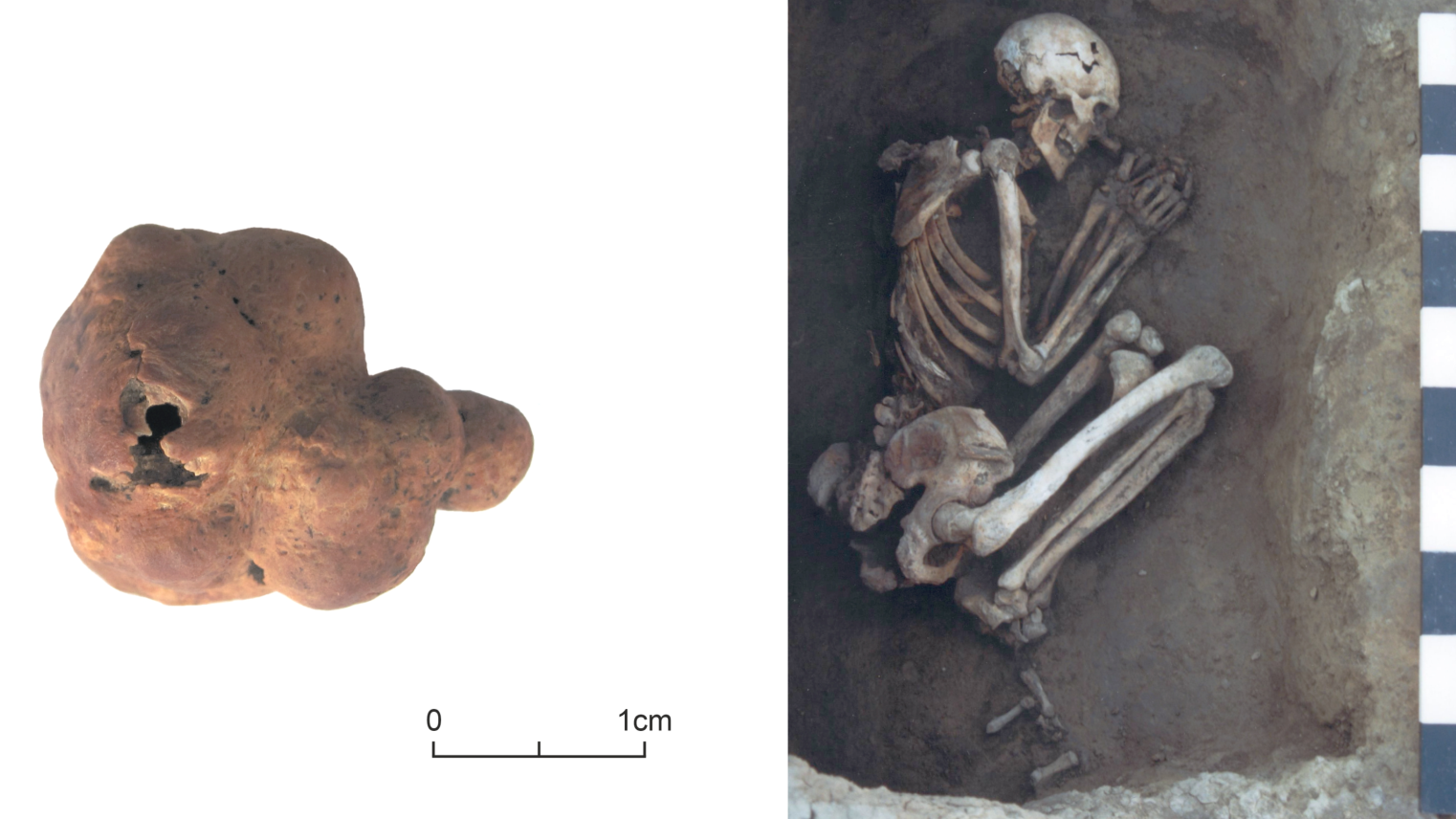
A grape-sized stone in a 5,300-year-old burial may preserve evidence of a long, painful illness. Researchers say the mineral composition points to a kidney stone associated with chronic urinary tract infection, though they can’t determine whether the condition caused the man’s death.
“He lived with a chronic urogenital infection,” study lead author Natalia Berezina, an anthropologist at Lomonosov Moscow State University in Russia, told Live Science by email. “It was not a brief episode,” she said. “His last years were probably marked by considerable and more or less constant pain.”
Clues in a small object
The team examined a brown, irregularly shaped object found among the hand bones of a man buried in the Stavropol Upland of southwestern Russia. It measured about 0.8 inches (2.1 centimeters) across, roughly the size of a grape. A crack in its surface exposed a crystalline interior.
Laboratory tests identified calcium and phosphorus as its main components. X-ray powder diffraction revealed several minerals, including whitlockite, a rare calcium salt associated with stones in the kidneys, bladder and prostate. These mineral masses, known as calculi, vary in composition and in the organs where they form; kidney and bladder stones can contain similar compounds.
Whitlockite’s association with bacterial infections led the researchers to conclude that the stone most likely formed amid a chronic infection. Their paper, published Sept. 30 in Archaeological and Anthropological Sciences, describes a kidney stone resulting from a persistent or recurrent infection as the likeliest explanation.
Urinary infections can contribute to stone formation by changing urine acidity and making minerals more likely to collect. The researchers can’t establish why the man developed urinary problems, or whether those problems ultimately killed him. The stone could also have moved from a kidney into the bladder, leaving its original location uncertain.
If it blocked one of the tubes connecting a kidney to the bladder, it might have led to kidney swelling, another infection or sepsis. Such complications could be fatal before antibiotics were available. The study presents these as possible consequences, not a confirmed cause of death.
A demanding life on the steppe
The man was in his 40s when he died around 5,300 years ago. His remains were found in a catacomb beneath a mound at a kurgan cemetery, part of an Early Bronze Age burial tradition across the steppe. A flint arrowhead lay near his pelvis.
His bones also record a physically demanding life. Researchers found signs of degenerative joint disease in his spine, shoulders, hips, hands and feet, along with healed fractures in his right shoulder, ribs and forearm. His build suggested he was well muscled.
“These were people who worked with cattle and heavy wagons on the open steppe,” Berezina said. “The injuries that follow from that are the injuries we find.” In a previous study at a nearby cemetery, her team found a man who had been run over by a wagon years before his death. Against that background, Berezina said, four healed fractures in this individual “look unremarkable.”
The stone stands out because it offers a rare glimpse of an illness that bones alone might not reveal. The team also considers a prostate infection or a sexually transmitted infection as possible contributors. Whatever its precise origin, the finding suggests that chronic pain and urinary disease were part of this man’s life alongside the physical strains recorded in his skeleton.
What do you know about the bones in your body? Test your knowledge with our human skeleton quiz.
Discussion
Sign in to join the discussion.