Astronomers have identified a nearby pair of supermassive black holes in the early universe, shedding light on their rapid growth and interactions.
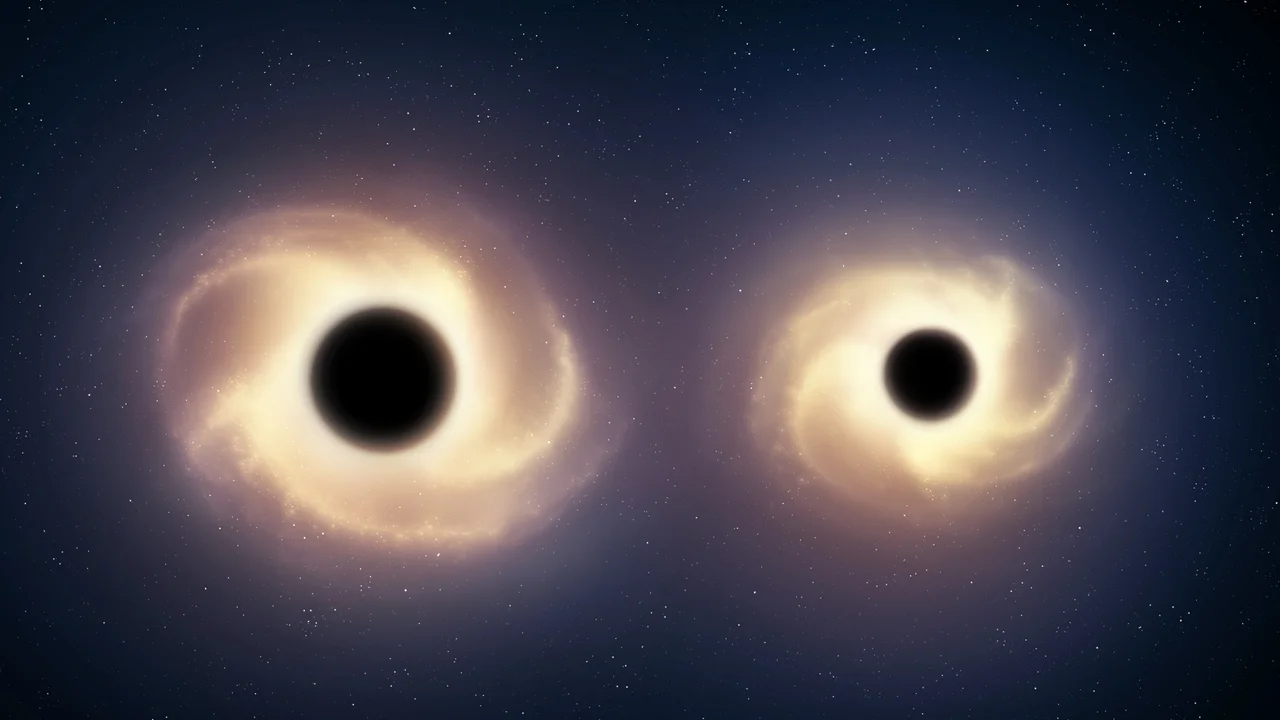
Astronomers have recently uncovered a pair of supermassive black holes, termed LID-1166, situated just 1.3 billion years after the Big Bang. This remarkable find, noted for its proximity of roughly 4,900 light-years, occurs within a merging galaxy, offering insights into the dynamics of black hole growth at a pivotal time in cosmic history.
The formation of large galaxies commonly involves mergers with other galaxies, typically accompanied by central black holes. Consequently, dual black hole systems may be prevalent in the early universe, although their dense gas and dust environments have historically obscured them from observation.
A study released on July 21 highlights this unique discovery, conducted by a team led by Hyewon Suh from the International Gemini Observatory in collaboration with the James Webb Space Telescope (JWST) and the Atacama Large Millimeter/submillimeter Array (ALMA) in Chile. Their findings are set for publication in Nature Astronomy.
According to Anna Trindade Falcão, an astrophysicist at NASA's Goddard Space Flight Center, the significance of this finding lies in the potential of observing the two black holes as they grow and interact within such an early cosmic period.
A Distant "Close" Pair
The LID-1166 system was initially detected as an X-ray source in the Chandra COSMOS Legacy Survey, yet it eluded detection in deep-field observations by the Hubble Space Telescope. The distinctive X-ray signal implied vigorous feeding activity from the black holes.
Using the JWST's Near-Infrared Spectrograph (NIRSpec), the research team identified two compact luminous sources separated by 4,900 light-years. This makes LID-1166 the closest confirmed dual black hole system found so early in the universe's timeline, a notable distinction as prior candidates were often significantly farther apart.
Roberto Decarli, a co-author from the Italian National Institute for Astrophysics, emphasized that this discovery was only possible due to the JWST's advanced imaging and spectroscopic capabilities, which far surpass those of ground-based observations at these wavelengths.
"Meaningful Evidence"
Both black holes exhibited spectral signatures suggesting gas swirling at high velocities, typical of actively feeding black holes, or active galactic nuclei, driving the merging galaxy system. Trindade Falcão mentioned the rigor applied in testing various methods to isolate the signals, reaffirming that the observations consistently indicated two separate entities, a claim warranting further validation.
With additional insights from ALMA's data, the team spotted substantial reservoirs of cold gas around each active galactic nucleus, reinforcing the notion that they reside within two galaxies poised for merger.
This surrounding galactic context also helped eliminate alternative explanations for their formation. For instance, should one black hole have been ejected from its galaxy during a merger or a chaotic interaction, it would display characteristics of a "naked" black hole, devoid of nearby gas. Instead, the data showcased both black holes retaining their surrounding environments.
Monstrous Growth
This discovery may illuminate one of astronomy's longstanding mysteries: the relatively swift growth of some supermassive black holes in the early universe. Current models propose that gas from galaxies flows towards their centers, feeding black holes effectively. Decarli notes that this raises intriguing questions, especially regarding the dynamics when galaxies harbor their own massive black holes.
Trindade Falcão points out that while the notion of galaxies merging and dragging their black holes together is well-established in theory, the close proximity of LID-1166’s black holes offers a first glimpse at a hidden population of such systems—something theorists have long posited but have been difficult to observe.
The findings not only provide evidence of these interactions but also pave the way for further explorations into the early development of supermassive black holes. This research may ultimately enhance our understanding of galaxy formation and evolution in those transformative early years of the universe.
To engage with the subject, consider testing your knowledge on black holes with our black hole quiz!
Discussion
Sign in to join the discussion.