Hubble and Webb’s infrared images expose the Cat’s Head Nebula’s turbulent gas, star-sculpted edges and an unexplained bright spot.
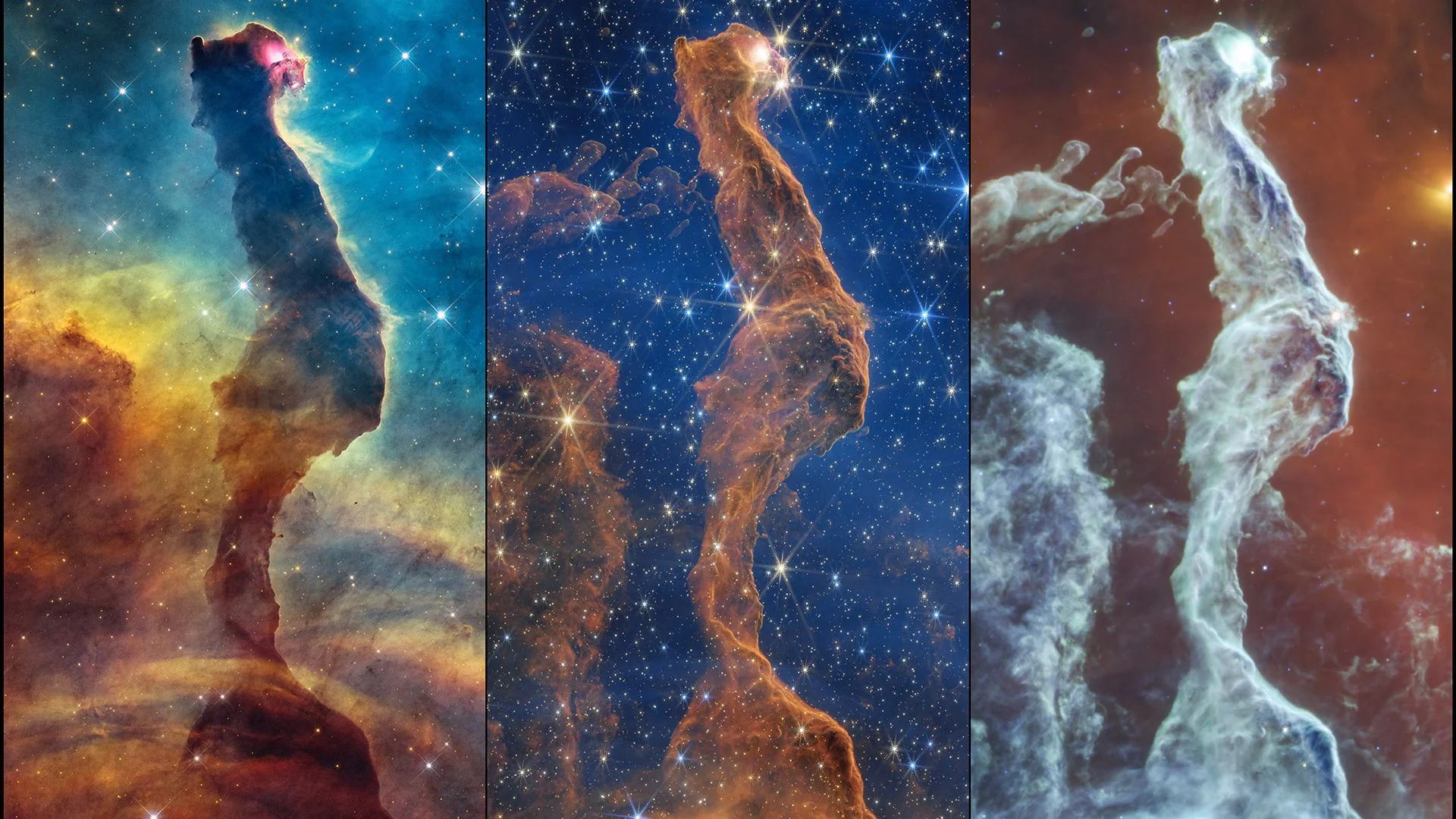
The Cat’s Head Nebula changes character with every wavelength. In visible light, Hubble shows a pillar of gas and dust holding its shape against the radiation of nearby stars. James Webb’s infrared cameras see through some of that dust, exposing turbulent material and an unexplained bright spot. Put together, the images show how much an astronomical object’s appearance depends on the light a telescope can detect. They also offer a closer look at young stars reshaping the clouds around them.
The nebula sits in the Carina Nebula, about 7,500 light-years from Earth. Its column resembles a seated cat turning its head, with a young star buried in the dust near its “eye.” That resemblance makes the object memorable, but the underlying structure is a changing cloud of gas and dust, not a fixed silhouette. Radiation from young stars illuminates and erodes surrounding material, gradually reshaping features like this one. The pillar’s edges show that process in action.
The European Space Agency shared the three telescope views around Halloween. Hubble records visible light, while Webb’s Near-Infrared Camera (NIRCam) and Mid-Infrared Instrument (MIRI) detect wavelengths beyond human vision. Each image emphasizes different parts of the same region, so their differences aren’t simply a matter of sharper or blurrier photography. They reveal how light interacts with material at different wavelengths, giving astronomers distinct views of the same environment.
Hubble traces the pillar’s exposed edges
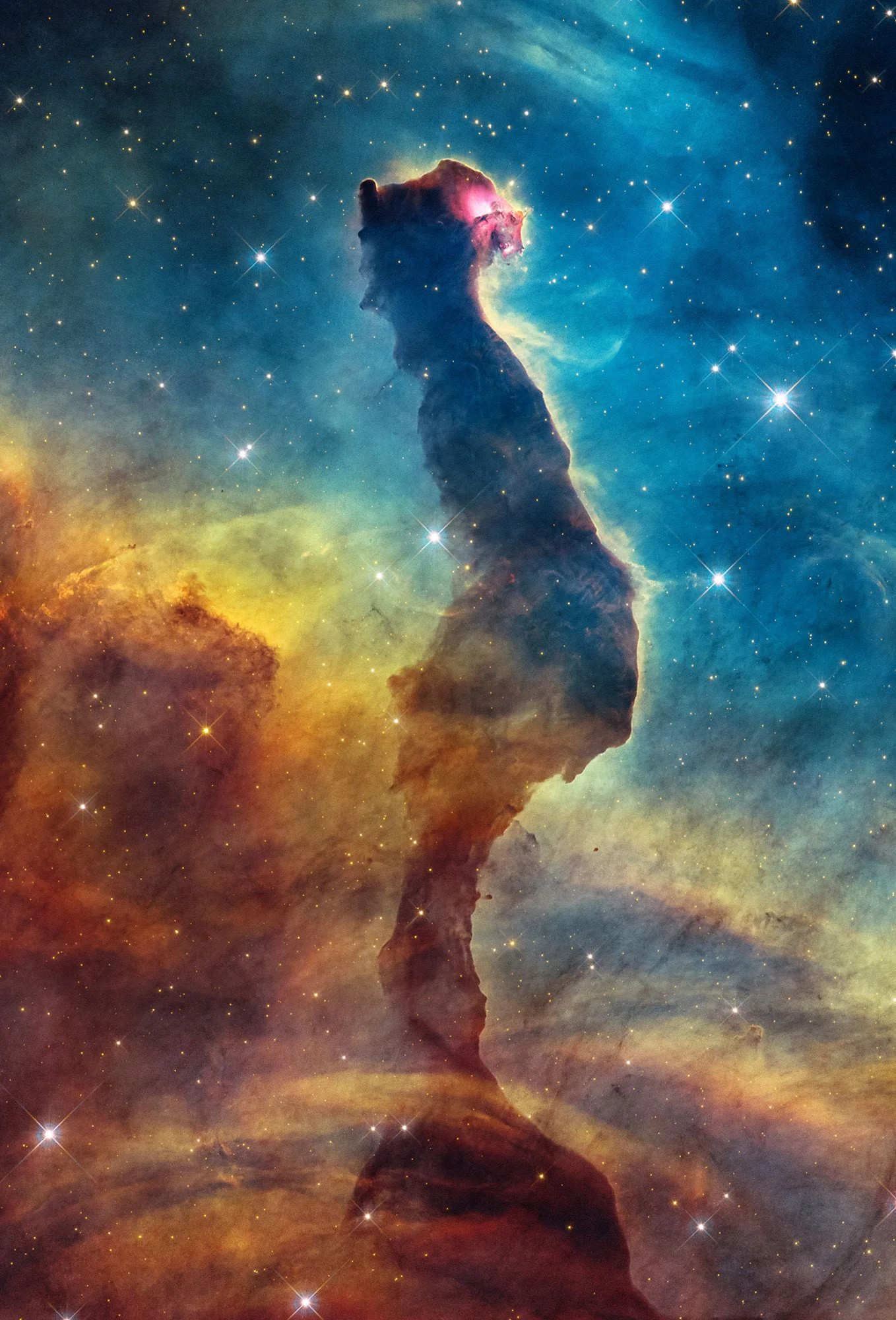
Hubble’s optical image picks out a dark central pillar that has held together under ultraviolet radiation from nearby stars. Against the brighter nebula, the pillar’s outline is clear, but its interior remains largely hidden by dust. Along its right edge, thin wisps mark gas being heated and dispersed by starlight. The structure is being worn down even as it remains visible against the brighter nebula—a temporary balance between material resisting erosion and radiation steadily changing it.
Blue, yellow, orange and red regions show starlight interacting with oxygen, hydrogen and sulfur, according to ESA. The colors reflect different gases responding to radiation; they aren’t what an observer would necessarily see with the unaided eye. The comparison to auroras is useful here: atmospheric molecules also produce distinct colors when energized. Here's the thing: color in these images carries information about the material, as well as making the structure easier to read.
Webb’s near-infrared view exposes the interior
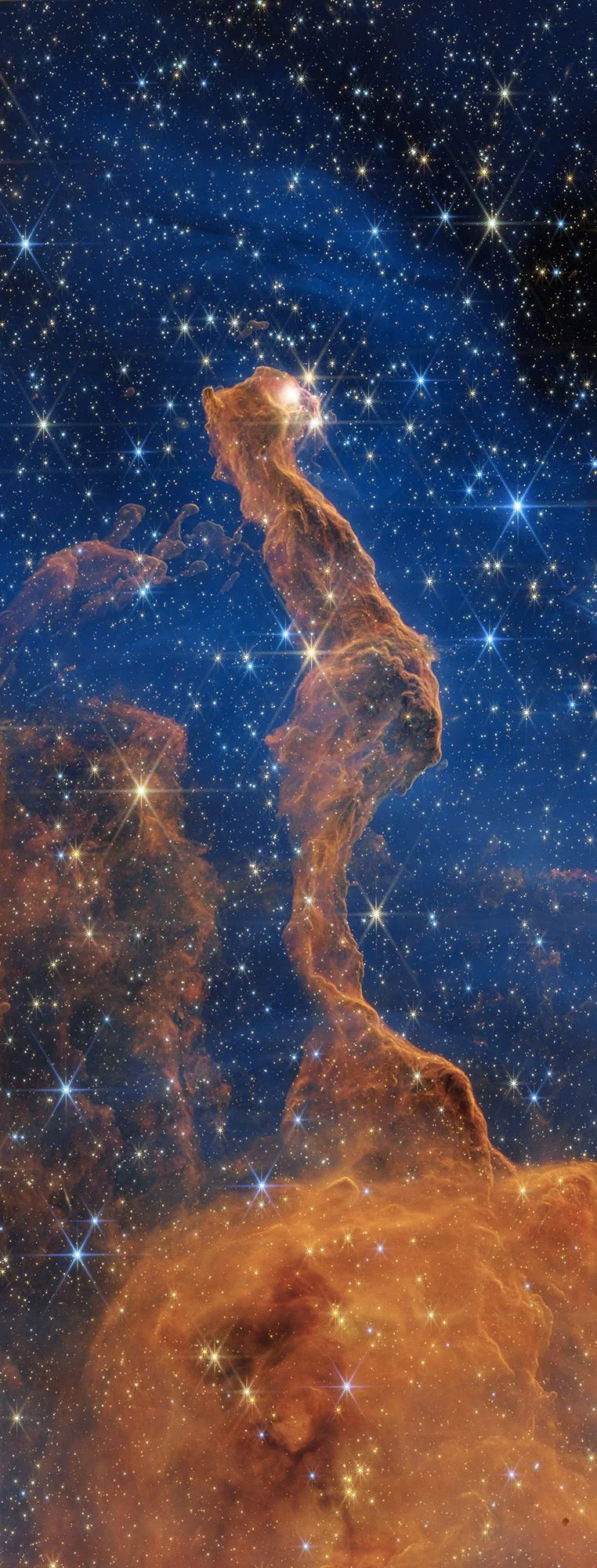
Webb’s NIRCam sees through some of the nebula’s thinner outer dust, bringing denser material at the column’s center into view. That added visibility changes the impression of the pillar: what appears comparatively solid in Hubble’s optical image becomes a more layered structure. The same infrared reach reveals background stars and galaxies whose light is obscured at visible wavelengths. Those distant points provide a reminder that the nebula sits in front of a much larger field of objects.
This image also shows radiation carving into the column’s interior, not just its outer boundary. To the left, a detached, hand-like feature appears to reach toward the cat-shaped cloud. It’s a striking visual detail, though the resemblance is a matter of perspective rather than an explanation of the feature. The infrared view exposes a more complex structure than Hubble’s optical image, with material and illumination arranged in ways that the visible-light view can’t show. More detail, though, doesn’t automatically answer every question about what’s happening inside.
Mid-infrared light reveals a mystery
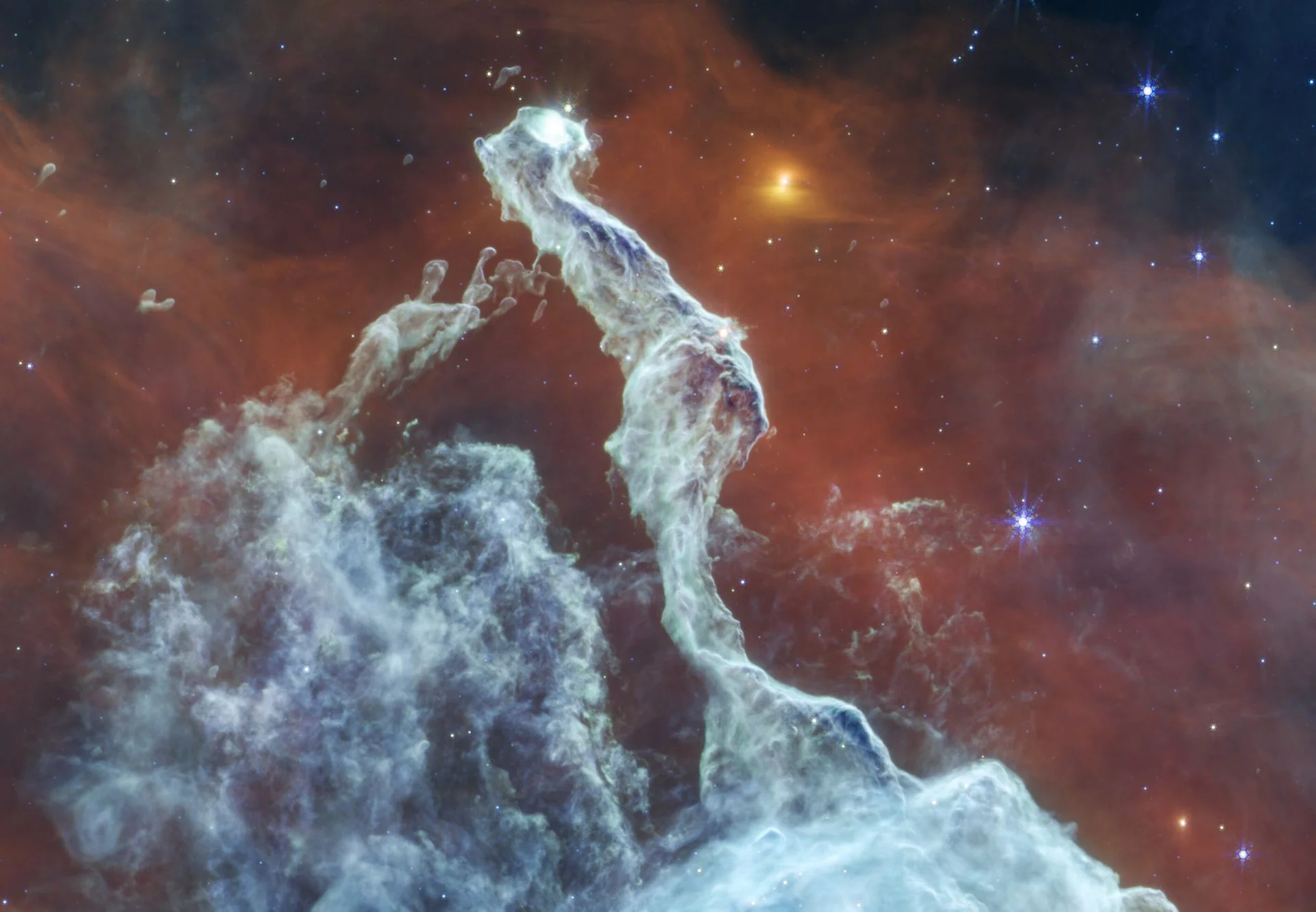
MIRI’s mid-infrared image strips away much of the visible starlight, leaving a faint, ghostlike core. ESA attributes the emissions to polycyclic aromatic hydrocarbons, carbon-and-hydrogen molecules associated with combustion. Their presence gives the image a different emphasis from the views taken in visible and near-infrared light: here, the material’s emissions stand out while much of the familiar stellar background recedes. The result is less a portrait of the cat’s outline than a view of what the nebula is giving off.
One feature stands out: an orange point of light to the right of the cat’s head. ESA says its nature is unclear, as is its connection to the nebula. That uncertainty matters. A bright spot can catch the eye without revealing whether it belongs to the cloud, lies behind it, or has some other relationship to the scene; the image alone doesn’t settle that question. The unexplained point gives Webb’s deepest view a useful reminder: even a familiar shape can still hold surprises. A mystery in plain sight.
What the three views tell us
The images make a case for combining observations across wavelengths. Hubble maps the exposed edges and glowing gases, NIRCam peers through some dust to show denser interior material, and MIRI highlights emissions that are less apparent in the other views. Each instrument contributes a different piece of the picture, while leaving some questions unresolved. This is more significant than it looks: the contrast between the images shows why a single striking telescope view can’t stand in for the full complexity of a star-forming region.
If you're working in this space, the practical lesson is that image interpretation depends on knowing what a telescope can and can’t detect. The cat shape helps orient the viewer, but the scientific value lies in tracing how radiation affects the surrounding gas and dust. And yet, the unexplained orange point keeps the story open. Further observations could help clarify its nature, but the information presented with these images doesn’t say what those observations will find.
Discussion
Sign in to join the discussion.