A new discovery reveals S301, the closest and fastest star orbiting Sagittarius A*, deepening our understanding of black hole physics.
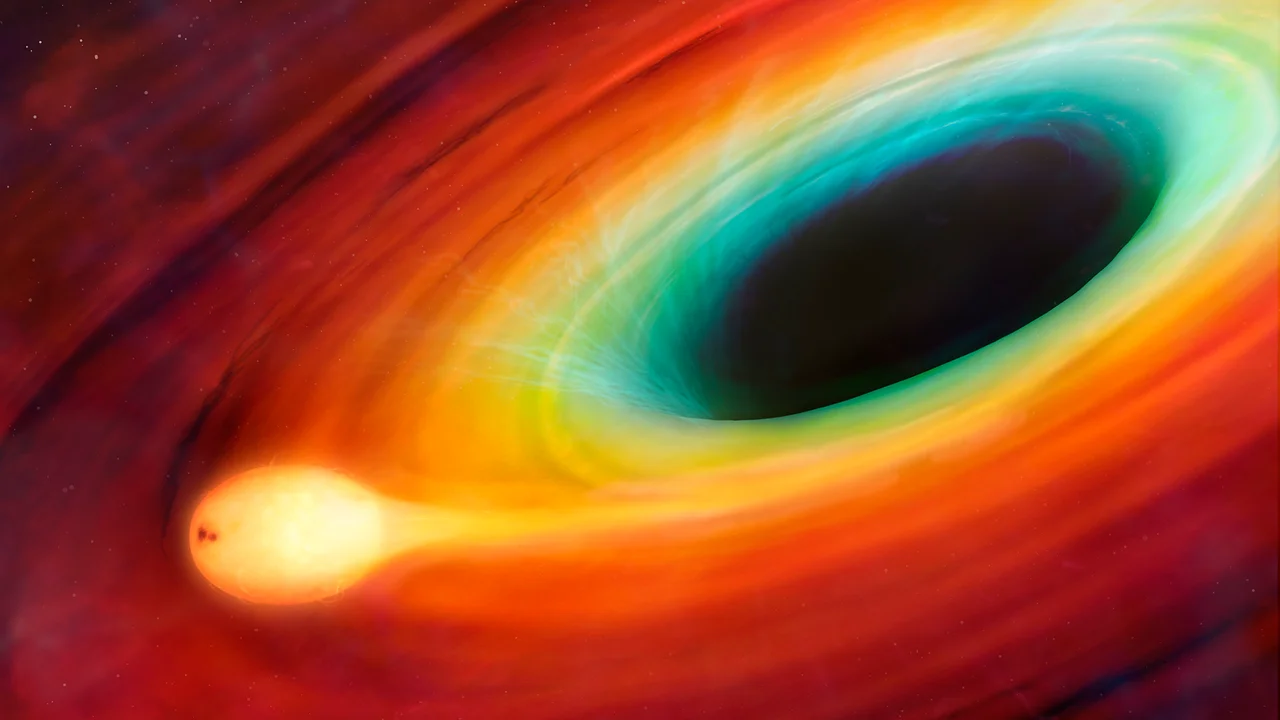
Astronomers have uncovered S301, the nearest and fastest star revolving around Sagittarius A* (Sgr A*), the 4.3 million-solar-mass black hole at the center of our galaxy. This faint star completes its orbit every 8.7 years at an astonishing speed of about 55 million mph (90 million km/h), roughly 8% the speed of light. The results were published in the journal Nature on August 19, showcasing a significant advancement in observational astronomy.
Understanding the Galactic Center
The core of the Milky Way serves as an exceptional natural laboratory, located approximately 27,000 light-years from Earth. Within this region, about a few dozen stars complete tight orbits around the black hole. These celestial bodies behave in ways that challenge traditional Newtonian models, providing key insights into gravitational dynamics.
"Stars orbiting Sgr A* are fascinating as they serve as luminous probes of the curved spacetime around the black hole," explained study co-author Felix Mang, a doctoral student at the Max Planck Institute for Extraterrestrial Physics. Until now, the star S2, which orbits every 16 years, has been the most studied.
Observations of S2 have validated fundamental predictions of Einstein's theory of general relativity by demonstrating how light loses energy when escaping the black hole’s immense gravitational pull and revealing the slow rotation of its elliptical orbit—referred to as Schwarzschild precession. However, there's a second black hole property that scientists have been unable to analyze thoroughly: rotation.
S301: A New Player in the Game
Enter S301. Captured by the GRAVITY instrument on the European Southern Observatory's Very Large Telescope in Chile, this star orbits Sgr A* so closely that measurements of its orbit could detect the spin of the black hole. It was first observed in early 2023 but later confirmed through archival images dating back to 2017, resulting in 19 measurements spanning eight years that outline a complete elliptical orbit.
S301’s orbit is exceptionally extreme; it takes only 8.7 years to complete its revolution, breaking the previous record of 12 years, and its elongated trajectory brings it within approximately 12 astronomical units of the black hole—close enough to generate significant relativistic effects but still safe from being torn apart. The star itself is a main-sequence star with about 1.5 solar masses, likely a remnant of a once double star system that was disrupted by the black hole's gravitational forces.
"Strong general relativistic effects are fully evident in S301’s orbit. The Schwarzschild precession effect leads to an observable shift of about 2 degrees each orbit," Mang noted. Within the next decade, researchers anticipate measuring the spin of Sgr A* using S301 as a reference point.
Challenges of Observing S301
The discovery of S301 itself posed significant challenges. From Earth, this star is roughly 2 billion times fainter than Betelgeuse, a well-known star, and sits among a myriad of brighter stars, complicating observations. The team applied a sophisticated image reconstruction technique along with upgrades to the GRAVITY instrument to enhance sensitivity, allowing them to locate S301 amid the stellar clutter.
However, an important aspect remains unresolved: while the team can track S301’s movement across the sky, determining its velocity toward or away from Earth is still pending. This leaves dual possibilities for its orbit. Mang indicated their intent to continue monitoring S301’s movements using both GRAVITY and upcoming instruments that will measure shifts in the star's light spectrum.
Simulations suggest that sustained observation may allow astronomers to distinguish between rapidly rotating and stationary black holes with a high degree of confidence. While S301 is a remarkable find, it’s likely not alone; researchers speculate that approximately 100 similar stars could exist, though many remain undetectable due to their faintness. Monitoring these potential candidates could yield further groundbreaking insights into black hole physics.
Test your knowledge of black holes with our black hole quiz!
Discussion
Sign in to join the discussion.