New sound-activated robots harness Helmholtz resonance to fly and move, with transformative potential for tiny device applications.
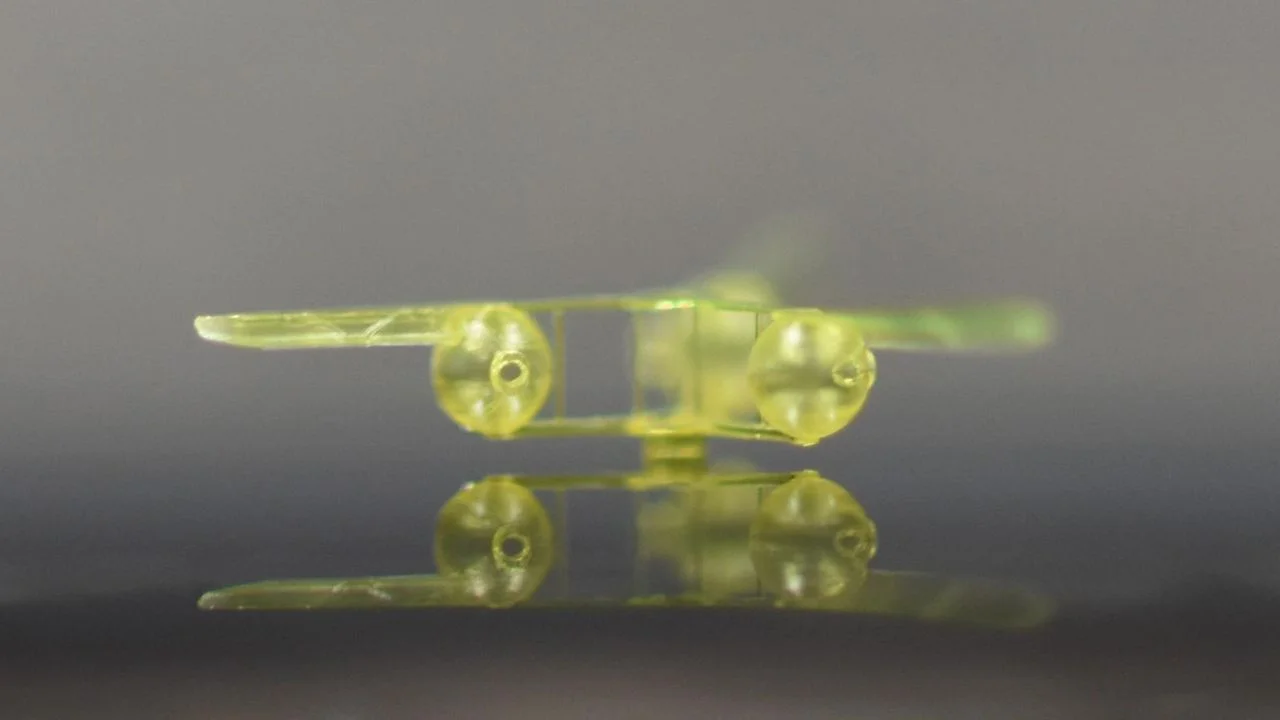
Engineers are tapping into the principles of sound to create miniature robots powered entirely by acoustics, sidestepping the need for traditional motors. Using Helmholtz resonance, these devices can be triggered by specific frequencies to produce thrust, which allows for movement in the air or on water. This method marks a departure from conventional propulsion systems, turning to the omnipresent medium of sound waves.
A recent study published on August 12 in Science Advances reveals this intriguing approach. When sound waves strike hollow chambers within these robots, the resonance generates air jets that provide sufficient thrust for these lightweight machines to navigate their environments. This represents not just an engineering challenge, but potentially a shift in how we think about mobility in small devices.
The Science Behind Sound-Powered Motion
The core principle in play here, known as Helmholtz resonance, traces back to Hermann von Helmholtz's experiments in the mid-19th century when he sought to tune musical instruments. Helmholtz uncovered that resonating air cavities could release jets of air; this action, however, has its limits. Low pressure can restrict their effectiveness, but increasing the pressure can harness these jets into powerful forces for various mechanical applications. This principle has been relegated to niche uses, until now.
By miniaturizing Helmholtz's resonators, the research team made a leap forward. They shifted the activation frequency into the ultrasonic range, enabling more precise control without the discomfort associated with audible sounds. Larger resonators that would operate at lower frequencies risk not just annoyance but potential harm. The challenge, then, is to strike a balance: create devices that are efficient, effective, and safe.
Miniaturization and Practical Implementation
The researchers employed a novel 3D printing technique known as two-photon printing to create these tiny resonators, carefully crafting them according to Helmholtz's equations. Their successful lab tests and simulations validated the thrust production, indicating a promising path ahead. What does all this mean? It shows that theoretical concepts can be transformed into practical applications, bridging the gap between science and engineering.
One tangible application involved constructing miniature boats about 2 inches long, outfitted with multiple resonators. By adjusting the sound frequency through a nearby speaker, the boats could be navigated in various directions, showcasing direct control of movement through sound. (And this is the part most people overlook: the simplicity and precision of controlling such small devices opens up vast potential.) At even smaller scales, less than 0.04 inches in size, microfliers emerged that achieved flight using two distinct propulsion methods: they could generate lift through downward thrust, akin to a rocket, or utilize rotating blades like a helicopter, both of which are activated by sound waves. This demonstrates a flexibility in design that’s uncommon in conventional motor-based systems.
This sound-powered technology is not just about enabling movement in small robots; its implications reach far beyond. The research team believes that similar principles could soon enable the manipulation of small objects in mid-air without direct contact, allowing for applications that could revolutionize sectors like manufacturing. Additionally, adaptive surfaces that respond to specific frequencies could lead to advancements in biomedical applications, such as heart stents that react to ultrasonic signals. Imagine how these principles could disrupt industries that rely on precision.
Implications and the Future
The findings herald significant advancements in the field of miniature robotics. By straying from conventional motors, these robots could operate in environments where traditional machinery might fail, like in delicate ecosystems or even within human bodies. This opens doors—not just from a technical perspective, but also in ethical considerations. The ability to create movement without direct energy inputs implies a potential for quieter, environmentally friendly devices.
Currently, as research sets the foundation for potential future developments, the words of co-author Selman Sakar come to mind: “This paper is significant in the sense that we’ve outlined the core design principles.” He highlights that the groundwork laid here provides the stepping stones for enhancing control and navigation systems. The expectation is that ongoing studies will home in on practical applications, pushing the boundaries of what's achievable with these sound-powered devices. If you're working in this space, or just intrigued by technology, the future looks compellingly noisy—albeit in an intelligent way.
Discussion
Sign in to join the discussion.