Hubble's recent observations highlight a dynamic 10-sided wave around Saturn's south pole, raising questions about its rapid formation.
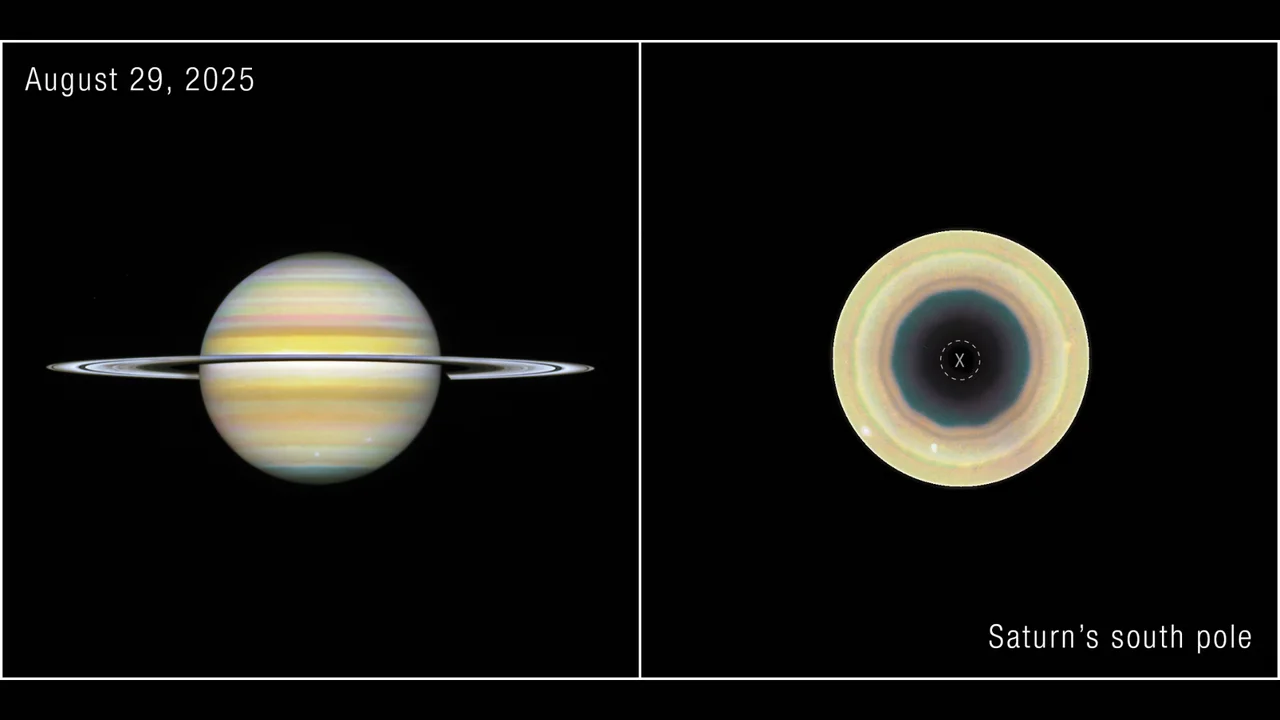
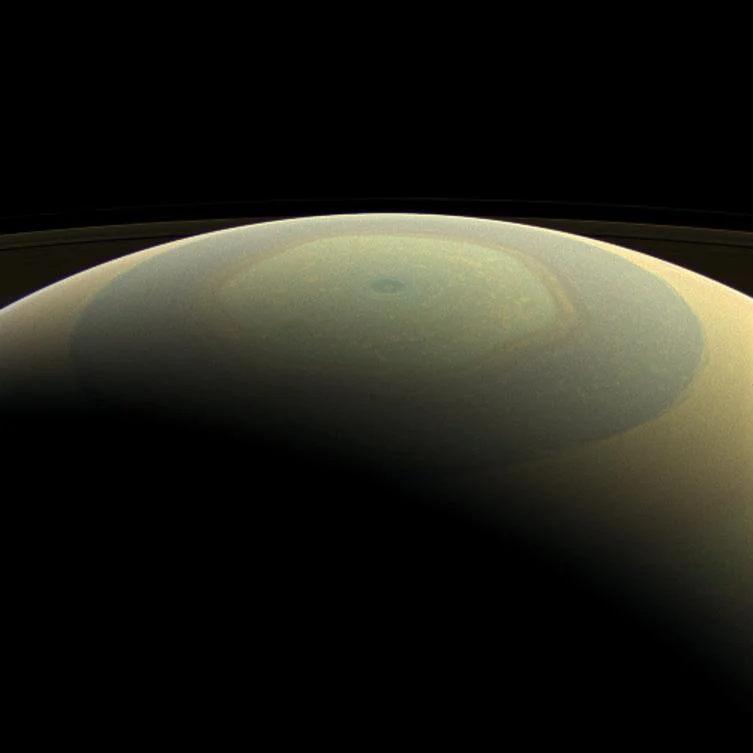
Recent observations from the Hubble Space Telescope have unveiled a striking 10-sided jet encircling Saturn's south pole, revealing a pattern that seems to be evolving rapidly. This atmospheric wave, known as the "decagon," has attracted significant attention from scientists after its formation became evident in early 2023, a stark contrast to the planet's long-standing hexagonal arrangement at the north pole, which has been observed for over four decades.
The Mystery of the Decagon's Emergence
As the scientific community grapples with the emergence of the decagonal structure, one question remains particularly pressing: why now? "The intriguing question that arises is why this structure has emerged at this time," said Amy Simon, a senior scientist at NASA's Goddard Space Flight Center and co-author of a recent study detailing these observations. Simon pointed out that the northern hexagon has consistently been visible every year for 40 years, making the emergence of the decagon particularly notable. "This feature is different — it appears to be strengthening, allowing us a rare opportunity to observe the development of a massive atmospheric pattern."
The decagon's formation poses a challenge to our understanding of planetary atmospheres. While scientists are accustomed to observing stability in such weather patterns, the sudden shift in Saturn's southern atmosphere could indicate unsolved dynamics within the planet. This brings to light both the delicate balance of gas giant atmospheres and the possible factors—such as solar activity or internal heat—that may contribute to these transformations.
Unparalleled Observations and Future Prospects
The persistence of the decagonal wave across multiple atmospheric layers, extending even beyond the cloud tops, has sparked interest in its potential connection to Saturn’s jet streams. Future observations through both Hubble and the James Webb Space Telescope (JWST) will be pivotal in unraveling how this wave was generated and what it signifies for the atmospheres of gas giants. If you're working in this space, the implications for atmospheric science could be profound, providing insights that are currently lacking.
These observations are part of Hubble's Outer Planet Atmospheres Legacy program, which is designed to image the solar system's major outer planets annually. With Saturn currently positioned favorably for observation, researchers are eager to continue tracking the decagon's evolution. This program allows for systematic monitoring, leading to long-term studies that could highlight atmospheric trends previously obscured by lack of continuous observation.
A Brief Look Back at Discovery
Interestingly, the decagon's formation was first indicated by ground-based observations in 2024. A group of researchers, including Agustín Sánchez-Lavega of the University of the Basque Country, began detecting an undulating band around Saturn's south pole. They utilized the university's Planetary Virtual Observatory Laboratory to capture evidence from a network of international efforts. This early rollout of detection methods can serve as a model for future collaborations in the field.
While early images in 2025 suggested the wave transitioning into a decagonal shape, Hubble's observations provide unmatched clarity. Freed from atmospheric distortions, Hubble's vantage allows for a level of precision that ground observations simply can't match. This feature eluded the earlier Cassini mission, which operated from 2004 to 2017, indicating that it had not yet begun to take form during that period. Sánchez-Lavega noted the limitations of previous missions, emphasizing how quickly evolving phenomena can go unnoticed with less advanced equipment and techniques. (And this is the part most people overlook: a missed opportunity means we lose pieces of the puzzle.)
The Broader Implications of Saturn’s Weather Patterns
Both Hubble and JWST stand poised to further explore Saturn's new atmospheric patterns in the coming years. As cosmic studies evolve, Saturn's peculiarities are not alone. Other solar system giants, such as Jupiter, display fascinating polar phenomena, including the colossal cyclones surrounding its south pole that echo the planet’s distinguished Great Red Spot. This suggests a broader inquiry into the underlying mechanisms governing these atmospheric features across gas giants.
What does this mean for the future? Understanding the dynamics of Saturn’s decagon could set a precedent for future missions aimed at probing similar features elsewhere in the solar system. Evaluating the atmospheric processes and shifts both on Saturn and its gas giant counterparts could inform theories regarding planetary formation, evolution, and behavior—essentially redefining how we perceive outer planets. The universe might just be calling for us to scratch the surface and ask the right questions.
Discussion
Sign in to join the discussion.