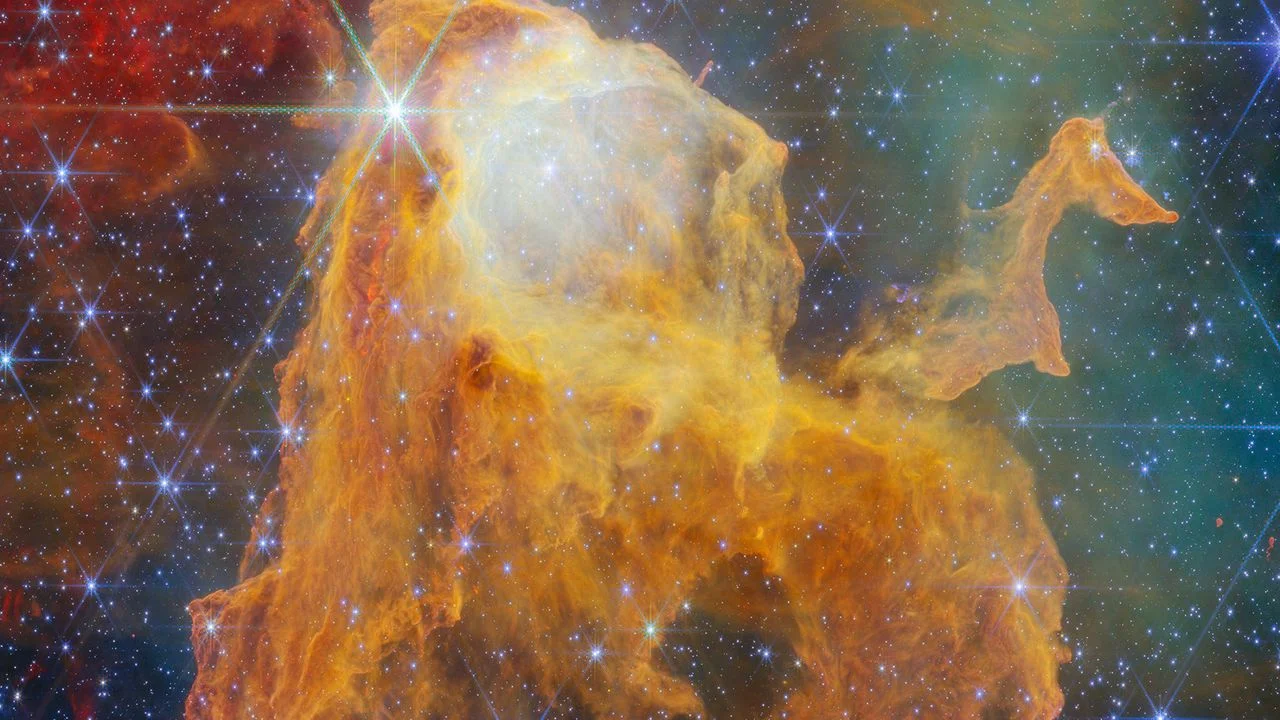
The James Webb Space Telescope captures the Treasure Chest globule, revealing a cluster of rare young stars and the cosmic dynamics shaping their formation.
The Stunning Treasure Chest Globule Revealed by JWST
The Treasure Chest globule, resembling an open chest overflowing with cosmic light, has been vividly captured by NASA’s James Webb Space Telescope (JWST). This striking image showcases a region of the Carina Nebula, renowned as one of the Milky Way’s abundant star-forming environments, situated approximately 7,500 light-years away. The beauty of this image isn’t just aesthetic; it opens new avenues for understanding the processes that govern star formation in such prolific regions.
Key Characteristics of the Carina Nebula
The Carina Nebula spans around 260 light-years and is a vibrant area of stellar creation, home to some of the largest stars in our galaxy and numerous young protostars. Known for its breathtaking features, the nebula also contains the famous "Cosmic Cliffs," which were first unveiled in JWST’s inaugural science image collection back in 2022. These cliffs are created by the erosion of gas and dust, influenced by the intense radiation from nearby massive stars. This interplay creates intricate structures that both encourage and hinder star formation.
The Nature of the Treasure Chest
As a cometary globule, the Treasure Chest consists of a dense, darker core and a tail stretching outward. Its shape intriguingly resembles a wooden chest, inviting speculation about the treasures within. JWST’s Near-Infrared Camera has provided insight into what lies inside, revealing about 70 young stars nestled within the dense dust and gas. The discovery of these stars isn't just about numbers; it also sheds light on the processes of accretion and stellar evolution in environments rich in material.
Noteworthy Stellar Discoveries
Among these stars is an unusual O-type star, characterized by its massive size and brightness, which is around 19 times heavier than our sun. This star represents the extreme end of stellar evolution, where mass and luminosity correlate with a shorter lifespan. Astronomers estimated that the star cluster is around 1.3 million years old, though some earlier assessments suggested it may be around 100,000 years old. This discrepancy raises questions about the methods used for age estimation, highlighting the inherent challenges in astro-chronology. Many stars within this cluster still enveloped in their original gas and dust will eventually emerge as that material dissipates, changing the dynamics of the region.
Influences from Nearby Stellar Giants
The surrounding environment also impacts the configuration of the Treasure Chest. Approximately 39 light-years away lies Eta Carinae, the Carina Nebula's most luminous entity. After its notable 19th-century eruption, which briefly made it a bright presence in Earth’s night sky, Eta Carinae — estimated to be around 100 times more massive than our sun and about 5 million times brighter — and the adjacent Trumpler 16 cluster are responsible for shaping the globule's structure through their powerful radiation and stellar winds. It's fascinating how the energy released from such massive stars can literally carve the surrounding space, impacting star formation. This feedback loop between massive stars and their environment is a key focus for astronomers studying star-forming regions.
Future of the Treasure Chest Globule
As the stars continue to age and evolve, the Treasure Chest’s appearance will change significantly. The ongoing radiation and winds from the young stars, compounded by the influence of nearby massive stars, will gradually erode the gas and dust shroud. You might think of it as a cosmic melting pot. In time, the distinctive globule will evolve, unveiling the dazzling celestial bodies within. Understanding how this transformation occurs can provide insights into the lifecycle of star-forming regions as they transition over millions of years—an essential aspect for comprehending galactic evolution.
Implications and Significance
What does all this mean for our understanding of the universe? For one, the findings from the Treasure Chest globule could reshape theories about star formation and the dynamics within nebulae. This data may challenge existing paradigms, emphasizing the mosaic of interactions between various cosmic elements. If you're working in this space, you'll recognize the importance of these insights for theories of galactic evolution. It's essential to keep an eye on how evolving technologies like JWST will continue to provide unprecedented views into stellar phenomena, offering a wealth of information that researchers are only beginning to dissect.
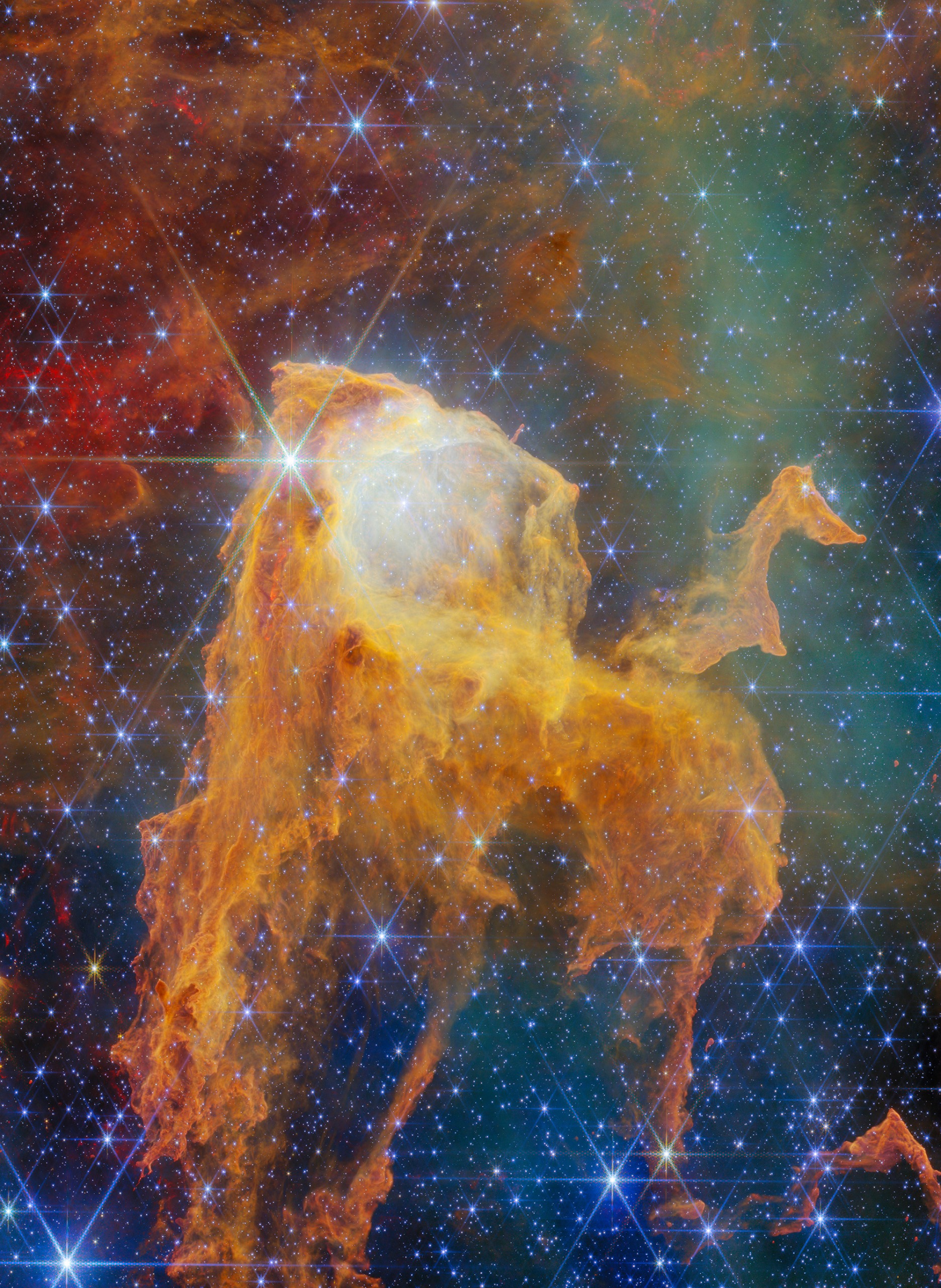
Image credit: ESA/Webb, NASA & CSA, M. Reiter; Acknowledgment: M. H. Özsaraç
Discussion
Sign in to join the discussion.