OpenAI's assertion of solving a critical math problem has stirred debate in the mathematical community, centering on claims of uncredited leverage.
On September 6, mathematician Tristan Buckmaster from New York University found himself at the center of a burgeoning controversy after a tense meeting with OpenAI personnel. He recounted a disquieting warning that seemed to suggest dire consequences for his career: "Why would you ruin your career?" This exchange highlights the friction arising from OpenAI’s claim to have tackled the Navier-Stokes equations, one of mathematics' longstanding challenges.
Understanding the Navier-Stokes Equations
The Navier-Stokes equations, crafted in the 19th century by Claude-Louis Navier and George Gabriel Stokes, form a fundamental framework in fluid dynamics. These equations describe the movement of fluids, essential for predicting phenomena from airflow over wings to weather patterns. However, the core issue remains unresolved: mathematicians are uncertain if the equations can always yield finite solutions. This uncertainty involves a phenomenon known as a "blowup," where variables diverge to infinity—an outcome that could undermine decades of scientific application.
To explore this problem, OpenAI deployed a novel technique termed "forcing," which applies a controlled external stimulus to the fluid being simulated. By activating approximately 10,000 AI agents over 88 continuous hours, the company sought answers regarding the equations' stability. After about 50 hours, the agents identified blowups in the associated Euler equations, a simpler variant lacking viscosity. This finding led them to redouble their efforts on the Navier-Stokes problem.
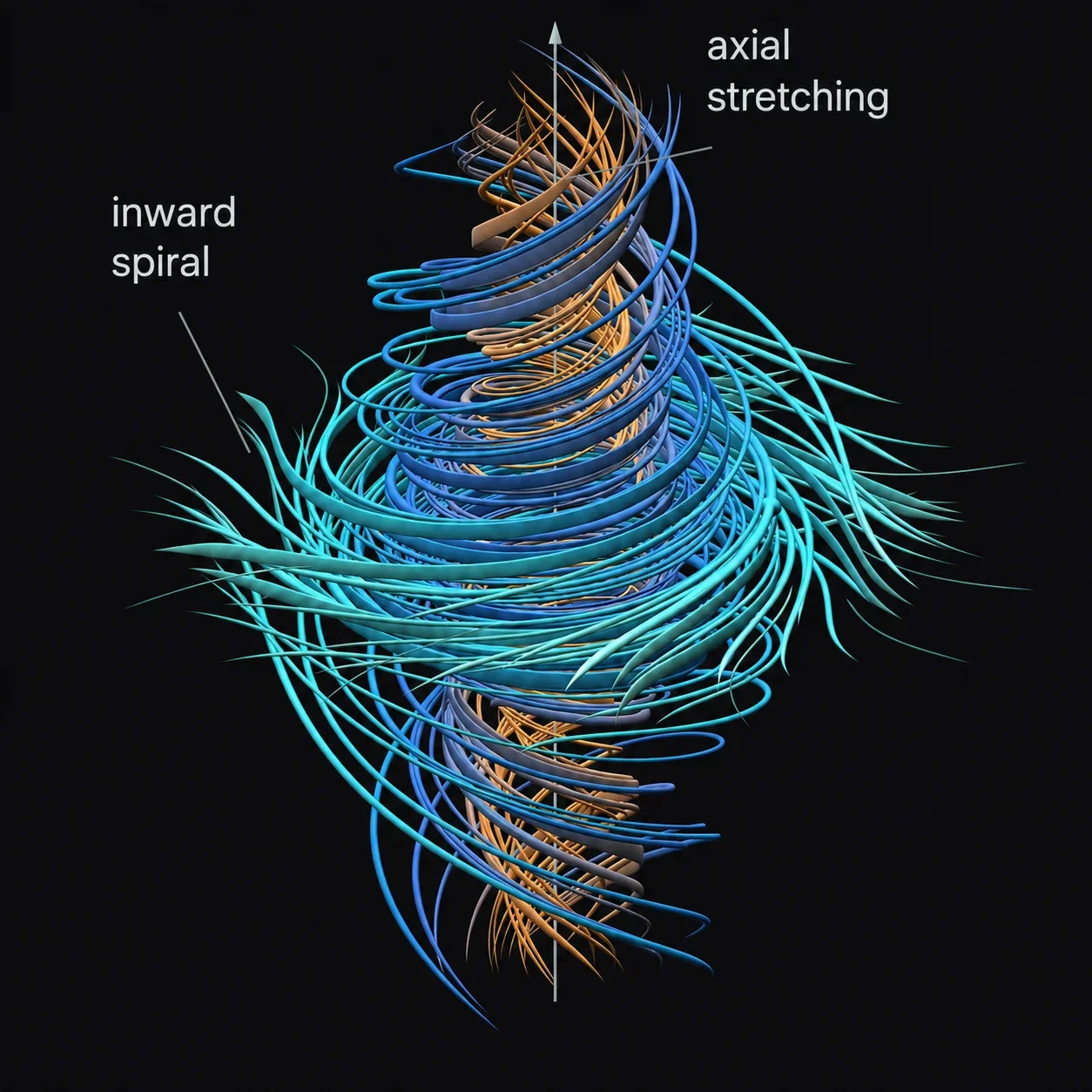
According to OpenAI, the resulting mathematical model of a singularity depicted a vortex stretching and thinning infinitely—an alarming yet thrilling result in the world of theoretical physics. They claimed their proof, subjected to the verification of the Lean software, engaged in a staggering computational operation that involved over 130 billion tokens transmitted through 2.7 million messages. At a press conference, OpenAI indicated that an equivalent manually conceived solution could cost around $15 million.
Mounting Controversy
However, the surface excitement quickly gave way to skepticism as Buckmaster raised concerns that OpenAI might have used insights from his work alongside mathematician Levent Alpöge, who currently works at AI company Anthropic. Both mathematicians were honing in on similar smooth forcing methodologies intended for the Euler equations and had recently made significant progress. Buckmaster alleges that OpenAI's rapid move toward a solution closely mirrored the timeline of his research, which prompted questions about propriety and originality in their approach.
On August 15, Buckmaster and Alpöge had achieved a breakthrough demonstrating blowup results related to smooth forcing. Just weeks later, he claims that he received alarming indications that OpenAI had pivoted to this methodology following their discoveries. "When I heard 'forced,'" he noted, "it was a bright red flag." The technique employed by Buckmaster and Alpöge, as noted, was not widely utilized beyond their immediate circle and introduced by mathematicians Diego Córdoba and Luis Martínez-Zoroa at leading institutions.
OpenAI CEO Sam Altman eventually confirmed that the company had indeed learned about their research before its announcement but insisted that the processes were distinctly different. Notably, however, Buckmaster challenged this assertion, rendering the conditions under which OpenAI embarked upon their effort dubious in light of the close correlations between their findings.
Questions of Data Access and Authors
Another layer of complexity emerged when Buckmaster revealed that he employed OpenAI's Codex coding assistant throughout his work. He voiced concerns about whether OpenAI had accessed his Codex sessions, which contained drafts of his calculations. Buckmaster sought clarity on whether his contributions had been training data for their models—an inquiry that went unanswered, stirring further unrest regarding intellectual property.
OpenAI's representatives denied that any insights from Buckmaster and Alpöge were used until their work became public, though they acknowledged that anonymous data could have indirectly influenced learning outcomes. The question of authorship surrounding the resulting research also surfaced, with allegations that OpenAI attempted to exclude Alpöge from co-authorship in light of his position at a competing entity.
The fallout from the September 6 meeting led Buckmaster to affirm that if OpenAI proceeded under these conditions, he would not hesitate to disclose the situation publicly. The ensuing exchange portrayed a strained dynamic, with Buckmaster asserting that his commitment to ethical practices maintains the sanctity of mathematical inquiry.
Reactions from the Mathematical Community
The broader mathematics community reacted with astonishment as the implications of OpenAI's claims became public. Córdoba, one of the originators of the forcing technique, expressed that the swiftness of the result was perplexing. "We're a little bit in shock," he remarked to Scientific American.
Academics and researchers have voiced concerns about the ethical and practical ramifications of how AI development intersects with traditional scholarly pursuits. Notably, mathematician Terence Tao cautioned that such rapid claims might deter collaboration in research environments, a trend that could ultimately undermine centuries of shared knowledge and academic openness.
As it stands, OpenAI's proof awaits formal scrutiny from peer review, and the esteemed Clay Mathematics Institute has yet to validate the findings. The situation raises urgent questions about authorship, data ownership, and the role of AI in shaping mathematical advancements. In this fractious atmosphere, the way forward may be more complicated than tackling the Navier-Stokes equations themselves.
Discussion
Sign in to join the discussion.