Astronomers have detected water vapor in the surroundings of star IRS 3, close to Sagittarius A*, challenging previous beliefs about such extreme environments.
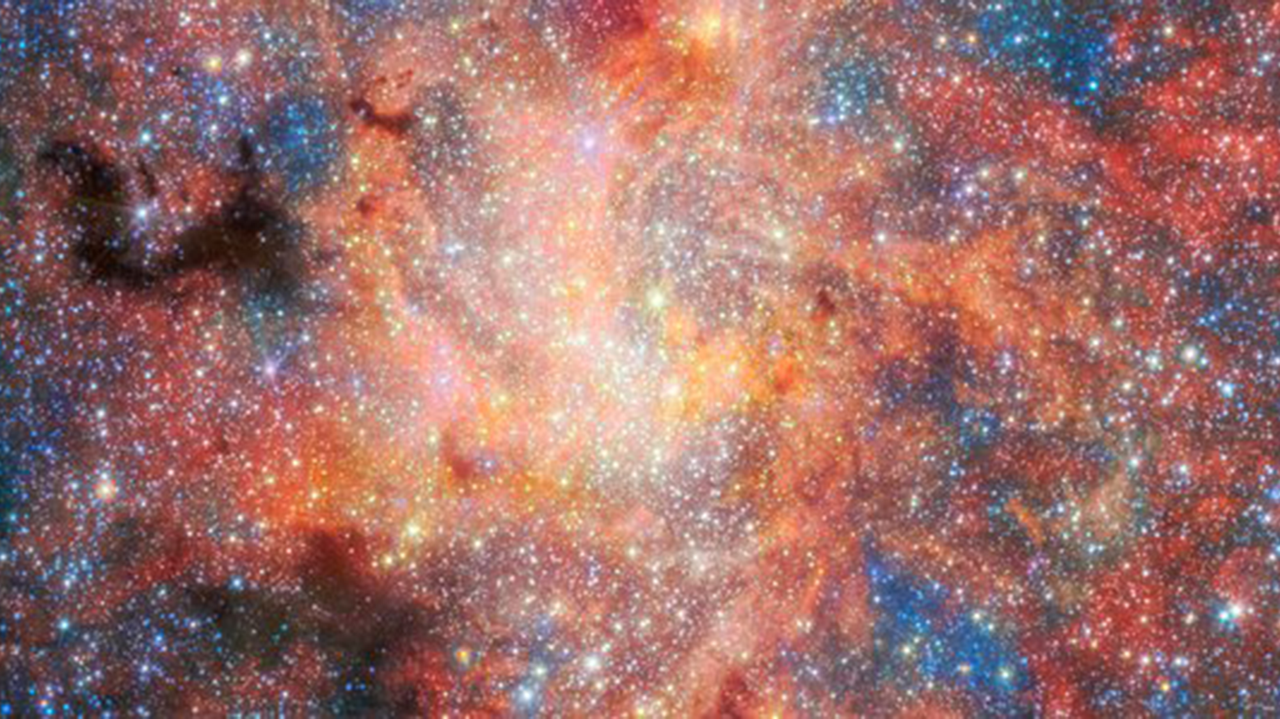
This stunning image reveals a hostile, yet fascinating environment around a dying star, IRS 3, situated near the Milky Way's supermassive black hole, Sagittarius A*. The data from this observation showcase the star shedding substantial gas and dust, forming a vast envelope around itself. The significance of this discovery extends beyond the immediate observation—it challenges long-held beliefs about the effects of extreme conditions on stellar processes.
Unpacking the Water Discovery
For the first time, traces of water have been identified in this extreme region, suggesting that even in the adjacent vicinity of such intense radiation, aging stars can still contribute to the cosmic dust cycle. This finding, published on August 11, 2026, in the journal Astronomy & Astrophysics, defies earlier assumptions that conditions near supermassive black holes would inhibit such processes. The knowledge that molecular materials can survive and even form under extraordinary circumstances shifts our understanding of star formation and evolution in extreme environments.
Macarena Garcia Marin, a co-author of the study and researcher at the European Space Agency, expressed her excitement about the implications of this finding. "The detection of water is particularly thrilling because it indicates molecular materials can endure the harsh, radiation-dominated environment of a galaxy's center," she remarked. What does this mean for the broader universe? It opens up avenues for exploring how stars can manufacture the building blocks of life, even in the most inhospitable locales.
Capturing the Image
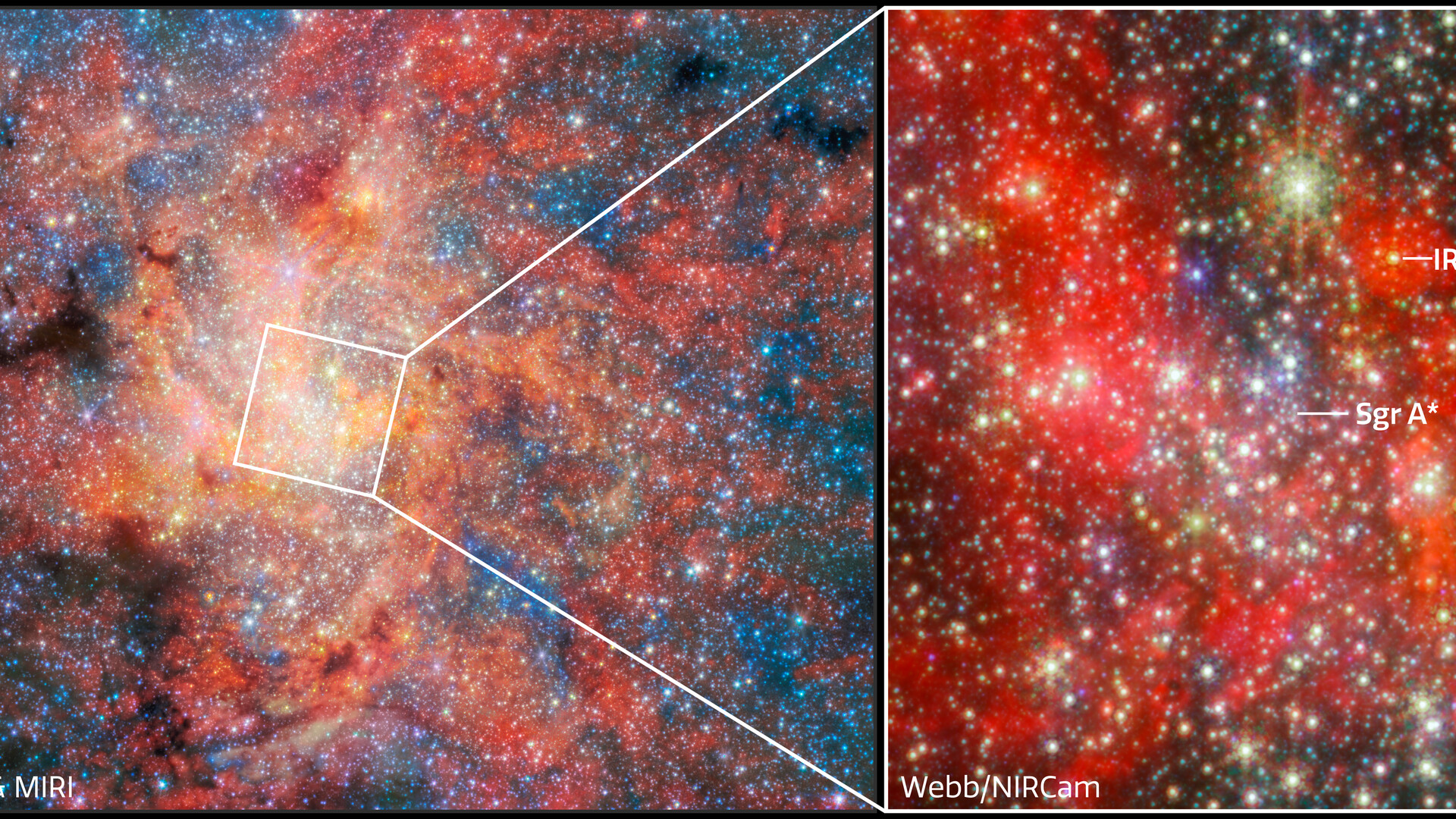
This incredible view was generated using data from the James Webb Space Telescope's (JWST) Near-Infrared Camera and Mid-Infrared Instrument. Garcia Marin, who leads the Mid-Infrared Characterization of Nearby Iconic Galaxy Centers (MICONIC) program, stated, "This marks the first instance where a continuous mid-infrared spectrum has been recorded for this star, facilitating our detection of silicate dust features and revealing its chemical identity." The precision of JWST's instruments is remarkable, allowing astronomers to dissect the star’s composition in ways previously unattainable.
A comparative image provides context for IRS 3's location, just 0.55 light-years away from Sagittarius A*. This relatively proximity may seem minor on a cosmic scale, but in astronomical terms, it puts IRS 3 in a direct line of influence from one of the most powerful gravitational forces known.
IRS 3: Character and Classification
IRS 3 isn't just any star; it belongs to the asymptotic giant branch class, characterized by substantial size, cooler temperatures, and high luminosity. Such stars are nearing the end of their life cycle, expelling layers of material through vigorous stellar winds. This process is crucial for enriching the universe with cosmic dust, which can eventually form new stars and planets. The new study emphasizes that the intense surrounding conditions do not inhibit this dust production—evidence indicates it does not. This realization has profound implications for our understanding of the life cycles of stars and the interstellar medium.
To understand the structure of IRS 3's material envelope, the research team integrated JWST spectral data with models simulating how light from the star interacts with varying dust configurations. The resulting model suggested a shell-like structure extending about 10,000 astronomical units from IRS 3. Within this model, light interacts in various ways with dust particles at contrasting temperatures. The temperature ranges from approximately 1,200 kelvins (1,700 degrees Fahrenheit) closer to the star to roughly 100 kelvins (minus 280 F) at the outer edge, showcasing a significant thermal gradient that reflects the dynamic nature of stellar environments.
Evidence of oxygen-rich dust was identified in the mid-infrared data. This challenges an earlier study that categorized IRS 3 as carbon-rich. As science progresses, classifications may need to change. The research revealed strong infrared signatures associated with silicate dust composed of silicon and oxygen, enhancing our understanding of the star’s chemical makeup. This finding allows astronomers to refine models of star evolution, especially in environments near supermassive black holes.
The Resilience of Water
Intriguingly, water traces were detected within the material envelope. This discovery, despite IRS 3's proximity to the fierce radiation surrounding Sagittarius A*, underscores the resilience of molecular materials, even in extreme conditions. What's striking here is that water could exist so close to a supermassive black hole, an area presumed too chaotic for such delicate molecules to survive—(and this is the part most people overlook). The study estimates that IRS 3's mass is about six times that of the sun, and its luminosity is around 60,000 times greater than that of our central star. It’s remarkable to consider that even in the throes of stellar death, vital components for life can endure.
Future Implications and Significance
This finding isn't just an isolated incident; it forces us to reconsider existing theories surrounding the lifecycle of stars and cosmic environments. If stars like IRS 3 can produce water and dust so close to a supermassive black hole, it paves the way for understanding star formation in extreme conditions elsewhere in the universe. It challenges the narrative that only serene environments are suitable for the emergence of complex organic molecules essential for life.
What this means for you, if you’re working in this space, is opportunity. The intersection of stellar evolution and the presence of water in harsh environments could ignite studies seeking to answer fundamental questions about how life may arise in different cosmic locales. This is more significant than it looks. As our observational capabilities advance, revisiting our assumptions will be necessary, shaping future research directions and, perhaps, our understanding of life itself.
For those looking to test their knowledge of black holes, check out our interactive black hole quiz!
Discussion
Sign in to join the discussion.