New research identifies the first known green star among white dwarfs, revealing a surprising spectrum of colors in these stellar remnants.

Recent astronomical research has brought to light a striking variety of colors in white dwarf stars, including the discovery of the first-ever green star. These findings, published in the RAS Techniques and Instruments journal on October 15, reveal that white dwarfs can emit hues far beyond just white or pale blue. The implications of these findings could reshape our understanding of stellar evolution and the life cycles of stars.
Understanding White Dwarfs
A white dwarf is essentially the compressed core left after a low- to medium-mass star exhausts its nuclear fuel. Traditionally, these stars were thought to only emit colors associated with high temperatures, primarily perceived as glowing white or pale blue due to their extreme heat. However, this new study challenges that perception significantly, suggesting that these dense stellar remnants can emit colors across a much broader spectrum, including pink, green, cyan, purple, and yellow.
Mark Hollands, an astronomer from the University of Warwick and the primary author of the study, expressed his astonishment at the unexpected colors produced by white dwarfs. He mentioned, "It turns out these incredibly dense stars can produce colours nobody expected, and some of them genuinely surprised me." This revelation stresses that the physical and chemical properties of these stars result in a spectrum of colors that defies conventional astrophysical wisdom. For instance, it was historically assumed that white dwarfs, owing to their end-state compression, would settle into a more monotonous color range, but that assumption is now being reevaluated based on these observations.
Color Variability Explained
The research proposes that certain trace elements, like carbon, calcium, and sodium, interact with the surrounding dense helium plasma. This interaction leads to the absorption of light over a broader range of visible colors, which contributes to the stars' unique appearances. Essentially, the presence of these elements can shift a star's apparent color away from the usual orange, white, or blue often generated by a perfect radiator. This finding underscores the complexity of stellar physics, where even small variances in composition can lead to significant observable differences.
This isn't just a cosmetic issue—understanding these colors helps astronomers glean insights into the many physiological processes occurring within and around these stars. Each color can indicate different chemical makeups and, by extension, varying evolutionary histories. This kind of analysis could prove instrumental in mapping the lifecycle of stars more accurately than ever before.
Measuring Stellar Colors
Given their great distances and small sizes, measuring the colors of white dwarfs directly poses significant challenges for astronomers. This study employed spectral analysis—a method that examines the unique chemical fingerprints left by starlight—to infer their colors. This technique allows researchers to distill complex information from starlight that would otherwise remain obscured. By applying a model of human color vision, researchers could enhance the visibility of these variations, making it easier to categorize and analyze stellar colors.
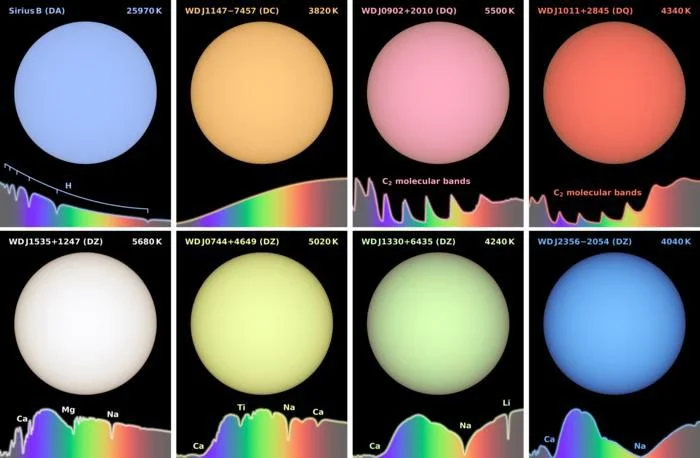
Interestingly, the findings show that carbon-rich white dwarfs often appear purple or pink, while those containing materials often originating from asteroids lean towards yellower hues. Cyan or pale-blue shades emerge when hydrogen and helium molecules collide within these dense atmospheres. It’s fascinating how these interactions reveal more than just color—they present a narrative about the origins and evolution of the star itself.
New Discoveries: Green and Red Stars
The researchers identified a standout white dwarf, designated WD J1330+6435, notable for its "chartreuse green" appearance. This unusual color results from traces of calcium, lithium, and sodium in its atmosphere. Hollands elaborated, "The traces of sodium... absorb the orange part of the spectrum, leaving behind a ghostly green glow." Discovering a green star isn’t just a fun fact; it challenges our understanding of stellar classifications and engages the imagination. Finding something like this feels almost like something straight from science fiction.
In an exciting twist, they also noted the discovery of what may be the reddest star on record, dubbed WD J1011+2845, located about 48 light-years from Earth. This star's unique hue originates from carbon being brought to the surface by intense convection currents, leading to a "deep salmon-pink glow." This process of light bending and color variation is not just a scientific curiosity—it's a reminder that the universe has layers of complexity we are just starting to scratch the surface on.
The study analyzed a sample of 151 white dwarfs within a 65-light-year radius of Earth, revealing that roughly one in thirty emits a color other than white. This suggests a broader spectrum of colorful remnants scattered throughout the universe than many have previously realized. What this means for you if you're working in this space is the potential to expand our knowledge significantly, opening doors to new avenues of research.
Implications and Future Outlook
The findings from this research carry implications that extend beyond mere curiosity. Understanding the color variability in white dwarfs can change how we approach the study of stellar evolution, composition, and even the physical conditions present in distant stars. For astronomers, this means that what was once considered an anomalous category of stars may now require a systemic reconsideration. It encourages looking closer at other stellar remnants that may exhibit unnoticed color variations.
This isn’t merely an academic exercise; the data gained could refine existing models of stellar evolution and impact theories related to supernova processes and cosmic chemical enrichment. As more advanced observational techniques become available, one can expect these discoveries to multiply, leading to potentially novel insights. In an age where astronomical observations push the boundaries of what we understand about the cosmos, the newly identified colors in white dwarfs are more significant than they look on the surface. As researchers probe deeper into the universe's mysteries, we might just redefine our place in it.
Discussion
Sign in to join the discussion.