JWST caught a supernova more than 12.5 billion years ago, offering a rare view of an early cosmic explosion slowed by the universe’s expansion.
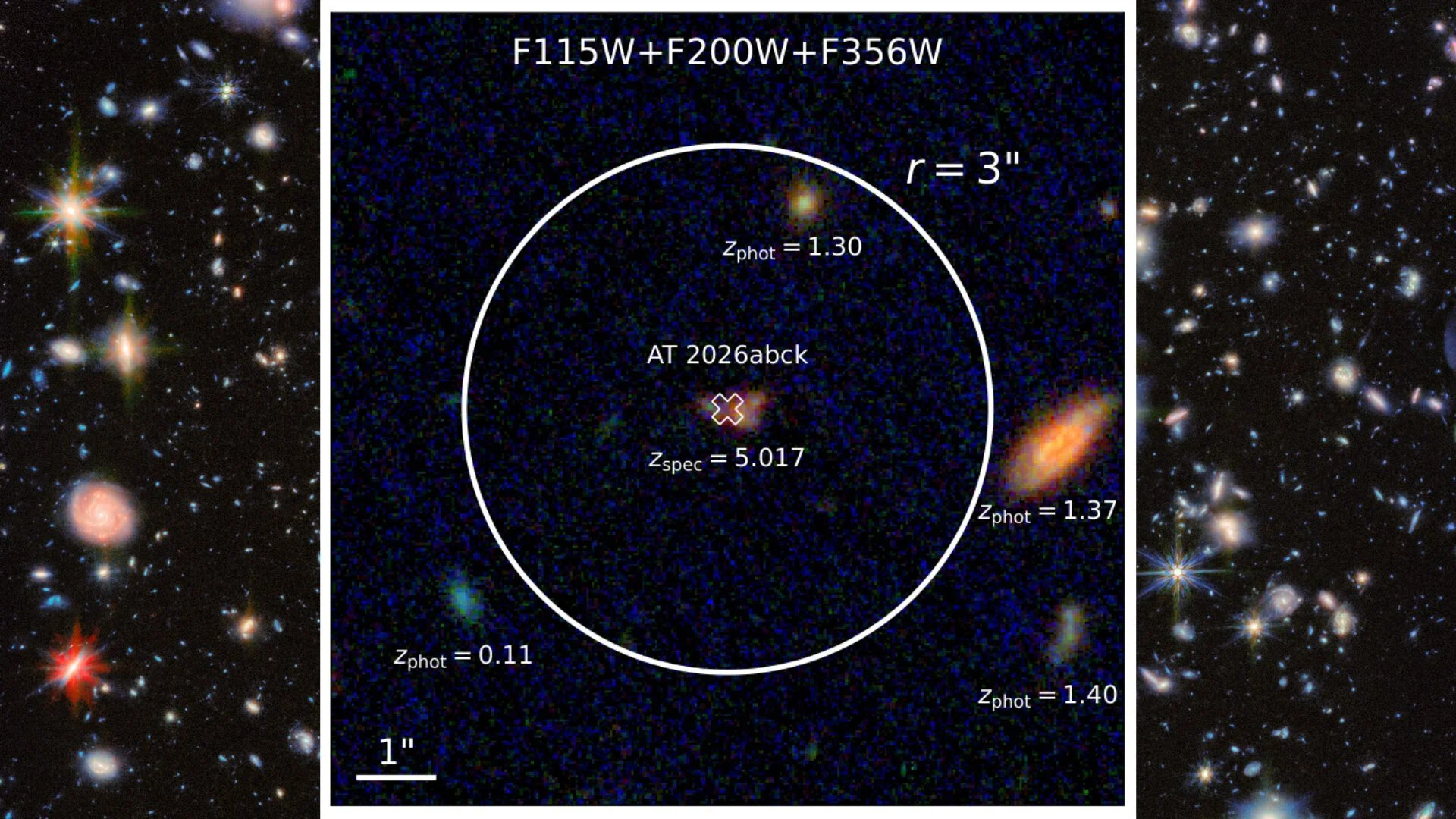
JWST has caught an unusually early supernova near the start of its life, giving astronomers a rare chance to study how a star exploded when the universe was less than a tenth of its current age. The event, AT 2026abck, appears to have been only four to 10 days old when its light reached the telescope’s observations.
The explosion occurred about 1.15 billion years after the Big Bang, more than 12.5 billion years ago. Since then, cosmic expansion has stretched the distance between the source and Earth to roughly six times what it was when the light began its journey.
Details of the discovery appear in a paper posted to arXiv on Sept. 29. It has not yet been peer reviewed. The team estimates that, at its brightest, AT 2026abck shone about 8 billion times brighter than the sun.
“At its peak, the supernova is about 8 billion times the brightness of the sun … almost as bright as the whole Milky Way Galaxy,” study co-author Xiaohui Fan, an observational cosmologist and professor of astronomy at the University of Arizona, told Live Science by email. “Over the course of the explosion, it radiates the energy that the sun will radiate over about 2 billion years.”
A rare view without a cosmic magnifier
AT 2026abck’s brightness makes it striking, but the way it was found is just as telling. Many supernovas at comparable distances have been spotted only because a massive foreground galaxy cluster bent and magnified their light through gravitational lensing. This event was seen without that boost.
“Most supernovas this far away were found with help from a massive foreground galaxy cluster acting as a natural magnifying glass,” first author Mingyang Zhuang, an observational astrophysicist at the University of Illinois Urbana-Champaign, told Live Science. “It's the most distant one we've actually seen appear.”
The team found it through the NEXUS Treasury program, which uses JWST to revisit selected regions of the sky in search of ancient explosions. The telescope had observed the supernova’s host galaxy, ID101411, in earlier years. On May 28, 2026, the star had not yet exploded in the telescope’s view; on Aug. 7, JWST saw the supernova.
Repeated observations of the same small patch of sky gave the team a chance to catch the short-lived event. “You have to observe the exact same tiny patch of sky repeatedly with [JWST], and the explosion has to happen at the right moment,” Zhuang said. “We were lucky.”
Expansion stretches the event in time
The gap between JWST’s two observations illustrates how cosmic expansion affects what astronomers see. Seventy-one days passed on Earth between May 28 and Aug. 7, while the team estimates that only about 12 days elapsed in the supernova’s own frame of reference.
“Because the universe has expanded since this light was emitted, everything about this explosion appears to us in slow motion, about six times slower than it actually happened,” Zhuang said. “Changes that took one week at the supernova take about six weeks to unfold from our point of view.” That stretching gives researchers more time to track a rapidly changing explosion than observers near the source would have.
The supernova’s physical properties also offer clues to its surroundings. Its temperature is above 30,000 degrees Fahrenheit (16,000 degrees Celsius), and its expanding shell of ejected material has reached a radius of about 46 astronomical units—roughly 46 times the Earth-sun distance, or close to Pluto’s farthest distance from the sun.
ID101411, the host galaxy, contains about 6.3 billion solar masses and is forming stars at more than 10 times the Milky Way’s rate, Zhuang said. Like many early galaxies, it has few elements heavier than hydrogen and helium. There had been less time for generations of stars and their explosions to produce and disperse heavier elements.
The explosion’s identity is still open
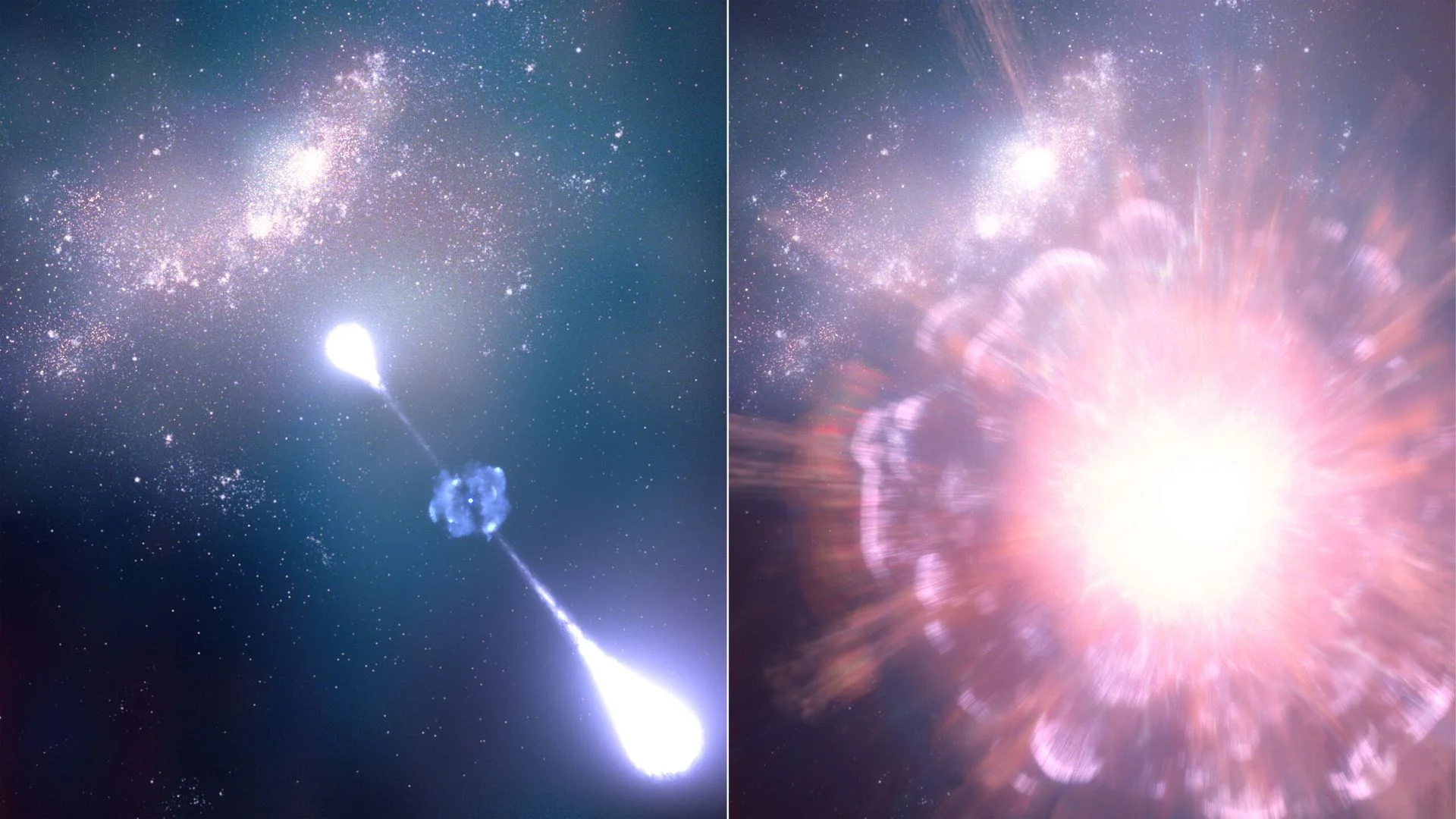
The team has not settled on what kind of star produced AT 2026abck. A typical core-collapse supernova follows the death of a star roughly eight to 50 times the mass of the sun, after it runs out of nuclear fuel and its core collapses. The early brightness of this event raises another possibility: a superluminous supernova, a rare class that can release tens or hundreds of times more energy than an ordinary supernova.
What happens next may help distinguish between explanations. Continued heating or a turn toward cooling could reveal more about the explosion’s environment and its underlying cause. For now, the analysis remains tentative. “Our interpretation is still preliminary,” Zhuang said. “Follow-up observations will tell us more about exactly what kind of explosion this was.”
- Famous supernova that lit up skies in 1181 is now full of mysterious knots — Space photo of the week
- A star 20 times the size of the sun died in a supernova — and telescopes around the world joined forces to watch it
- Scientists mapped the shape of a supernova for the first time ever – and it's not what we expected: Space photo of the week
How well do you know our home galaxy? Find out with our Milky Way quiz!
Discussion
Sign in to join the discussion.