A text analysis supports the idea that the Voynich manuscript began as loose parchment sheets, offering a new route toward understanding its baffling script.
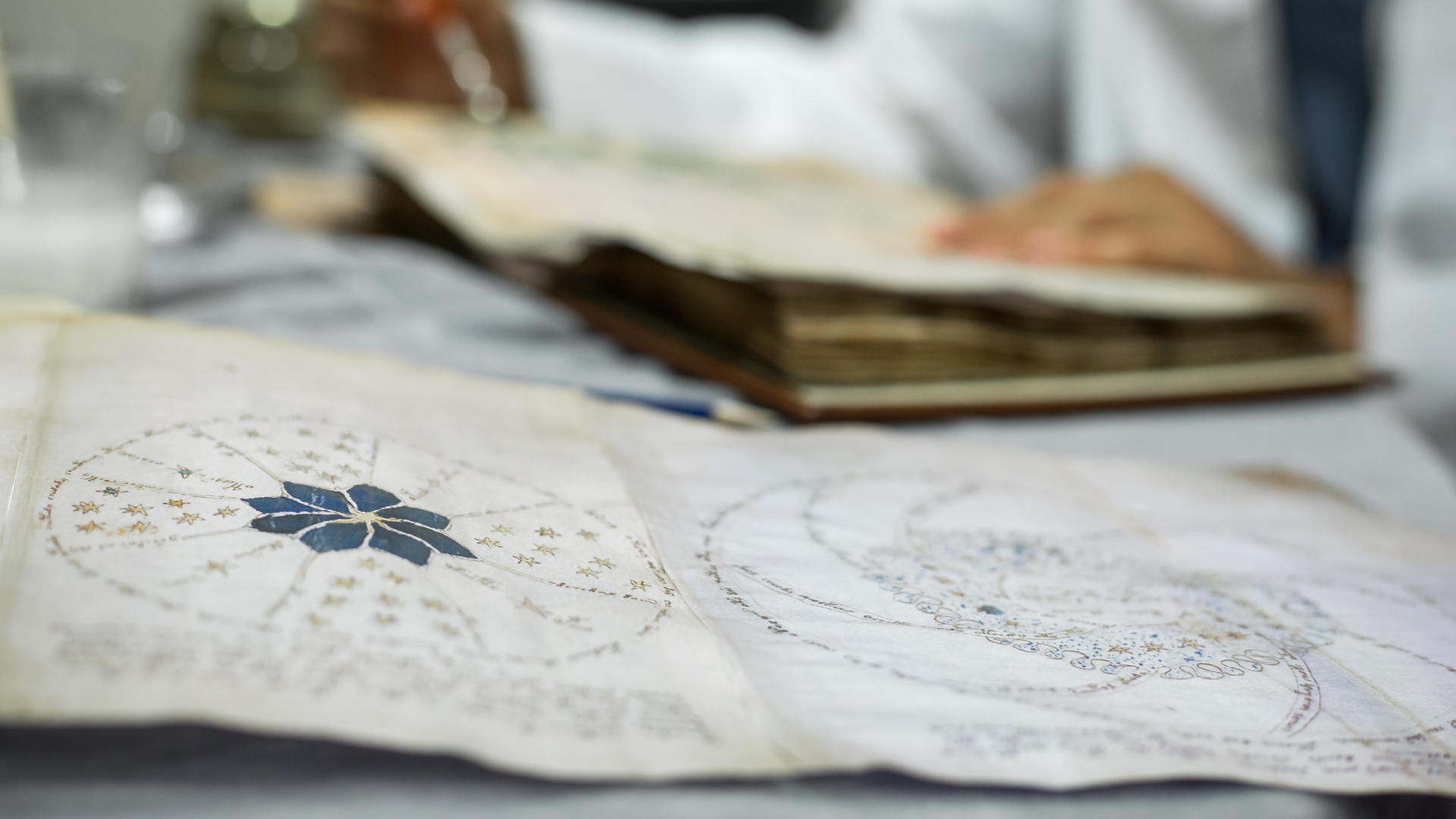
The Voynich manuscript may be difficult to read for a basic physical reason: its pages could have been assembled in the wrong order centuries ago. A new analysis of the manuscript’s text supports the idea that it was once a set of loose sheets, complicating efforts to find meaning in its unfamiliar script.
The medieval codex contains 240 parchment pages, carbon-dated to the early 15th century, with about 38,000 words in a script known as “Voynichese.” Its illustrations include plants, people and astrological symbols. The manuscript, also called the Beinecke Cipher manuscript, was once owned by a Holy Roman emperor. Wilfrid Voynich bought it in 1912, and since 1969 it has been held by Yale University's rare book library. More than a century of attempts to decipher it have yet to produce a generally accepted reading.
“We don't know if it's a code,” Lisa Fagin Davis, co-author of the study and executive director of the Medieval Academy of America, told Live Science. She and Colin Layfield, an information systems researcher at the University of Malta, argue that the manuscript’s unusual physical arrangement may reflect a later binding error.
Clues in the book’s construction
Davis noticed inconsistencies while studying how many scribes had written the manuscript. The handwriting appears on pages in sequences that don’t fit neatly together. Some illustrations also continue across a page edge, with their other parts appearing after intervening leaves. Those features make more sense if the sheets were rearranged before the book was bound.
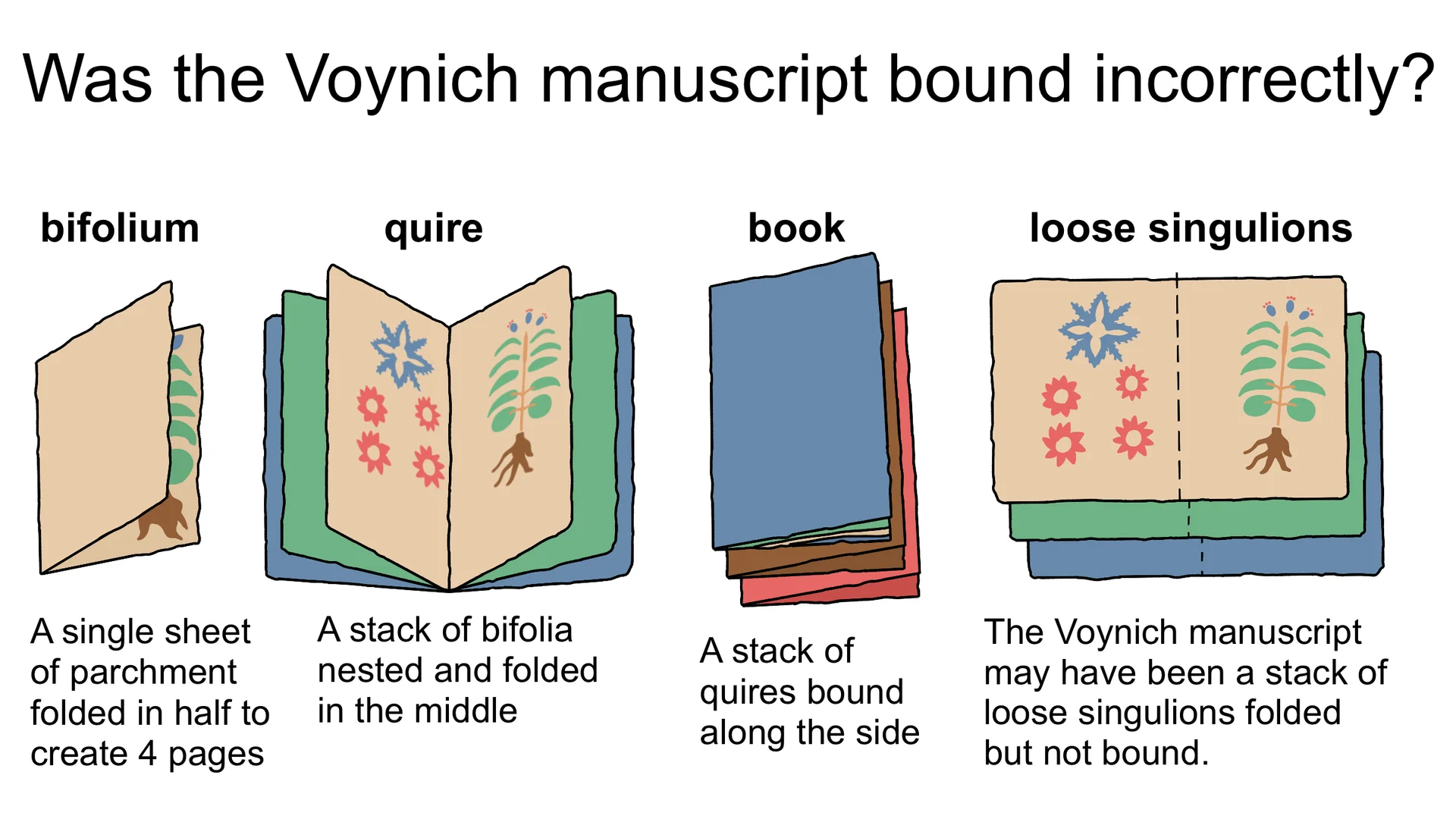
Books of the period were generally built from parchment sheets folded into pairs, called bifolia. Several bifolia were nested together to form a quire, and quires were sewn along the spine. Davis and Layfield propose a different starting point for the Voynich: a stack of individual bifolia, or singulions, that weren’t originally gathered into quires. Someone who couldn’t read the text may later have bound those sheets in the wrong sequence.
Earlier researchers have also raised the possibility that the pages are out of order. The new study, published Oct. 19 in Digital Medievalist, tests that proposal by comparing patterns in the manuscript’s text.
Comparing text blocks
Layfield used latent semantic analysis, a method developed in the late 1980s to identify patterns across text. The approach treats the manuscript as a text with a possible message, then measures how similar different blocks are. Some pages showed little similarity, which may indicate they weren’t meant to sit together; other pages showed stronger similarity, consistent with a shared sequence.
The method also suits a small body of text, Layfield said. Modern AI systems often require far more examples for training than researchers have here: “We've got just 35,000 or so words. That's it.”
For Davis and Layfield, the singulion theory brings several physical details into alignment. It could explain why each scribe appears to have written on a single sheet and why some illustrations cross the gutter between pages. “When you start to think about it in the context of the other strange features of the manuscript, all of those problems are resolved,” Davis said.
The proposal doesn’t decode Voynichese. It does, however, challenge past analyses that treated the manuscript’s current sequence as original. “This work helps us think about whether there's actual meaning underneath it all,” Davis said. “It doesn't get us there,” she added of a translation, “but it moves the ball because you can't make sense out of a book where all the pages are mixed up.”
A possible path to reordering the pages
Davis points to Cain’s Jawbone as a reason to keep working on the problem. The puzzle, created in the 1930s, is a murder mystery printed across 100 pages in the wrong order. Only a handful of people have solved it, and even AI has failed to solve it. Its difficulty comes from the unusual text and its vague, stylized language.
The Voynich team is also looking beyond the writing for clues. A large water stain appears in the upper margin of some pages, but its shape isn’t symmetrical across the leaves where it should be. Davis says that mismatch supports the idea that the sheets were bound out of order. The researchers are considering ways to compare the stain patterns and use them to reconstruct the manuscript’s sequence.
See if you know what these mysterious artifacts are with our archaeological fragments quiz!
Discussion
Sign in to join the discussion.