A 10-minute ultrasound session eased delusions for at least a week in a 10-person trial, while hallucinations and cognition showed no significant change.
A brief ultrasound treatment aimed at a deep brain structure was associated with less severe delusions for at least a week in a small study of people with schizophrenia or schizoaffective disorder. The result points to a possible way to study and influence circuits linked to psychosis without implanting electrodes, though the trial’s 10 participants make it an early signal, not evidence of established treatment.
The researchers used transcranial ultrasound stimulation: a device on the head sent sound waves through the skull toward a chosen brain region. Each treatment session lasted 10 minutes. Participants received both the active stimulation and a placebo session, with a week between them. Researchers then assessed how strongly participants believed their delusions and how much distress those beliefs caused.
After ultrasound stimulation, delusions were less severe than after the placebo session, with the difference lasting through the following week. The study found no significant change in auditory hallucinations or overall cognition. That distinction matters: the findings suggest an effect on one symptom measure, not a broad improvement across psychosis symptoms.
Delusions are beliefs that remain difficult to shake despite evidence against them. They can involve fears of being followed or expectations of disaster without supporting evidence. The study included people with schizophrenia and schizoaffective disorder, which can involve psychotic symptoms as well as mood symptoms such as mania.
Aiming at a deep brain circuit
The team targeted the right globus pallidus internus, or GPI, a structure beneath the brain’s outer cortex. It sits within the cortico-striatal-pallido-thalamic circuit, a network that includes several deeper structures. The circuit’s role in schizophrenia remains uncertain, in part because its components are difficult to examine clearly with MRI.
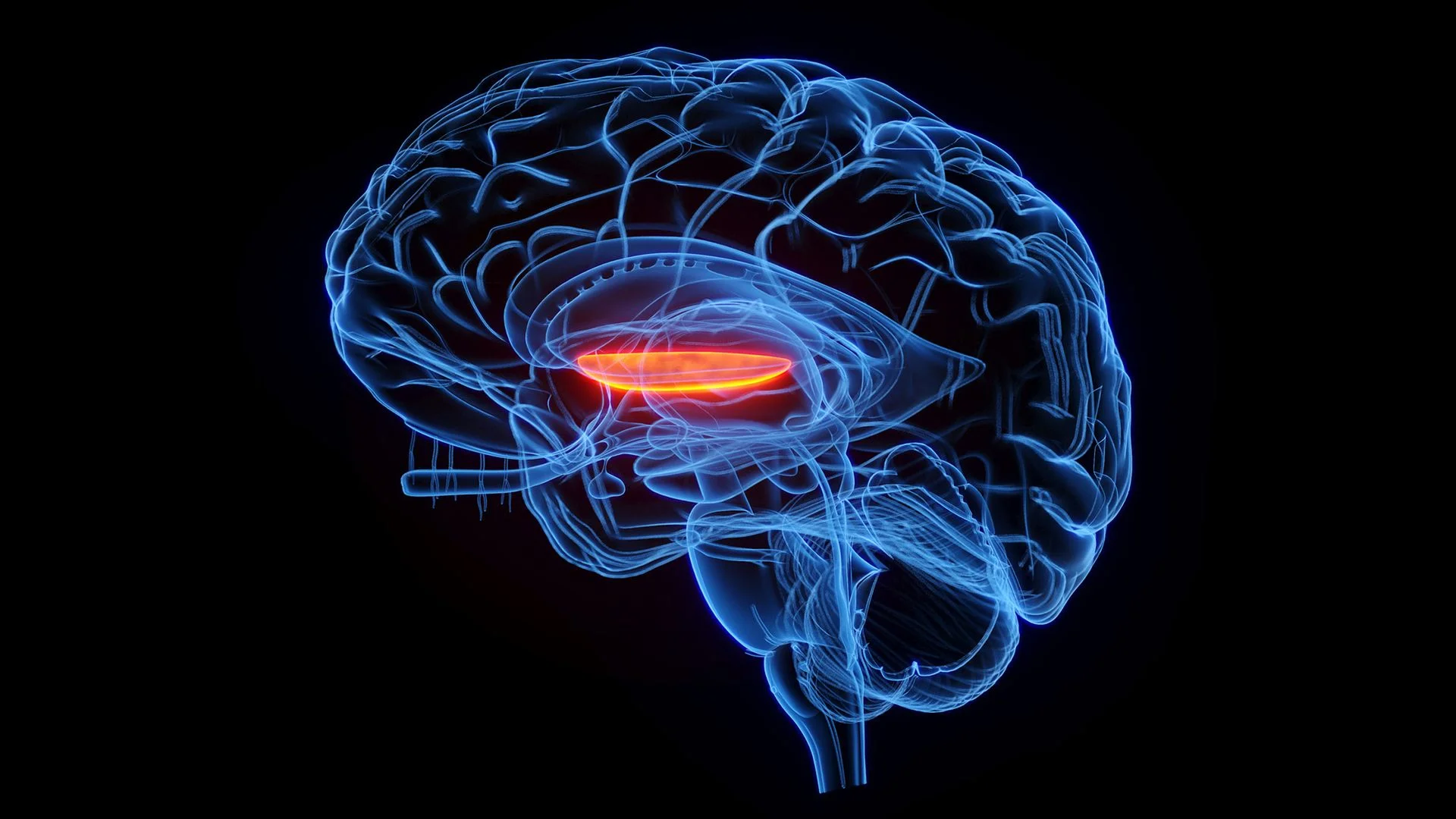
Earlier work by the study authors linked stronger connectivity between the GPI and another region, the dorsal anterior cingulate gyrus, with more severe psychotic symptoms. That association helped guide their choice of target. It doesn’t establish that the connection causes delusions, but it gives researchers a specific circuit to test.
Some ideas about this network come from studies of movement disorders, including Parkinson's disease. In those conditions, imbalances between signals that excite and inhibit neurons can affect movement. The researchers propose that a related imbalance in how the brain weighs relevant and irrelevant signals might contribute to psychosis.
"Our hypothesis is that, in schizophrenia, there is an imbalance between excitation and inhibition regarding what in the environment is actually important," study co-author Dr. Wei Qi, a clinical assistant professor of psychiatry at NYU Grossman, told Live Science. "The failure to inhibit irrelevant signals could be the basis of psychosis."
What the trial can—and can’t—show
Transcranial magnetic stimulation also influences brain activity without surgery, but ultrasound can reach deeper targets with greater specificity, according to study co-author Shy Shoham, a neural engineer at NYU Grossman. He likened the device’s focused sound waves to a lens directing light toward a particular point. The ability to reach structures below the cortex makes ultrasound a useful tool for testing whether specific brain regions are connected to particular symptoms.
The trial recorded mild side effects, including headaches and fatigue. Some participants reported temporary increases in delusions, but these occurred just as often after placebo. The researchers said such fluctuations can happen as part of schizophrenia symptoms, so the study cannot tie those changes to ultrasound.
The work appears in npj Acoustics. Co-author Dr. Donald Goff, a professor of psychiatry at the New York University Grossman School of Medicine, told Live Science, "It's too early to know for certain what the therapeutic benefits will be, but it's very exciting."
Deep brain stimulation can reach structures below the cortex, but it requires surgically implanted electrodes. Ultrasound offers a less invasive way to investigate those targets, said Dr. Deepak Sarpal, an associate professor of psychiatry at the University of Pittsburgh School of Medicine, who wasn’t involved in the study. He noted that few attempts to treat psychiatric symptoms by targeting such deep structures have succeeded.
A separate group has also used transcranial ultrasound to stimulate parts of the striatum in people with schizophrenia. That study, published earlier in the year, focused on hallucinations and reported reduced symptoms lasting at least a week. The two studies explore different symptoms and targets within the broader circuit, offering researchers ways to compare how stimulation at different points may affect psychosis.
For now, the most useful takeaway is the narrow one: a short session aimed at the GPI was followed by a measurable reduction in delusion severity in a small pilot study. Larger studies will need to determine whether that pattern holds up, which patients might benefit, and how the dose or target affects results. Qi, Goff and colleagues plan to test the approach with more participants and explore different ultrasound doses.
"If we find that a specific circuit or a node in a circuit seems to be closely linked to symptoms we're trying to treat, then it will be a matter of understanding what pattern of stimulation may allow us to correct that," Goff said. He added that more work is needed, while describing the team as "quite optimistic about its promise."
The next stage will show whether the initial symptom change can be reproduced and refined. For researchers, the approach also offers a way to probe how specific brain circuits relate to delusions—knowledge that could help shape future treatment studies.
For background on delusions and schizophrenia, see the Mayo Clinic’s overview. Antipsychotic medications can have wider physical effects, including weight gain and high blood pressure, but this pilot study did not compare ultrasound with medication or establish that it could replace existing care.
See how much you know about the most complex organ in the human body with our brain quiz!
Discussion
Sign in to join the discussion.