Two carrion crows judged moving dots in 235 milliseconds on average, with brain recordings pointing to decision processes shared with primates.
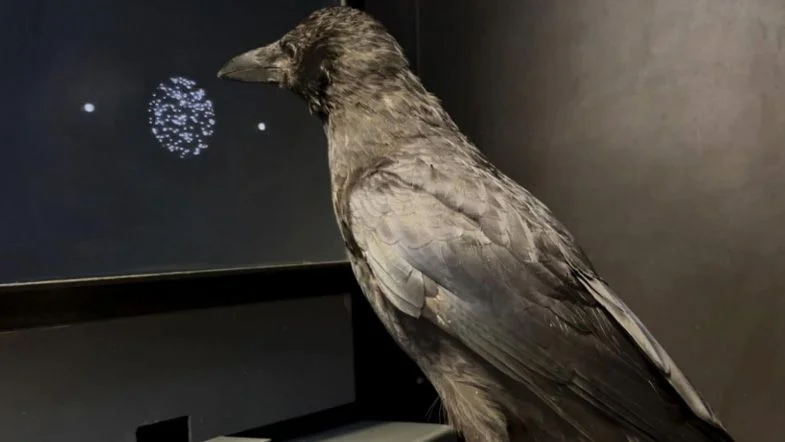
Carrion crows can make a visual decision in about 235 milliseconds, and recordings from their brains suggest they use a process also found in primates. The result adds to evidence that sophisticated thinking doesn't depend on the mammalian brain’s layered cortex, though the small study leaves open why these birds were so quick.
The research, published Oct. 22 in Science, tested two carrion crows (Corvus corone) on a screen-based motion task. Earlier studies suggest that humans and monkeys take roughly twice as long on comparable, self-paced visual tasks. The researchers didn’t test people or monkeys alongside the crows, so that comparison should be treated as a guide rather than a direct head-to-head result.
Reading a cloud of moving dots
The birds saw white dots moving across a black screen. Some traveled left or right, while others moved randomly. To earn a mealworm, each crow had to identify the direction followed by most of the dots and peck the matching target.
The researchers varied how many dots moved together, changing how clear the answer was. When the motion pointed strongly in one direction, the crows were nearly 100% accurate. Even when only 3% of the dots moved in concert, both birds performed above chance, answering correctly 50% of the time.
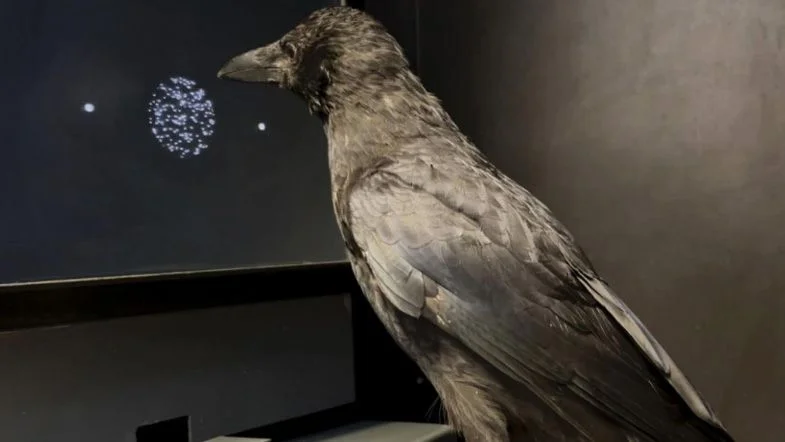
Accuracy stayed high across rounds, suggesting the birds weren’t simply trading careful judgment for speed. The average decision time was 235 milliseconds, less than a quarter of a second.
Earlier research has found that humans and monkeys take about twice as long on similar visual motion tasks. But because the crow study didn’t put the species through the same experiment, it can’t establish a precise speed advantage.
Similar computations in a different kind of brain
To track the decision process, the team recorded activity from 248 neurons in the nidopallium caudolaterale (NCL). This bird-brain region is considered functionally comparable to the prefrontal cortex in humans and other primates. Birds don’t have the layered cerebral cortex found in mammals, but their NCL supports advanced functions.
In primates, neurons gather sensory evidence, with their activity rising until it reaches a threshold that signals a decision. The crow recordings pointed to a similar pattern. The team could predict the birds’ eventual choice as early as 70 milliseconds after the dots appeared, about 170 milliseconds before a crow pecked its answer.
“The bigger implication is that a brain does not need a mammalian neocortex to perform sophisticated computations,” study co-author Andreas Nieder, professor of animal physiology and director of the Institute of Neurobiology at the University of Tübingen in Germany, told Live Science.
Birds and mammals have evolved along separate paths for more than 310 million years. Nieder said the findings suggest evolution may have arrived independently at similar ways of solving the same computational problem.
Speed may reflect the demands of flight
The researchers think the crows’ quick responses could be useful in everyday life. Flight requires birds to process visual information and coordinate movement as they navigate three-dimensional spaces, avoid obstacles and respond to moving objects. Finding food and catching prey can also call for fast, accurate decisions.
“These pressures may have favoured fast information processing,” Nieder said.
The study’s two-bird sample makes the result an early clue, rather than a final account of crow decision-making. More research could test the pattern in additional crows and compare birds directly with primates. For Nieder, the broader lesson is to study different species on their own terms: that can help researchers distinguish shared principles of thought from abilities shaped by a particular animal’s environment.
Are you a bird nerd? Find out with our bird quiz!
Discussion
Sign in to join the discussion.