A brain imaging study found that fractions and whole numbers map onto a shared neural scale, organized by value rather than by the digits they contain.
Fractions and whole numbers appear to share a common neural scale: when people compare them, brain activity tracks their value along a pattern resembling a number line. The finding offers a clearer view of how the brain connects written symbols to numerical meaning, though it doesn't explain why fractions are harder to learn.
A shared map for different number formats
Researchers led by Daniela Valério and Stanislas Dehaene at France’s INSERM-CEA Cognitive Neuroimaging Unit asked 20 adults to compare a sequence of numbers and decide whether each was larger or smaller than the one shown before. The sequence included both fractions and whole numbers.
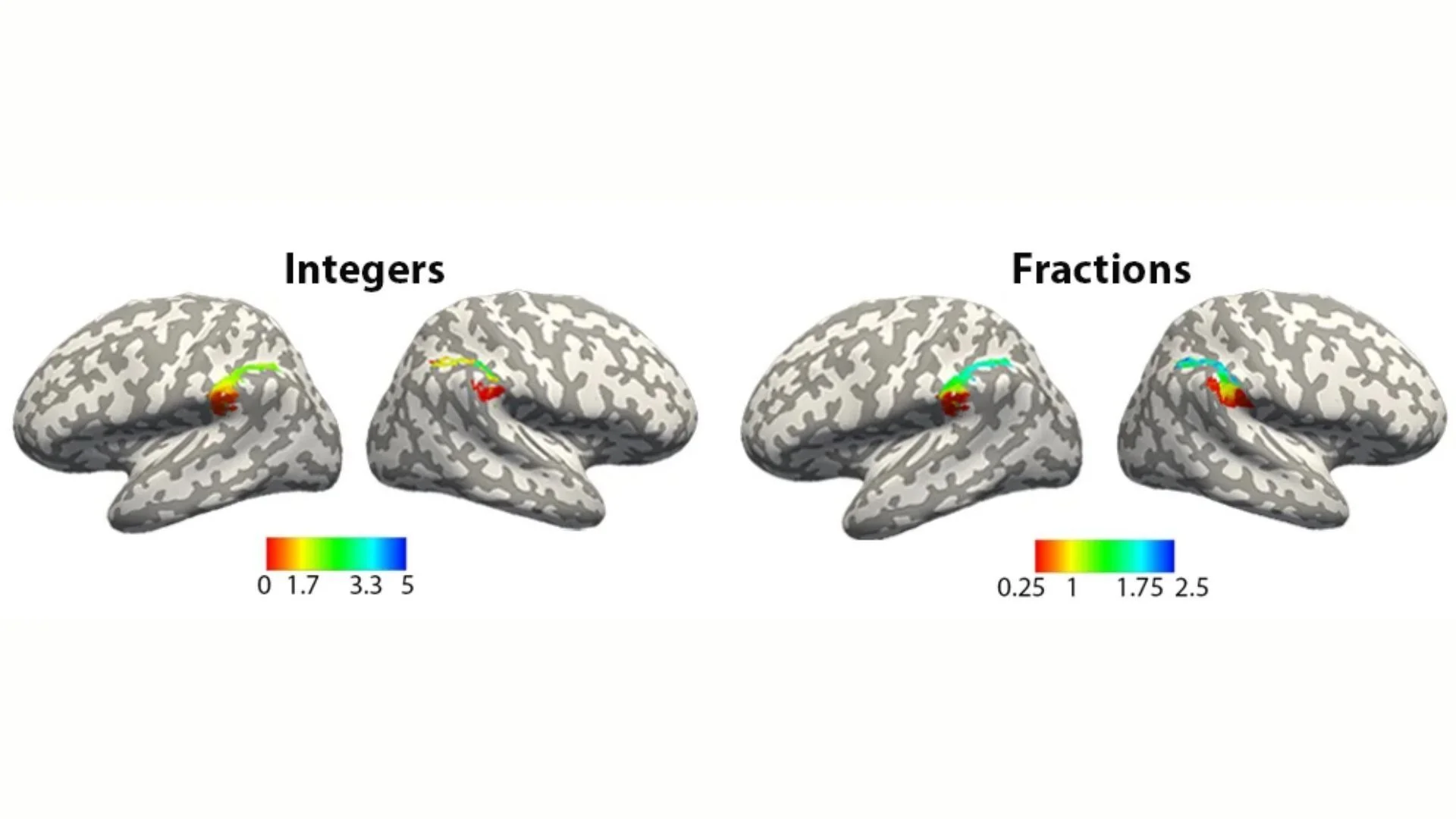
Using high-resolution functional MRI to track changes in blood flow as an indirect measure of brain activity, the team found orderly patterns in the anterior inferior parietal cortex, an area involved in number processing. Activity associated with both number types followed a shared arrangement based on magnitude. The brain appeared to place numbers according to how much they represent, rather than sorting fractions and integers into separate systems.
“Numbers are abstract concepts, but our brains have ways of organizing them that allow us to compare and reason about their values,” Valério and Dehaene said in a joint statement. They described the ability to place integers and fractions within one system as a striking feature of the result.
The pattern also reflects quantity rather than the symbols themselves, said Abiot Derbie, a cognitive neuroscientist and founder of psychology assessment company LifeByLogic, who wasn't involved in the study. A fraction such as “¼” includes the digit 4, he noted, but its value lies close to zero. In the scans, the brain’s activity followed that smaller value.
What the study adds—and what it leaves open
Earlier research had linked numerical magnitude to activity in the parietal lobe, but scientists had a less complete picture of how the brain handles fractions alongside whole numbers. The team said its study is the first, to its knowledge, to examine the geometry of neural representations during a task involving both formats. The results were reported Thursday, Oct. 22, in PLOS Biology.
Derbie said previous work had shown that fractions and integers engage overlapping parts of the brain’s number-processing network. This study, he said, offers a more detailed picture of how their values are arranged within that network. Valério and Dehaene pointed to decimal numbers as a useful subject for future research.
The participants were slower and made more errors when comparing fractions than when comparing whole numbers, a result the researchers expected. But the experiment wasn't designed to explain why fractions are harder to understand or learn. Its contribution is showing that both kinds of number fit within a shared neural map.
The findings also come with limits: all 20 participants were native French speakers. Derbie suggested that further work could examine whether the representation differs with age, education, mathematical experience, language or culture. He also proposed following children as they learn fractions to see how their brain activity changes alongside their understanding.
That next step could help researchers connect the brain’s apparent map of numerical value with the process of learning. For now, the scans suggest that the mind can look past the surface form of a number and organize fractions and integers by the quantities they represent.
Discussion
Sign in to join the discussion.