New findings from a well in Osijek suggest skeletal remains may be linked to the Plague of Cyprian, shedding light on ancient urban mortality.
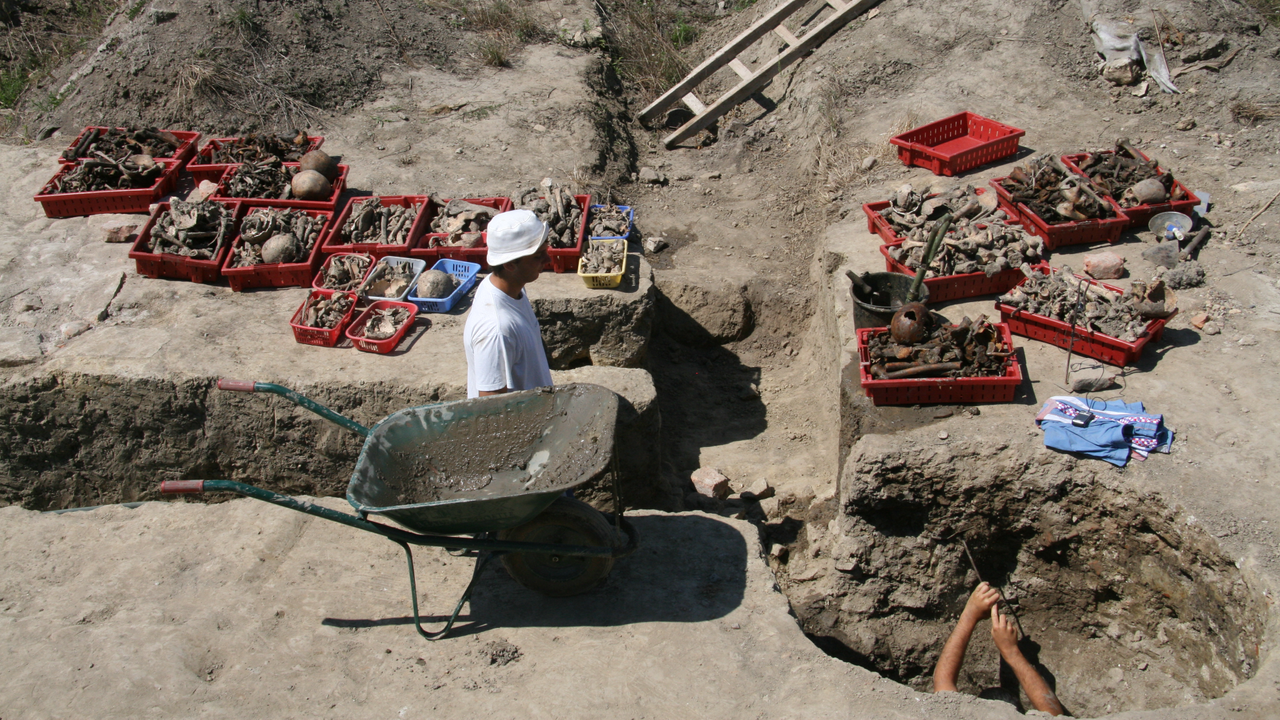
In a significant archaeological discovery, researchers have unearthed nearly 43 skeletons from a well in Osijek, Croatia, potentially linked to the Plague of Cyprian, a devastating epidemic that swept through the Roman Empire in the mid-third century A.D. This finding, presented by bioarchaeologist Mario Novak at the 25th European Paleopathology Association meeting in Berlin, indicates the remains might be those of civilians affected by the outbreak. The implications of this discovery stretch far beyond the number of skeletons unearthed, revealing potential insights into ancient societal responses to crises.
The Context of the Discovery
Novak explains that the skeletons were found in wells commonly utilized in ancient Rome for various purposes, including the disposal of bodies during times of crisis, such as epidemics and battles. He noted, “They basically used these dried-up wells just to throw people in — either from battle or from epidemics.” This assertion point to a tragic yet practical aspect of Roman urban life; it highlights how societies historically dealt with mass mortality—often by resorting to methods that reflected both a dire need for public health and a lack of resources to manage the dead in more respectful ways. It’s a grim reality that underlines the extremely pragmatic choices that had to be made under pressure.
The excavation took place in 2008 near a Roman necropolis in Osijek, a city established by Emperor Hadrian in A.D. 133. This area, historically known as Mursa, played a vital role in the Roman Empire's military efforts, particularly in protecting the strategic waterways of the Danube. The city's significance during this period contextualizes why it would have been so adversely affected by epidemics. If the skeletons do indeed belong to victims of the Plague of Cyprian, they represent a demographic snapshot of a society struggling not just against an enemy on the battlefield but also an invisible foe.
Analyzing the Skeletal Demographics
Having previously investigated wells filled with the remains of young men who likely died in battle, Novak's latest findings diverge significantly. The newly analyzed skeletons comprised a diverse demographic, including adults and children of both sexes, and curiously lacked any signs of violent trauma. “I would say this is a typical demographic cross-section of a civilian population. So nothing resembling those two battle-related mass burials,” he remarked. This leads to the hypothesis that these individuals could have died as victims of the plague—a theory that could have profound implications for our understanding of how pandemics affect all strata of society.
This situation raises important questions about who suffered the most during the Plague of Cyprian. It suggests that not just the warriors but families, children, and a broader civilian population also bore the brunt of the epidemic's impacts. If you’re working in this space, the demographic insights from the findings remind us that societal vulnerabilities often extend far beyond what might be immediately visible in historical records. The presence of both adults and children adds an emotional weight to the findings, invoking a sense of loss that transcends mere statistics.
Understanding Historical Epidemics
Historical epidemics of the time, particularly the Plague of Cyprian, are well-documented. This outbreak reportedly began with Roman troops stationed along the Danube, causing severe mortality across the Empire. While the precise cause of the plague remains uncertain, contenders range from hemorrhagic fevers to smallpox, all devastating in nature. Understanding these diseases isn't just a historical concern; it provides a lens through which modern societies can examine their own reactions to pandemics, like COVID-19.
Commenting on the implications of the findings, Patrick Randolph-Quinney, a biological anthropologist based in Sweden, emphasized that this situation does not represent traditional mass graves: “These weren't really mass graves — instead, the bodies were dumped into a series of pre-existing wells at the site.” This observation adds a layer of complexity to our understanding of burial practices during periods of epidemic distress. The act of discarding bodies into wells reveals societal panic and a lack of infrastructure to cope with sudden spikes in mortality, a common thread among communities facing large-scale health crises.
Medical Insights from the Remains
Preliminary assessments of the skeletons indicate some non-fatal medical conditions, such as osteoarthritis and dental issues. Interestingly, there were also indications of possible tuberculosis and scurvy among the remains. However, the actual cause of death has yet to be established. This mixture of ailments could signify broader health issues prevalent at the time, reflecting not only the crises associated with the plague itself but also the general state of medical knowledge and public health in the Roman Empire.
As Novak notes, the need for more concrete data is apparent. Ongoing DNA analyses may provide crucial insights, helping to determine if these individuals were local residents or soldiers conscripted from distant parts of the Empire. This research not only deepens our comprehension of ancient mortality but also offers a glimpse into the societal impacts of health crises in the Roman world. The results could shift our understanding of how interconnected local communities were, especially in times of socio-political turmoil.
Implications and Future Outlook
These findings spark a variety of questions—about how societies manage public health crises and how they memorialize those lost. The significance lies not just in the skeletons themselves but in what they represent about human resilience in the face of catastrophe. What this means for you, the reader, is that history isn’t just a tale of wars and conquests; it’s also about the invisible battles fought against disease, which shaped the very fabric of civilization.
As this research unfolds, expect more revelations that may challenge or enrich our current understanding of Roman history and its health crises. We're poised to learn whether these findings will lead to a broader investigation of the area and further excavations, potentially unearthing additional evidence from this time period. And this is the part most people overlook: the past has a unique way of informing the future, particularly as we grapple with our health systems and societal structures today.
For those curious about ancient Rome's leaders, test your knowledge with our Roman emperor quiz!
Discussion
Sign in to join the discussion.