The Teghaza 001 meteorite reveals that Mars was losing its water over 4 billion years ago, reshaping our understanding of its habitability.
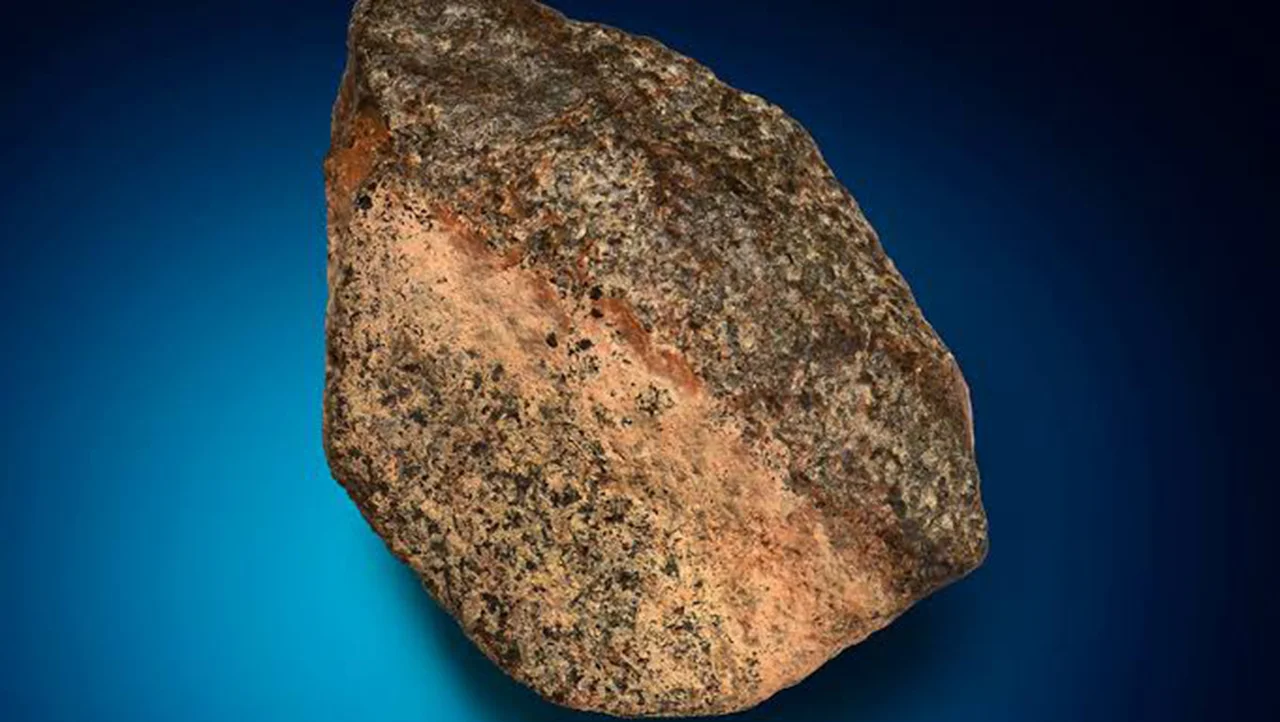
The Teghaza 001 meteorite, an inconspicuous but significant brownish rock, is providing geoscientists with a rare glimpse into Mars' ancient past. This ancient space rock, recovered in 2022 from the Taghaza archaeological site in Mali, weighs about 28 ounces (800 grams) and is now owned by the Maine Mineral and Gem Museum. Its study is shedding light on the early history of the Red Planet and its potential for habitability.
Formed roughly 4.5 billion years ago from the same disk of gas and dust as Earth, Mars has shared its geological materials through countless meteoroid impacts over millennia. Such events have launched hundreds of Martian meteorites toward Earth, making studies like those based on Teghaza 001 invaluable for understanding the evolution of our neighboring planet. Each piece of Martian rock holds secrets about its environment, and in a field where every specimen counts, this meteorite is particularly exciting.
Notably, two previous meteorite specimens have garnered attention: the Allan Hills 84001, which contains ancient organic molecules, and NWA 7034, known for its ancient water content. However, these samples lack the diversity and age representation of Mars’ crust, which Teghaza 001 may compensate for with its unique composition. This diversity is critical. A broader range of samples helps scientists construct a comprehensive picture of the planet's history and its capacity to harbor life.
Fresh Insights from Teghaza 001
In a preprint published on April 14, researchers utilized radioactive decay measurements from Zircon crystals embedded in the Teghaza 001 meteorite, establishing an age of at least 4.1 billion years. This positions it as potentially the oldest-known Martian material. The mineral richness of Teghaza 001, largely comprising silica, suggests that Mars may have experienced geological processes traditionally linked to plate tectonics, like granite formation, despite lacking an active tectonic system. This implies a more complex history of geological evolution for Mars than previously assumed.
These findings contrast sharply with our understanding of Mars as primarily basaltic in composition. The previous assumption that its surface was predominantly basaltic limited the scope of potential geological processes researchers envisioned for the planet. Researchers now propose that Mars could have had its own mechanisms for geological activity that might resemble, albeit differ from, Earth's tectonics. This provides a new framework to investigate how planets evolve and what conditions are necessary for life beyond Earth. The lines between the geological histories of terrestrial planets may be blurrier than we think.
Magma Networks and Habitability
In a paper published in June in Nature Astronomy, a team employed seismic data from NASA's InSight lander to model Mars' interior. Their study identified evidence of extensive magma networks underneath the Martian surface, potentially encompassing thousands of miles beneath the northern hemisphere. Such findings suggest a vibrant geologic past that could directly influence the planet's ability to host life.
Co-author Jon Wade from Oxford University highlighted the implications of these findings: “If Mars could develop this kind of complex crust without plate tectonics, then maybe the conditions needed for habitability can emerge on more planets than we realized.” This challenges longstanding assumptions about how planetary geology affects the potential for life. If other celestial bodies can maintain similar structures and processes without mechanisms seen on Earth, the search for habitable planets expands significantly, increasing the chances of discovering life beyond our solar system.
Early Water Loss on Mars
While Teghaza 001 paints a promising picture of early Martian conditions conducive to habitability, it also uncovers troubling evidence of water loss. A study published in June in Science Advances utilized chemical analyses of the meteorite to trace the evolution of Mars' hydrological history. By comparing the hydrogen isotopes in Teghaza 001 with those in younger meteorites, researchers found that Mars began losing its water through atmospheric escape shortly after its formation. The loss of water early in the planet's history raises concerns about the potential for life.
This study indicated that by 4.1 billion years ago, Mars was already experiencing significant atmospheric loss, leading to the depletion of its juvenile water reserves. Such early losses present a compelling narrative of a planet struggling to maintain conditions suitable for life. The timeline is somewhat alarming, indicating that any early forms of life would have faced immediate challenges, a narrative that's not uncommon among the rocky planets in our solar system. James Day, a professor at the Scripps Institution of Oceanography and not involved in the study, remarked on the importance of caution regarding these findings due to the limited sample size, stating, "This research is based on a single small stone." That viewpoint underscores the need for more samples to validate these findings.
Continued exploration of Martian meteorites like Teghaza 001 is essential for piecing together the complex history of Mars. Each new discovery can reshape our understanding of its geological processes, climate history, and, importantly, its potential to host life. If you're working in this space, the implications of these studies are significant. Understanding Mars' past may dramatically alter our approach to searching for life elsewhere in the cosmos.
Future Outlook for Mars Research
The findings derived from Teghaza 001 and other Martian meteorites are just the beginning. With more missions planned to Mars in the coming years, scientists aim to gather comprehensive data that could refine our understanding further. The prospect of Martian soil samples returning to Earth is tantalizing. Such samples would provide direct evidence to corroborate or contest current theories developed from meteorites. And this is the part most people overlook: the mix of remote data and actual samples is where the most significant breakthroughs are likely to come.
As researchers analyze Martian meteorites, the quest to understand the history of our neighboring planet becomes clearer. While there's still much to learn, the combination of geological studies, astrobiology, and planetary science creates an exciting interdisciplinary approach that could shine light on the broader question of life's existence throughout the universe.
Curious about Mars? Challenge your knowledge with our Mars quiz!
Discussion
Sign in to join the discussion.