Point Nemo, the most remote spot on Earth, captivatingly blends oceanic isolation with tales of space junk and Lovecraftian lore.
Ask any adventurer, and they'll tell you stories of uncharted territories. Yet, few can compare to Point Nemo, the world's most isolated marine location. It's not just a remarkable geographic curiosity; it’s intertwined with the imaginations of both literary giants and space aficionados.
Defining Point Nemo: The Ocean's Pole of Inaccessibility
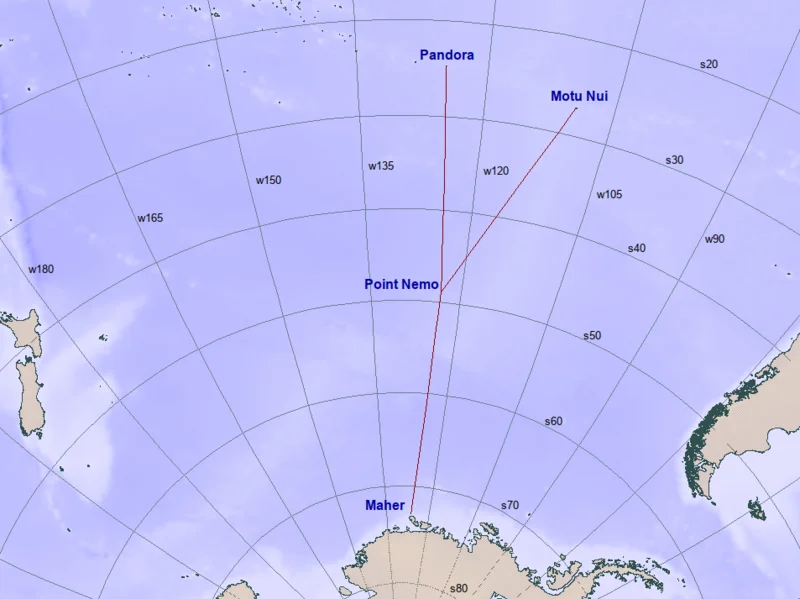
At coordinates 48°52.6’S 123°23.6’W, Point Nemo represents the furthest distance from any landmass on the globe. This oceanic outpost isn’t just a theoretical concept; it became a tangible location thanks to modern computing. In 1992, Croatian-Canadian engineer Hrvoje Lukatela developed a geospatial program which pinpointed this unique spot, naming it after Captain Nemo from Jules Verne's famed Twenty Thousand Leagues Under the Sea.
Geography and its Implications
The sheer remoteness of Point Nemo—1,670 miles (2,688 kilometers) from Ducie Island, Motu Nui, and Maher Island—creates a massive zone of ocean measuring 8,650,778 square miles (22,405,411 square kilometers). For reference, that's larger than the former Soviet Union. Its isolation translates not only to a geographical wonder but also significant safety concerns; rescue operations for stranded vessels can take an impractically long time, which makes this area particularly perilous.
The Space Junk Connection
Ironically, this stretch of ocean is also known as a repository for discarded spacecraft, leading to its title as the "Spacecraft Cemetery." Since the 1970s, hundreds of decommissioned vessels—many of them Russian—have plunged into these waters. Craft like the Mir space station draw public interest, but it’s the carefully managed descent protocols that make reentries like these noteworthy. Space agencies must notify maritime traffic in regions such as Chile and New Zealand before directing a spacecraft to reenter over Point Nemo, ensuring that pilots and sailors steer clear of the area during these fiery descents.
Cultural Echoes: Lovecraft's Underwater City
The eeriness of Point Nemo doesn't end with its remoteness or the trashing of space debris; it has also been a muse for writers. H.P. Lovecraft, a master of horror, positioned his fictitious city R'lyeh near this isolated water. In The Call of Cthulhu, the sunken city serves as the lair of the monstrous Cthulhu, crafted from a delightfully grotesque mix of myth and oceanic terror. Coincidentally, Lovecraft's coordinates for R’lyeh place it just 205 miles (330 km) from Point Nemo, displaying a fascinating symmetry between fiction and reality.
The Eerie Sounds of the Deep
Adding to the strangeness, the ocean around Point Nemo produced a sound in 1997, known as the Bloop. This ultra-low-frequency noise baffled scientists and was too powerful to originate from known marine life like blue whales. While some speculate it could have been caused by icebergs calving in Antarctica, others remain hopeful that it signals an undiscovered marine creature lurking in the deep, possibly stirred by both human activities and Lovecraftian myths.
A New Kind of Isolation
Point Nemo is so remote that it remains largely unvisited, with only rare instances marking close encounters. Participants in the 2015 Volvo Ocean Race noted that they were nearer to the International Space Station orbiting overhead than to any other human being while passing by this isolated reach. This fact elevates Point Nemo from just a point on a map to a haunting reminder of our planet's vastness and the solitude it can impart.
In contemplating Point Nemo, a multitude of themes bubbling beneath the surface emerges: the isolation of the human experience, the intersections of technology and nature, and the allure of mystery that stirs imagination. Whether it’s conjuring fear through Lovecraft’s tales or eliciting awe with its sheer seclusion, Point Nemo stands as a testament to the imagination and the mysteries of our world, as well as the remnants of our civilization cast into the abyss.
Discussion
Sign in to join the discussion.