Physicists have confirmed the interaction between gravity and quantum mechanics through a novel experiment, validating Einstein's equivalence principle at the quantum level.
For the first time, researchers have quantified a subtle quantum effect that occurs when an object falls through Earth’s gravitational field. This phenomenon, linked to Einstein's theory of relativity, was predicted nearly a century ago but had not been observed until now.
In their groundbreaking experiment, scientists utilized ultracold rubidium atoms placed in a superposition — a unique quantum state allowing a single particle to traverse two paths simultaneously. One path held the atom in free fall, while the other maintained the atom's stationary position. When the atoms were recombined, the tiny differences between these paths revealed significant insights.
The findings, published on September 2 in Science Advances, reaffirm Einstein's equivalence principle, which posits that acceleration and gravitational effects are locally indistinguishable, and now confirms its applicability in quantum scenarios. "The principle states that acceleration and gravity cannot be distinguished locally," explained Vlatko Vedral, a physicist at Oxford and co-author of the study.
Einstein's Conceptual Leap
Einstein's equivalence principle is famously illustrated by his thought experiment involving an elevator. A person in a sealed, windowless elevator cannot discern whether they are stationary on Earth or accelerating through space. This realization was dubbed by Einstein as "the happiest thought" of his life, forming the bedrock of his general relativity theory.
Historically, while the equivalence principle has been rigorously tested for large objects, exploring it within the quantum realm poses unique challenges. Quantum particles commonly exhibit wave-like behavior, where each wave maintains a phase that can only be indirectly assessed through interference patterns. When recombining two versions of the same particle, any phase discrepancies manifest as variations in the interference outcome, influencing where the particle is likely to appear.
Theoretically, a wave in free fall should accumulate a distinct phase in relation to a stationary wave, with the phase growth being proportional to the cube of the duration of the fall. This prediction was initially documented in 1927 by Charles Galton Darwin and Earle Kennard, but no experiment had succeeded in measuring the effect until this recent study.
Innovative Experimental Design
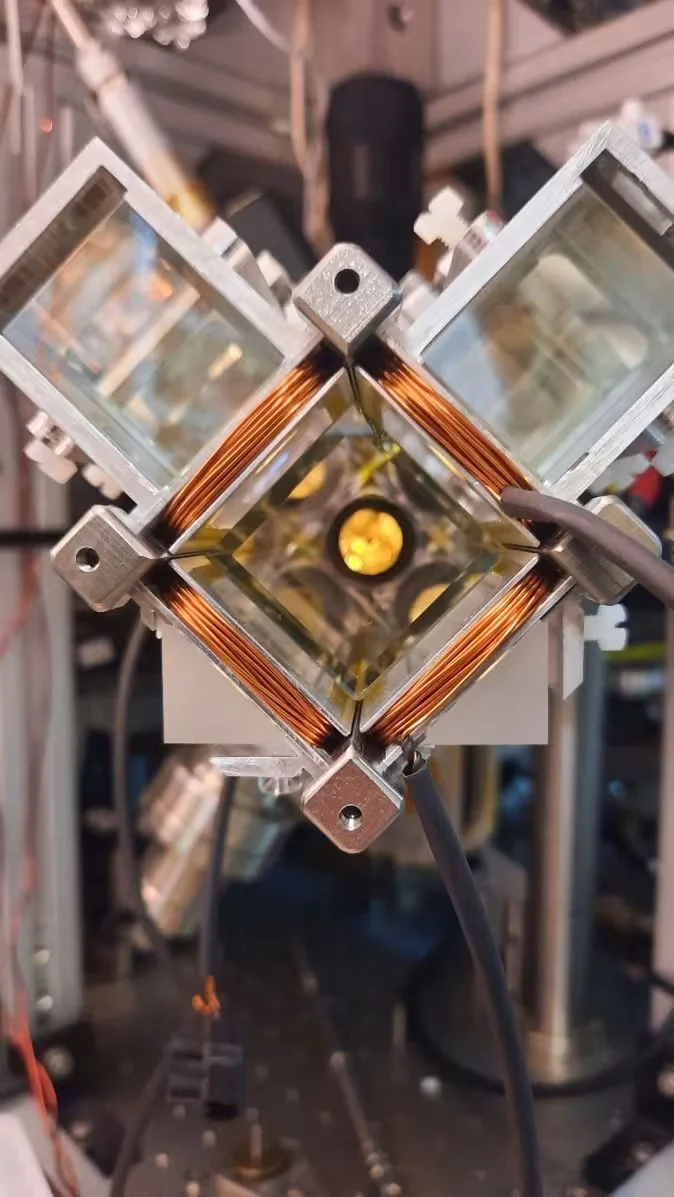
To capture the gravitational effect, the team crafted a unique apparatus featuring one arm at rest relative to Earth while the other experienced true free fall. Led by physicist Ron Folman from Ben-Gurion University, the research team chilled approximately 20,000 rubidium atoms to a state known as a Bose-Einstein condensate. After releasing the atoms from their magnetic containment, they executed the interference experiment about 113 micrometers below an atom chip equipped with fine gold-patterned wires.
Applying radio and microwave pulses, the team put each atom into a superposition of two magnetic states. A magnetic impulse thrust one of the states upward while a subsequent pulse made that half immune to magnetic forces, causing it to navigate freely under gravity alone. Meanwhile, the other fragment of the atom remained subject to a magnetic field designed precisely to counteract gravity, effectively suspending it in mid-air.
The height differential reached about 7.5 micrometers — about seven times wider than the atomic wave itself — before reversing the process to recombine the two quantities. The researchers named this experimental setup the quantum Galileo interferometer in homage to Galileo's foundational views on gravity.
"By superposing two different accelerations, one being the Earth's gravitational pull and the other non-acceleration, we were able to accurately measure the resultant quantum interference," noted Vedral.
Observations Confirm Theory
The team meticulously tracked the interference patterns as they extended the free-fall duration to approximately 2.4 milliseconds. Analyzing data from 633 iterations over a span of 5.3 hours, they noted 13 complete oscillations that reflected full cycles of phase accumulation between the atomic halves. This phase growth adhered closely to theoretical predictions, with deviations totaling around just 2.5%.
"We've effectively observed the phase that was theorized nearly a century ago in 1927, which increments cubically with time," remarked Vedral.
This result holds great significance as it illustrates that similar phase behavior can be interpreted in two distinct frameworks: observing gravity as a force affecting the quantum wave or adopting the perspective where gravity is negligible and using the equivalence principle. The agreement between these two approaches suggests a harmonious relationship between quantum mechanics and general relativity. "At this precision, there's no apparent conflict between quantum physics and gravity," Vedral emphasized. "The equivalence principle aligns perfectly with quantum mechanics."
Challenges in Recombining Quantum States
An ambitious aspect of the experiment revolved around the recombination of the two atomic halves. Due to their differential speeds, re-aligning them was exceptionally complex. Physicists have referred to this dilemma as the "Humpty-Dumpty effect," invoking the image of a character that cannot easily be put back together. Moreover, the magnetic fields interact diversely across the atomic cloud, further obfuscating the reunion of the two halves.
Initial interference contrast registered at 80% during short-duration runs but diminished to 20% for extended trials, imposing a practical limit on run length. While this measurement does not exclude every speculative theory that could invalidate the equivalence principle, it does reinforce significant confidence in existing interpretations.
Future Directions in Quantum Research
The research team is eager to extend their investigations into the equivalence principle under varying scenarios, including “the same experiment in a rotating frame,” Vedral indicated. "An even more fascinating approach could involve conducting an experiment where two systems in superposition influence each other gravitationally.”
This latter approach could illuminate one of physics' paramount inquiries surrounding whether gravity adheres to quantum principles. Transitioning this technique to larger entities, such as nanodiamonds, may allow scientists to explore notions posited by study co-author and Nobel laureate Roger Penrose, suggesting that gravity may be responsible for the collapse of quantum superpositions.
Test your knowledge about Einstein's life and theories with our Albert Einstein quiz!
Discussion
Sign in to join the discussion.