A groundbreaking discovery in Poland reveals a Stone Age man's burial with decapitated heads and a unique tooth necklace, implying significant ritualistic practices.
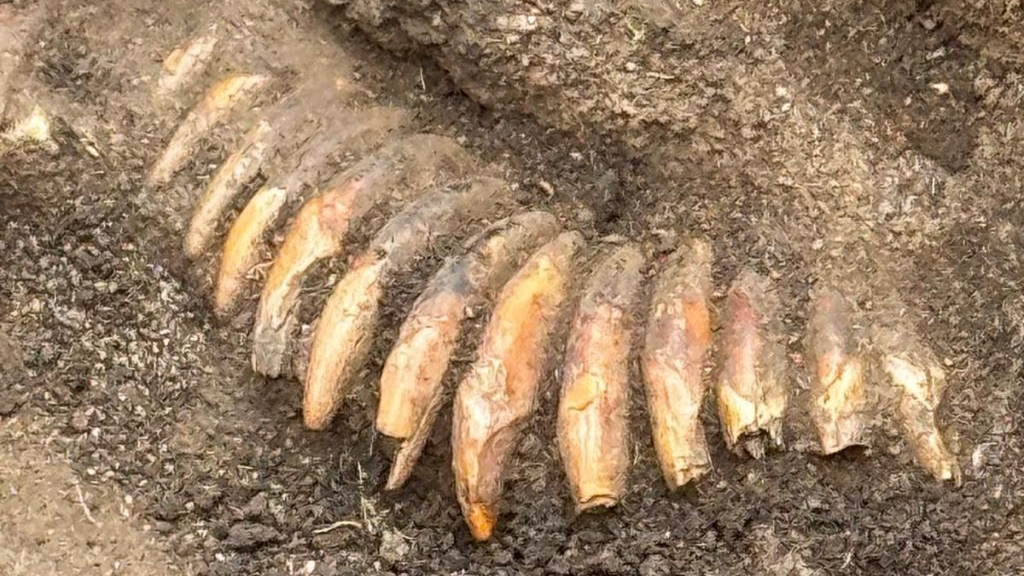
In a remarkable archaeological find near Wrocław, Poland, researchers unearthed a burial site that defies expectations. Originally thought to belong to the Roman period, the grave actually dates back to the Middle Neolithic, around 2900 B.C., making it over three millennia older. The adult male skeleton was interred with an array of intriguing artifacts, including two decapitated human heads, a necklace crafted from the teeth of large mammals, and a distinctive battle ax.
Excavation Insights
The discovery was serendipitous. As Paweł Dąbrowski, a biological anthropologist at Wrocław Medical University, recounted, "We were practically packing up when we discovered a circular shape in the ground and began to dig." This emphasizes a common theme in archaeology: significant finds often occur when expectations are least, urging researchers to remain vigilant even when the day's work seems to be concluding.
The excavation revealed a range of artifacts that can significantly enhance our understanding of Neolithic customs. Among them was a necklace made from carefully arranged animal teeth. This detail alone invites deeper investigation into the symbolism attached to animal remains in burial practices, particularly in a period characterized by evolving societal structures and emerging notions of identity.
Artifacts of Significance
The burial included additional notable items: amber beads and a flint blade alongside the ax, which is composed of serpentinite, a green-hued metamorphic rock. The variety suggests a complex relationship with local and exchange economies, indicating not just trade but potentially the movement of people and ideas. Dąbrowski has indicated that the funeral offerings, most notably the notable arrangement of animal teeth, suggest this individual may have held a position of importance, such as a clan leader or prominent hunter.
This idea of delineating social status based on burial goods isn't new. Similar findings in the region often see elite burials accompanied by weapons and valuable artifacts. This pattern hints at a society where warfare and hunting were vital to social standing—or perhaps revered roles. (And this is the part most people overlook.) Archaeologists must ask: What does being buried with these items tell us about the individual's life? Was this person a warrior, a skilled hunter, or someone with spiritual significance to the community?
Decapitated Heads: A Complicated Narrative
The presence of two human skulls complicates the narrative; these may represent decapitated heads interred as ceremonial offerings. The manner of their placement poses questions about ritual practices and societal norms surrounding death and reverence. Was this a marker of triumph over enemies, a tribute, or something else entirely? Further analysis will clarify their origins and the circumstances leading to their placement in the grave.
Understanding the significance of such burial practices can provide profound insights into early societal structures. Anthropological studies often suggest that rituals involving decapitation may signify a passage to another realm, but evidence can vary widely across cultures. The connection between such practices and the individual’s social status is an avenue for further investigation.
Cultural Context and Connections
This burial aligns with previously excavated elite graves nearby, which also featured weapons, tools, and ceremonial items. This pattern points to shared cultural practices, likely associated with the Corded Ware culture known for its influence across Europe and Asia. The Corded Ware culture, active during the late Neolithic, is characterized by its distinctive pottery and burial traditions, suggesting a significant shared identity among groups that adhered to these practices.
Such findings could imply that these communities were not simply isolated groups but rather participants in a broader network of trade and cultural exchange that spanned vast regions of Europe. This complexity paints a picture of societies that may have shared ideas about warfare, spirituality, and communal identity.
Future Implications: Unraveling the Past
Next steps include DNA analysis and other studies on both burials to determine familial connections and lifestyle insights from nearly 5,000 years ago. Dąbrowski anticipates initial findings to emerge later this year, shedding light on the lives of these early Europeans. This type of research could illuminate not just individual identities but group affiliations, offering a more nuanced understanding of how early humans interacted, lived, and died.
If you're working in this space or simply interested in prehistoric cultures, testing your knowledge of the Paleolithic, Mesolithic, and Neolithic periods can provide additional context. Take the Stone Age quiz to explore what you know. Knowing the foundational elements of these eras helps in understanding the significance of such finds and their implications on our historical narrative.
Discussion
Sign in to join the discussion.