James Webb Telescope observations unveil significant changes in Chariklo’s rings, challenging existing theories about small celestial bodies.
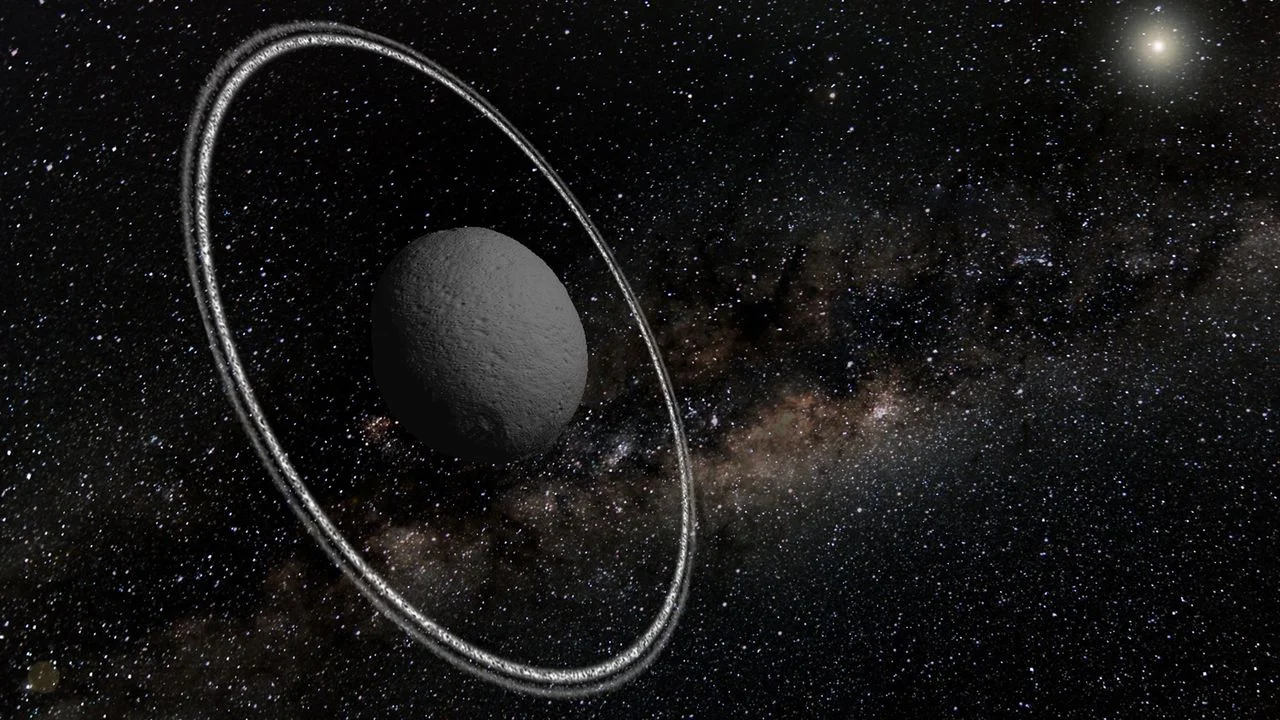
Recent observations from the James Webb Space Telescope (JWST) have shed light on the intriguing and dynamic characteristics of Chariklo, a centaur located between Saturn and Uranus. This small celestial body, measuring about 400 miles (250 kilometers) in diameter, is unique in that it exhibits features of both asteroids and comets. This dual nature makes Chariklo a fascinating subject for astronomers and planetary scientists alike. Its ability to show attributes reminiscent of both classes of celestial bodies can provide important insights into the formation and evolution of the Solar System.
Historic Discoveries and Initial Observations
Chariklo made history in 2013 when it became the first small solar system body discovered to possess rings. This revelation altered the long-standing perception of ring systems, traditionally associated only with larger planets. Subsequent studies using ground-based telescopes in 2014 and 2017 further examined its ring system, but the 2022 JWST findings have revealed notable transformations. According to researchers, these observations, detailed in a September 9 publication in the journal Science Advances, depict substantial changes over the past decade.
Comparative Analysis of Ring Changes
Comparative analysis of JWST data shows contrasting changes in Chariklo's two rings. "While the inner ring shows significantly higher opacity, the outer ring exhibits lower opacity," remarked Pablo Santos-Sanz, lead author and researcher at the Institute of Astrophysics of Andalusia. This discrepancy is intriguing and raises questions about the underlying causes of these alterations. It contrasts with what scientists typically expect from ring systems, where uniformity often prevails.
The study puts forth three hypotheses to explain these observed changes. The first suggests that JWST's enhanced resolution allowed scientists to detect variations in the density of ring materials. Higher resolution imaging can reveal subtle features that previous instruments might have missed. The second possibility involves alterations in the composition or the size of the ring particles themselves; a scenario that's not uncommon in celestial studies. Lastly, researchers propose that the differences in visibility could stem from "grains with wavelength-dependent optical properties," indicating that the telescope may have captured effects linked to particle size and material composition. This kind of detailed analysis could open new avenues for exploring ring dynamics, informing the understanding of how such structures form and evolve over time.
Redefining Stability and Formation Theories
Santos-Sanz expressed that these findings challenge existing notions regarding the stability of small bodies with rings. "Our results compel us to reconsider their formation, evolution, and the mechanisms that uphold their stability," he noted. These insights could reshape our understanding of ring systems, especially those not significantly influenced by nearby planets. This type of paradigm shift can have broader implications for astrophysics, considering that many celestial bodies exist in isolated regions of space, far from the gravitational influences of larger planets.
Future Observations and Opportunities
Looking ahead, the team anticipates that a future stellar occultation, when Chariklo passes in front of a star, will help validate JWST's findings—particularly regarding the changes in ring opacity. "Such observations would clarify the temporal changes and the wavelength-dependent scattering effects influencing Chariklo's rings," they predicted. This upcoming event offers a promising opportunity to enhance our understanding of Chariklo’s ring system by providing further empirical evidence.
A Noteworthy JWST Campaign
Chariklo's recent observations also represent a significant milestone for JWST. For the first time, scientists meticulously planned a viewing campaign targeting a stellar occultation—timing the observations to coincide precisely with the moment Chariklo obscured a distant star. This kind of forward-thinking planning underlines the growing sophistication of observational techniques available to astronomers.
All previously recorded observations of Chariklo's rings relied on the technique of stellar occultation, as the rings are too faint for direct imaging. By measuring variations in brightness as Chariklo transits in front of a star, astronomers glean critical information about these elusive structures. This method mirrors techniques employed to study exoplanet atmospheres using JWST’s advanced infrared capabilities, showcasing the versatility of the telescope's technology. The possibility of studying multiple celestial phenomena with a single instrument is a considerable advantage for researchers.
The relative speed of Chariklo during the observation was a manageable 1.5 miles per second (2.5 kilometers per second), allowing for enhanced imaging of the rings. The team utilized data from the European Space Agency's Gaia mission, which meticulously tracks the positions and movements of over 2 billion stars, to accurately time the occultation from JWST's vantage point, approximately 930,000 miles (1.5 million kilometers) away in the opposite direction of the sun. The execution of this mission demanded "extreme precision," according to the researchers. They orchestrated an intricate dance of timing, positioning, and observation that speaks to the heightened levels of strategy required in modern astronomical research.
Implications and Significance of the Findings
This discussion of Chariklo is more significant than it looks; it’s a manifestation of advanced astronomical capabilities and our growing understanding of celestial mechanics. If you're working in this space, consider how these findings could influence broader studies of planetary formation and evolution, as well as how other celestial bodies interact. The dynamics of ring systems have often been attributed to the immediate gravitational effects of nearby planets. However, Chariklo's characteristics call traditional models into question. The implications could stretch beyond just this centaur, prompting a re-evaluation of ring systems across various types of small bodies in the Solar System.
And this is the part most people overlook: the potential for these findings to lead to new discoveries, not just about Chariklo, but about the nature of rings and their stability throughout the cosmos. The interest in Chariklo may encourage further observational campaigns, driving a cycle of inquiry and discovery that adds layers to our understanding of the universe.
Discussion
Sign in to join the discussion.