Leading mathematicians voice concerns over OpenAI's recent claim to solve the Navier-Stokes problem, highlighting ethical implications and future challenges.
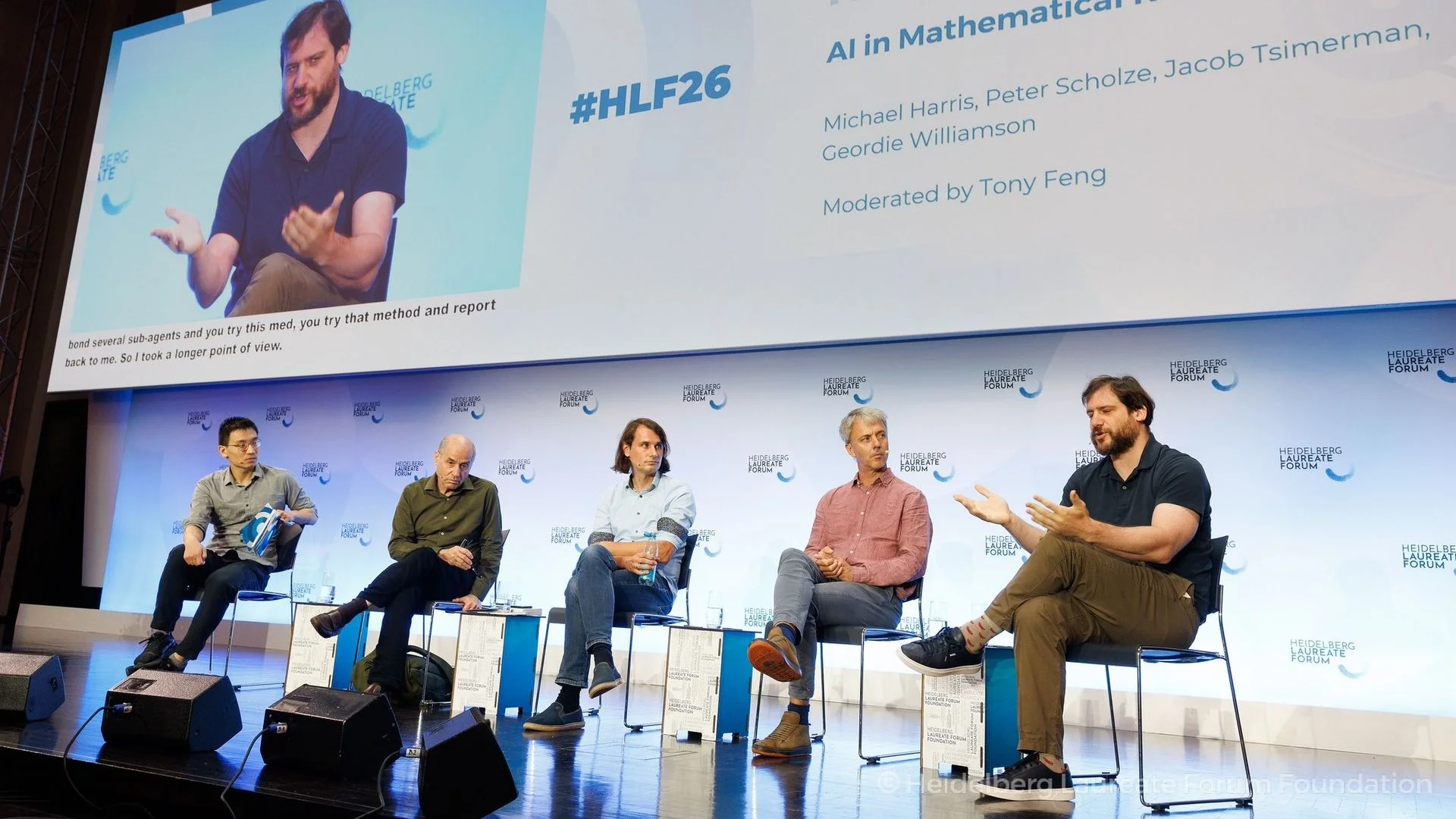
HEIDELBERG, Germany — The mathematics community is grappling with disruption as AI technologies rapidly evolve, often causing controversy. This tension came to a head at the Heidelberg Laureate Forum, where a panel of renowned mathematicians addressed the implications of AI's encroachment into their field.
The Rise of AI in Solving Mathematical Problems
AI's capability to tackle complex mathematical problems has surged over the past year, with systems assisting in resolving numerous issues raised by influential mathematician Paul Erdős and achieving publishable doctoral-level research. This represents a significant shift in how mathematical inquiries can be approached. Traditionally, solving such intricate problems required years of human effort, mental gymnastics, and deep intuition. Now, AI can sift through existing research, simulate scenarios, and propose solutions with remarkable speed and efficiency. Notably, two proofs previously awarded the Fields Medal have been independently verified by AI, while progress has been made on several other longstanding mathematical challenges.
The Controversy Over OpenAI's Claims
The conversation intensified following OpenAI's announcement on September 8, which claimed that a team of 10,000 AI agents had tackled the Navier-Stokes existence-and-smoothness problem. This problem is one of seven Millennium Prize Problems outlined by the Clay Mathematics Institute in 2000, each carrying a reward of $1 million for solutions. To date, only the Poincaré conjecture has been satisfactorily resolved. The significance of the Navier-Stokes problem can’t be understated; it’s fundamental to fluid dynamics and has far-reaching implications in physics and engineering.
Mathematicians Tristan Buckmaster and Levent Alpöge contested OpenAI's claims, asserting they had been researching the Navier-Stokes problem for nearly a year prior. They alleged that OpenAI had learned about their findings and acted swiftly to claim credit, with rumors of intimidation surrounding their decision to go public. This conflict raises questions about authorship, credit, and the ethical implications of using AI, particularly when human researchers believe they’ve been overlooked. In a field where reputation can define a career, the stakes are incredibly high.
Concerns Over Ethical Practices in AI Development
During the forum's discussions, panelist Michael Harris, a mathematics professor at Columbia University, described OpenAI's actions as akin to "predatory behavior" reminiscent of historical territorial conquests. His sharp criticism points to broader concerns within the mathematics community regarding the unchecked power of large tech firms and their impact on academic integrity. Harris emphasized that the current state of affairs poses no legal barriers that would prevent such practices in the mathematical community. This isn’t just an academic issue; it’s a pressing ethical dilemma that needs scrutiny.
He expressed concern over OpenAI’s approach, labeling major tech firms involved in AI as "gangsters" and advocating for regulatory frameworks to protect the integrity of mathematics and mathematicians. This perspective resonated with another panelist, Geordie Williamson from the University of Sydney. Yet, the question remains: how do we regulate creativity in a field that thrives on originality?
The AI-Driven Future of Research
However, Jacob Tsimerman, a 2026 Fields Medalist and AI safety researcher who recently joined OpenAI, highlighted the significant achievement of AI in resolving a Millennium Prize Problem, suggesting it ought to inform discussions on AI's capabilities. Tsimerman's viewpoint presents a dichotomy; he believes the announcement marks a turning point for mathematical research, suggesting a shift in focus from traditional expert-driven inquiry to a culture where new mathematics is increasingly produced by AI systems. This could represent a fundamental rewiring of how we view expertise. If you're working in this space, you’ll have to ask whether AI is enriching or diminishing human input.
He argued that while there may be cherished values in human-led research, the advancements obtained from AI could herald a new era. It's not about replacing human mathematicians but augmenting their capabilities. Here’s the thing: the workforce could soon find AI as a collaborator rather than a competitor.
By contrast, Peter Scholze, co-director of the Max Planck Institute for Mathematics and a Fields Medal recipient, dismissed the announcement as mere publicity. Scholze maintains that the essence of addressing the Millennium Prize Problems lies in fostering deeper understanding through human insight rather than through lengthy machine-generated proofs. This sentiment reflects a larger tension between embracing these new tools and clinging to traditional values that prioritize human understanding over machine efficiency. He pointed out the limitations of AI in truly grasping the nuances of mathematical progress, underscoring that intuition often plays a vital role in mathematical discovery.
Preserving the Human Element in Mathematics
In discussing the future of mathematics, several initiatives have arisen to maintain the human element in the discipline. Programs like Proofs and Prompts and the Association for Human Mathematics are working to preserve the culture and understanding inherent in mathematical research amid rapid technological change. These efforts illustrate a commitment to ensuring that while AI can serve as a tool, the human intuition that drives mathematical investigation remains paramount.
Looking Ahead: Uncertain Futures
Despite these efforts, uncertainty looms over the future of mathematics as it adapts to these newfound challenges. Tsimerman candidly remarked, "It’s hard to envision what the world will look like in just a few years," highlighting the unpredictable trajectory of both mathematics and AI. The complexities involved in intertwining these fields pose philosophical and practical challenges that mathematicians must navigate thoughtfully.
The panelists left the forum without clear predictions, but one thing is certain: the intersection of human mathematical inquiry and AI technology is poised to spark ongoing debates about the discipline's integrity and direction. As AI continues to evolve, mathematicians will have to determine their approach to these developments—whether to embrace collaboration or draw boundaries in a field where both creativity and accountability are essential.
Discussion
Sign in to join the discussion.