A physics-based imaging method uncovered 51 Eridani b in JWST observations, offering astronomers a way to search for fainter, more familiar worlds.
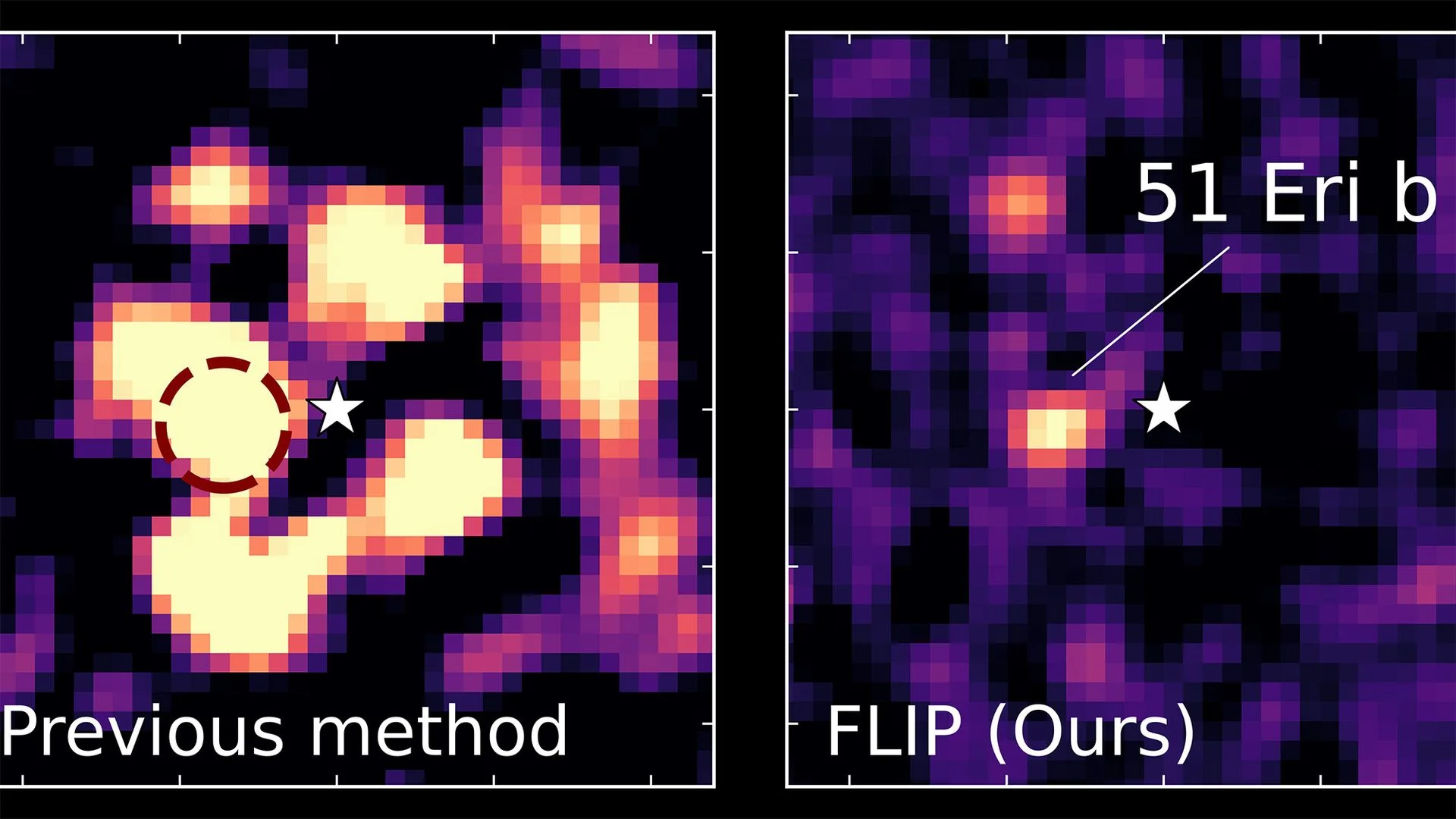
Recovering a planet from a telescope’s glare may depend as much on modeling the instrument as on blocking starlight. A Northwestern University team used a physics-based method called FLIP to bring the giant exoplanet 51 Eridani b into view in James Webb Space Telescope data, where earlier JWST observations had missed it. The work points to a less visible part of exoplanet imaging: a telescope doesn’t simply collect a scene. Its optics, detectors and small movements all shape the image that astronomers have to interpret.
The findings were published Nov. 4 in Nature. The result points to a practical obstacle in direct imaging: even after a telescope suppresses much of a star’s light, small imperfections in the instrument’s view can bury a planet. In this case, the obstacle wasn’t a lack of telescope sensitivity in isolation. It was the difficulty of distinguishing a faint planet from residual starlight and artifacts in the recorded data.
That distinction matters because direct imaging asks astronomers to find a comparatively dim object close to a far brighter one. A successful observation depends on both the hardware that controls incoming light and the methods used to make sense of what reaches the detector. Better interpretation can’t replace a coronagraph, but it may help researchers extract more from data the telescope has already collected.
Modeling the telescope to find the planet
Coronagraphs, which block a star’s central glare, help JWST capture faint objects nearby. But they cannot remove all the light, and the telescope shifts slightly as it observes. Those tiny movements create mismatches between a model of the image and what the detectors record—enough to hide even a large planet. The remaining glare can change in ways that complicate the search: an image-processing method has to separate the planet’s signal from both the star and the telescope’s own behavior.
To account for those effects, the researchers built a “digital twin” that simulates how light moves through JWST’s detectors without movement-based imperfections. They refined the replica with physics-based computational models and machine learning, then named the approach Physics-based Learning for Imaging Planets, or FLIP. The idea is to compare actual observations against an informed account of how the instrument should behave, making it easier to identify what doesn’t fit the expected pattern.
A digital twin is useful here because the instrument is part of the measurement. If a telescope’s small shifts change the image, a model that ignores those shifts can mistake instrumental structure for the sky—or fail to recognize a real object hidden among that structure. FLIP’s physics-based starting point gives the researchers a way to account for known behavior before using machine learning to refine the model. That’s a different role from asking a system to identify a planet with no physical account of the image behind it.
The team emphasized that FLIP isn’t an AI model. “Because we already know the physics, we don't need AI to understand what's happening,” study co-author Jason Wang, an astrophysicist at Northwestern, said in a statement. First author Rodrigo Ferrer-Chavez, also at Northwestern, described the underlying challenge: “Planets are a million times fainter than their stars. So, to image exoplanets, we need to remove that glare.” The distinction is useful, though the method still includes machine learning: its value lies in combining that tool with a model grounded in the instrument’s physical behavior.
A test case with broader reach
Researchers applied FLIP to observations of three stars, including 51 Eridani, about 97 light-years from Earth. Ground-based telescopes had previously detected the system’s giant planet, 51 Eridani b, but the planet had remained obscured in earlier JWST data. FLIP recovered it from those observations. The recovery shows that a planet missed in one analysis of telescope data may still be present in the recorded signal, if the instrument’s effects can be modeled well enough to reveal it.
The result is a demonstration on a known planet, which gives astronomers a concrete way to assess the method. It doesn’t, by itself, establish how often FLIP will recover previously unseen planets or how well it will work in every observing situation. Those questions depend on further applications and on the kinds of data available. Still, finding a known object that had been missed in earlier JWST observations is a meaningful test of whether the approach can improve the reading of challenging images.
The method could help astronomers find planets that current surveys tend to miss. Nearly 35 years of exoplanet discoveries have yielded many worlds unlike those in our solar system, in part because large, reflective planets are easier to detect. Smaller or less reflective planets may be harder to see with existing techniques. That selection effect shapes what scientists know: the planets that show up most readily in surveys don’t necessarily represent the full range of worlds that exist.
Ferrer-Chavez put the gap plainly: “It's not that [solar-system-like planets] don't exist. It's that we can't see them.” FLIP offers a way to address that visibility problem by accounting for how the telescope itself shapes the data. The planet was there in the observations. Hard to distinguish.
What better image modeling could change
This is more significant than it looks: progress in exoplanet imaging may come from improving the interpretation of existing observations as well as from building new instruments. Direct imaging is constrained by the contrast between a star and a nearby planet, and a telescope’s residual glare can obscure the very signal researchers want to isolate. A method that better describes those effects could make some data more informative, especially when the target is faint or close to its star.
That said, recovering a giant planet doesn’t establish that the same method will make small, dim planets easy to detect. Those targets present a harder visibility problem, and the source doesn’t say FLIP has already solved it. The broader value is that the technique offers a way to test whether instrument modeling can reduce one source of missed detections. Its reach will depend on how it performs across additional observations and targets.
If you're working in this space, the practical question is whether the method can be applied consistently to data beyond this test case. A useful analysis tool must do more than reproduce a result already known from another telescope; it must help researchers identify credible signals while accounting for the instrument’s quirks. FLIP has shown a route toward that goal. How far that route extends remains an empirical question.
(And this is the part most people overlook.) Astronomers don’t observe a planet in isolation; they observe light after it has passed through a complex instrument and been recorded by detectors. Modeling that chain can determine what becomes visible in the final data. For exoplanet research, improving the account of the telescope may help expand the set of planets scientists can study, even before the telescope itself changes.
Discussion
Sign in to join the discussion.