A 2,600-year-old black ceramic rooster doubles as a writing lesson, with the Etruscan alphabet carved around its belly and one letter carved wrong.
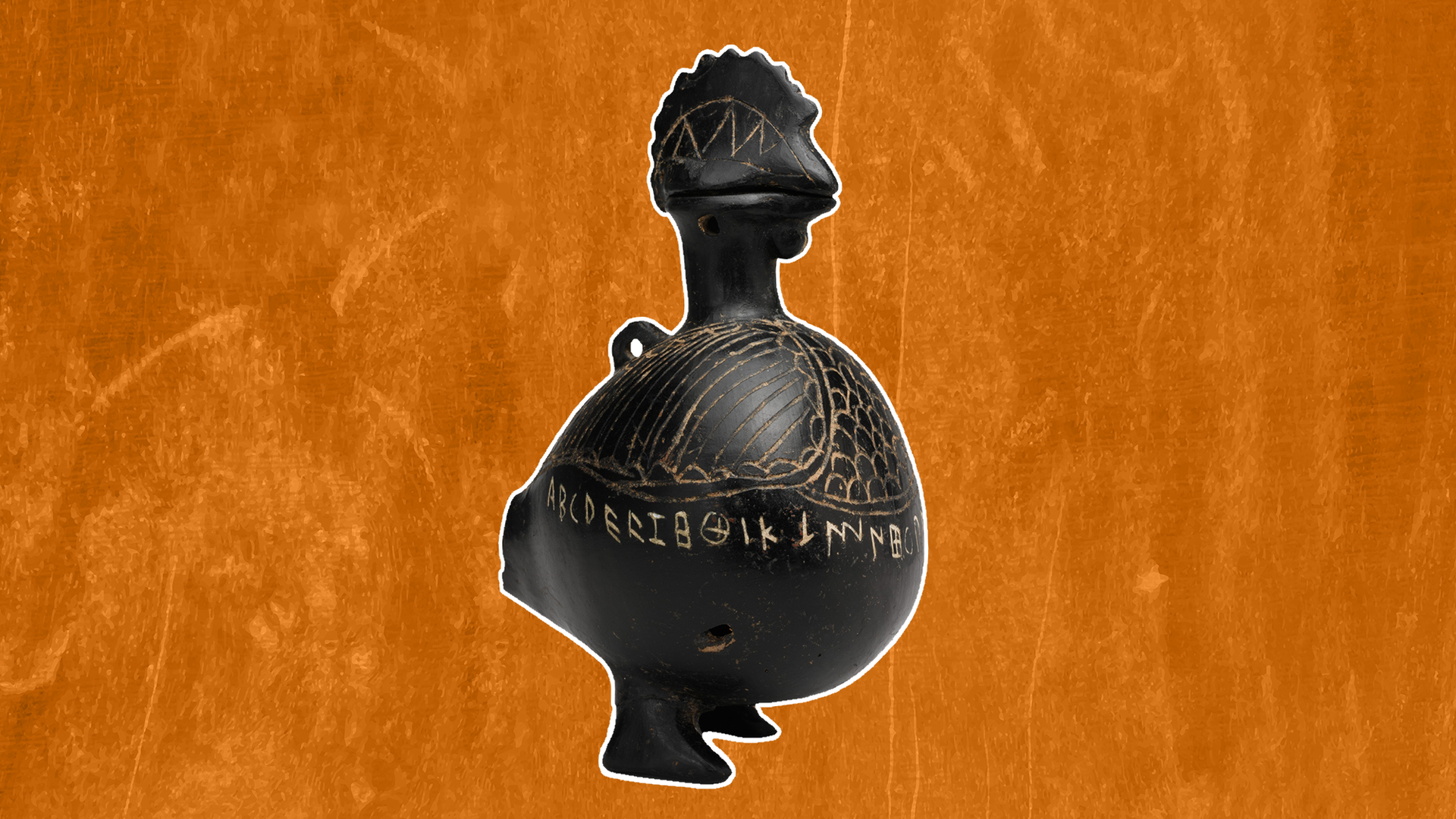
Most ancient inkwells don't come with a lesson plan. This one does. A small black-glazed rooster, made by the Etruscans roughly 2,600 years ago, has the alphabet running around its belly, and that makes it one of the more useful objects for researchers still working on a language no one speaks anymore.
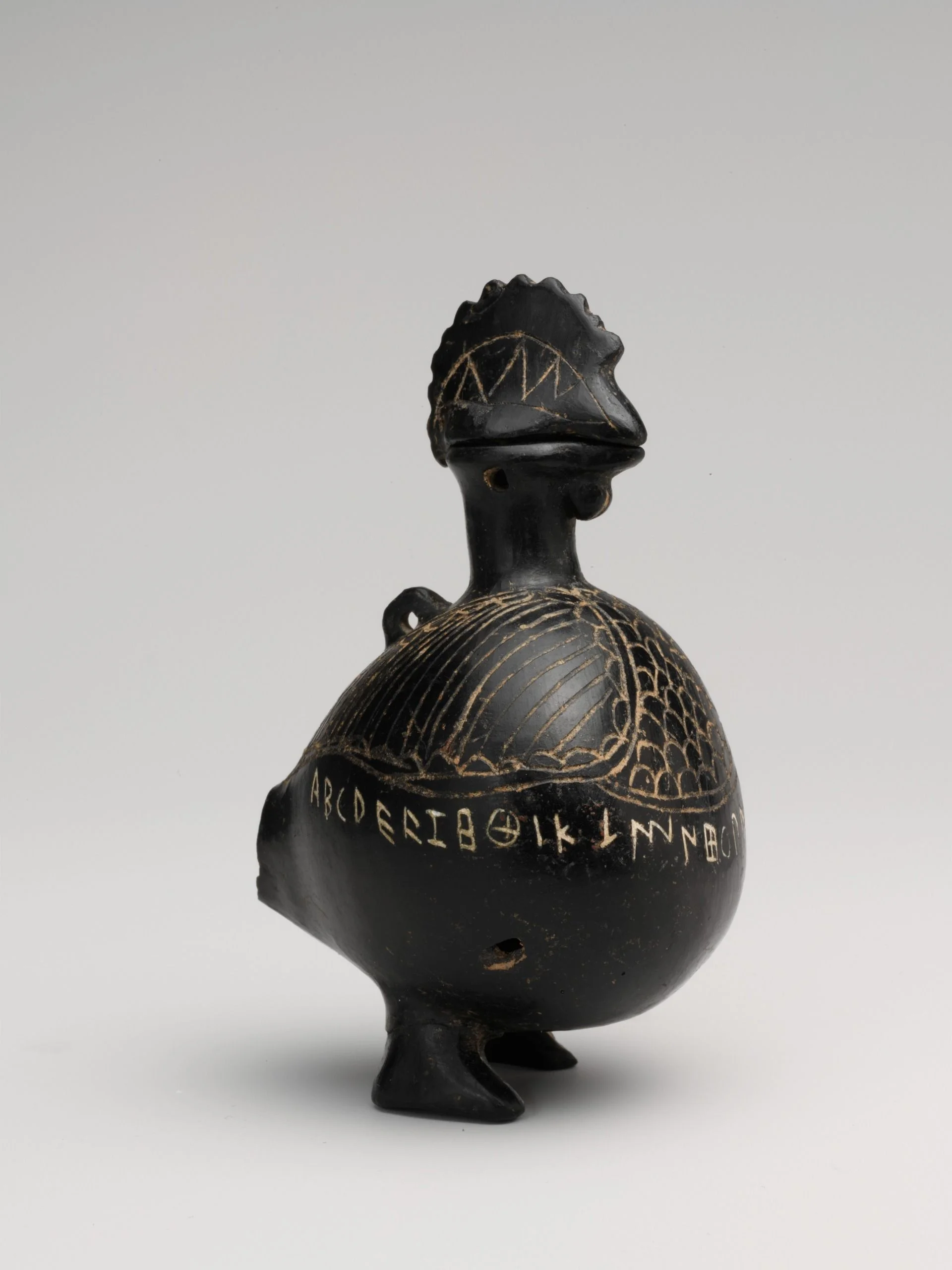
A rooster built for practice
The vase stands just over 4 inches (10 centimeters) tall. It shows a cockerel, or young male chicken, with human feet, and it came out of central Italy. That's small enough to sit on a desk, and the scale is part of the story. Anyone copying letters from this object would have had the whole alphabet within arm's reach, which is a very different experience from squinting at a wall chart. Its exact find spot is unknown, but it may have come from a grave in one of the many cemeteries around Viterbo, once an Etruscan town about 50 miles (80 kilometers) northwest of modern Rome. Today it sits in the Metropolitan Museum of Art in New York. Not knowing where it was dug up is a real loss, since context often tells you as much as the object does.
The glossy black surface is bucchero, the signature Etruscan ceramic. Potters fired it in a way that starved the kiln of oxygen, so the clay absorbed carbon and turned black. That's a finicky process, and it's one reason the finish looks so uniform even after two and a half millennia. Bucchero was produced from the seventh to the fourth centuries B.C., and it's the material most people picture when they think of Etruscan pottery. Objects in this category often turn up in burial contexts, which helps explain why so many examples have survived in good condition. (And this is the part most people overlook: the glaze that makes the vase look so polished is also what makes the lettering stand out so clearly.)
According to The Met, the piece was probably a portable inkwell for an Etruscan learning to write. The head served as the stopper and hung loosely from the body on a cord threaded through a set of loops. The text around the belly is an abecedarium, a sequential run of letters, the classroom staple of any alphabet. Notice the word "probably." Museum attributions like this are interpretations built from shape, function, and comparison with similar objects, not confessions from the people who made them. I'm comfortable with the reading, but I'd still treat it as a strong hypothesis rather than settled fact.
One letter in the wrong place
The Etruscans adopted their alphabet from a regional version of the Greek alphabet in the early eighth century B.C. Alphabets usually spread through contact and trade, and each community tends to adjust the letter forms and sometimes the sequence to suit its own speech. It had 26 letters, and this vase preserves nearly all of them in order. Here's the thing, though: it contains a mistake. Near the end, someone carved an S twice. The second one should be an X, The Met notes. That slip is a small human moment, a student or teacher getting a letter wrong, and it's more useful to researchers than a perfect copy would be. A flawless inscription would tell you what the alphabet was supposed to look like. A flawed one tells you how it was actually taught and learned, with all the shortcuts and confusions that come with a real classroom.
Archaeologist Gisela Richter drew attention to the object in a 1930 catalog of The Met's classical holdings. Catalogs like this one were, and still are, a place where curators record their working interpretations, so they matter as a paper trail. The vase, along with several other Etruscan artifacts, helped experts piece together the language by preserving the order of letters in the early alphabet. It's a modest contribution on paper, but sequence is the kind of basic fact that everything else depends on.
Sounding out is the easy part
Because the Etruscans borrowed the Greek script, the sound of each letter is largely settled. Reading the Etruscan language aloud is possible. Knowing what the words mean is another matter. Think of it like learning to pronounce a sentence in a language you've never heard, then discovering you have no dictionary. More than 10,000 Etruscan inscriptions have been found, but most are short, and any longer Etruscan literature that once existed has been lost. That imbalance is the core problem. You can read a tombstone's name and perhaps a formula, but you can't follow an argument or a story.
That gap is why a rooster-shaped teaching aid still matters. Each abecedarium fixes a letter's position in the sequence, and every new find gives scholars another anchor to test against the words they still can't translate. Short, repetitive texts like this one are unglamorous, but they're where the grammar of decoding gets checked. If a reading of a word requires a letter in a particular place, an abecedarium is one of the few artifacts that can confirm or challenge it.
What a rooster tells us about the bigger picture
It would be easy to oversell a single vase. This one doesn't unlock the Etruscan language by itself, and no one serious about the field would claim otherwise. Still, its value is more than decorative. Objects like it show how literacy was taught, handled, and displayed in a society whose written output is so thin that every fragment counts. That's a useful reminder for anyone working with partial archives, whether they're studying ancient scripts or mining a messy corpus of modern documents.
If you're working in this space, the practical lesson is about evidence hierarchy. Short, mundane texts often carry more reliable linguistic information than rare, elaborate ones, because they're less likely to be stylized or copied from elsewhere. The misspelled S is a good example. It's a small, unglamorous detail, and it may be the most honest thing on the vase. Expect progress in this field to come from incremental finds and careful cross-checking rather than a single breakthrough, and be skeptical of any headline that promises otherwise.
Discussion
Sign in to join the discussion.