Astronomers propose gravitational lensing might explain an exceptional black hole merger, illuminating new pathways for cosmic investigation.
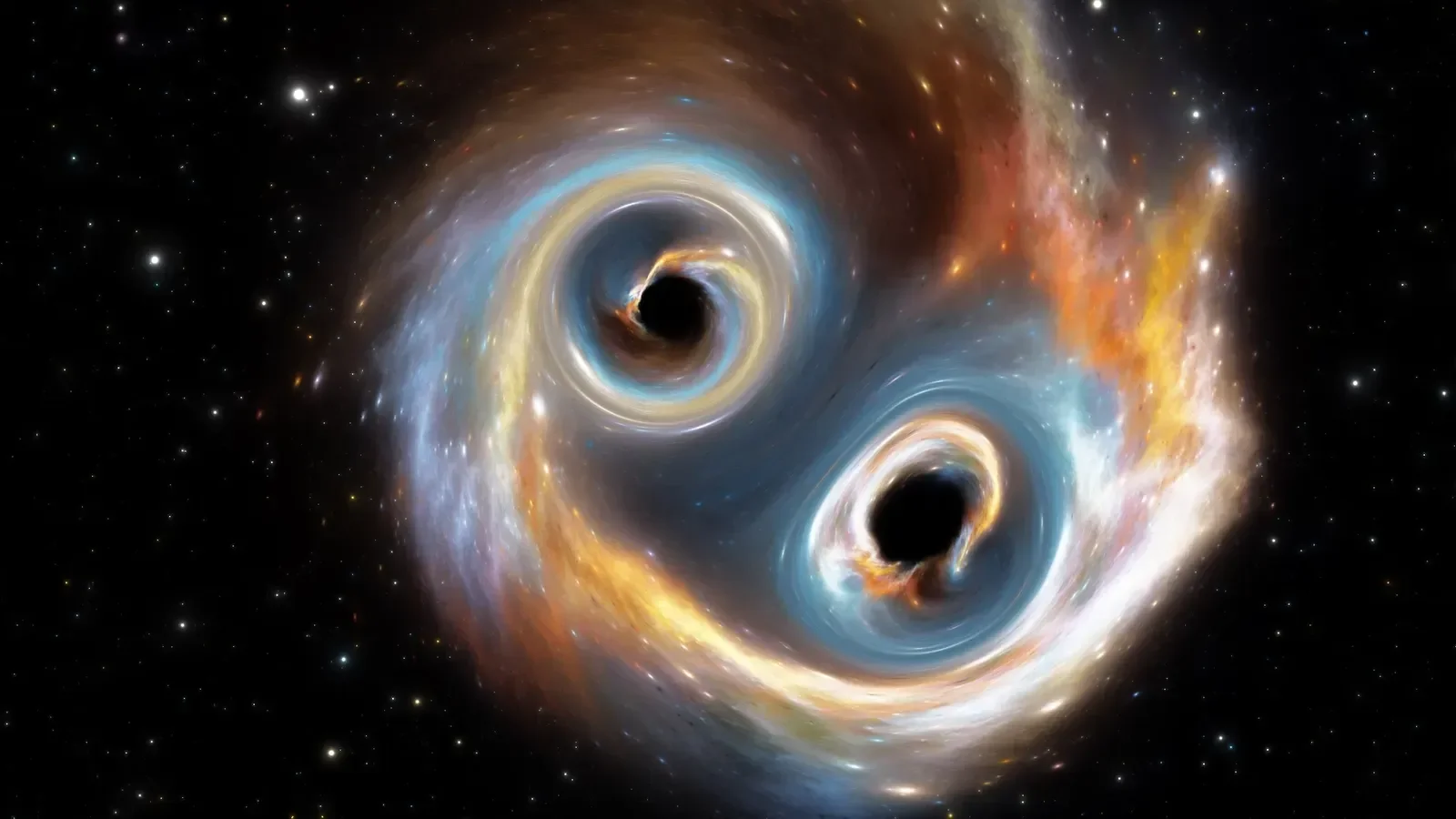
A puzzling black hole merger's mystery may be rooted in a unique variation of space-time phenomenon, reshaping our understanding of gravitational interactions. Recent findings hint that gravitational lensing might provide clarity on why this merger has left astronomers scratching their heads for years.
On November 23, 2023, the Laser Interferometer Gravitational-Wave Observatory (LIGO) recorded an extraordinary set of gravitational waves. These waves, which emanate from some of the universe's most immense events—like supernovae and rapidly rotating neutron stars—originated from a remarkable physical interaction involving two black holes situated roughly 2 billion light-years away from Earth. This event, known as GW231123, captured significant attention due to its classification as the most massive black hole merger on record.
The merger involved two progenitor black holes, weighing in at 100 and 130 solar masses respectively, leading to a newly formed singularity with an estimated mass around 230 times that of our sun. However, this poses a substantial challenge to existing astrophysical models, as the parent black holes lie within a "mass gap"—their sizes do not fit neatly into our current frameworks of stellar evolution or black hole formation.
These anomalies sparked various hypotheses, including one suggesting that these black holes might result from the collapse of even larger stars that should have exploded as supernovas. However, this notion contradicts previous observations, raising further questions about these ‘forbidden’ mass ranges.
Potential Explanation Through Gravitational Lensing
A study published on August 25 in The Astrophysical Journal Letters posits an alternate explanation. The researchers propose that the signal from GW231123 was potentially distorted by gravitational lensing—an effect that occurs when the gravity of massive foreground objects warps the fabric of space-time, impacting the pathways of distant gravitational wave emissions.
Historically, gravitational lensing has been observed bending visible light from distant celestial bodies, leading to stunning patterns such as Einstein rings. However, until recently, there was no evidence suggesting that a similar phenomenon could impact gravitational waves.
According to study co-author Miguel Zumalacárregui, an astrophysicist at the Max Planck Institute for Gravitational Physics in Germany, "Just like light, gravitational waves can also experience deflection and magnification from massive objects." He highlights the potential for these lensing effects to help us analyze and understand complex signals.
Gravitational lensing, first articulated through Albert Einstein's theory of general relativity in 1915, describes how gravity influences the spatial structure within its vicinity. If an object lies between Earth and a distant source, light from that source can be warped, leading to magnified or split signals. This model holds significant promise for astronomical research, especially in weighing lensing objects and uncovering properties of dark matter.
In their detailed simulations, the researchers indicate that the GW231123 signal might have been enhanced by an intervening object with a mass between 190 to 850 solar masses, or perhaps by a nearby extended structure like a globular cluster. This interpretation recalibrates the estimated post-merger black hole mass down to approximately 140 solar masses, allowing the original black holes to sit outside the problematic mass gap.
Emerging Questions
However, while the implications of gravitational lensing could resolve the GW231123 mystery, they simultaneously create new inquiries. A core question remains: what entity caused the lensing effect? Typically, significant cosmic structures like entire galaxies act as lenses; however, this case seems to suggest a need for something considerably smaller, prompting a search for compact objects or clusters in the area.
"Identifying the nature of this lens is a crucial aspect of our analysis," Zumalacárregui notes. "Finding individual compact lenses (with masses of 100 to 1,000 solar masses) should be exceedingly rare." The research team is adamant that future investigations must focus on whether these types of lensing objects can actually exist or if a collection of lighter objects could shed light on this cosmic riddle.
If further validations strengthen the gravitational lensing hypothesis, it could dramatically enhance our observational capabilities, enabling studies of ancient cosmic events—including black hole mergers that are otherwise beyond reach. Such discoveries might even redefine our approach to understanding dark matter through the patterns produced by gravitational wave diffraction.
Discussion
Sign in to join the discussion.