The CHIME telescope has successfully mapped ancient hydrogen gas independently, offering new insights into dark energy and the universe's expansion.
New Frontiers in Cosmic Mapping
Researchers have gained a significant advantage in studying the universe's accelerating expansion with a Canadian telescope, the Canadian Hydrogen Intensity Mapping Experiment (CHIME). For the first time, CHIME has independently mapped the distribution of hydrogen gas, relying solely on its own data, which culminated after seven years of meticulous effort. This achievement marks a notable advancement in astrophysics, as hydrogen mapping plays a key role in understanding cosmic evolution. By observing hydrogen, scientists can unlock secrets about the density and distribution of matter in the universe, enabling a clearer picture of how galaxies form and evolve.
Insights into Dark Energy
Published on September 28 in The Astrophysical Journal, the findings suggest that CHIME could offer a cost-effective method for exploring dark energy, the enigmatic force propelling the universe’s expansion. Dark energy remains one of the most perplexing aspects of modern cosmology. While it is known to drive galaxies apart at an accelerating rate, its nature and implications for the universe's fate are still poorly understood. The ability to measure hydrogen emissions opens doors to understanding the structure and dynamics of cosmic evolution, as it enables researchers to map expansions with greater precision than previously possible.
The Role of Hydrogen in Cosmic Structures
“Hydrogen is the most abundant element in the universe and serves as the foundational material for star formation,” explained Arnab Chakraborty, a postdoctoral fellow at the University of Toronto and co-author of the study. He highlighted how hydrogen's faint radio emissions can act as cosmic markers that help researchers trace matter distribution throughout space. By focusing on hydrogen, CHIME is not just cataloging elements; it's offering a deeper narrative about the universe's formative processes. This has ramifications for how we understand the lifecycle of stars and the intricate web of galaxies.
Operational Breakthroughs with CHIME
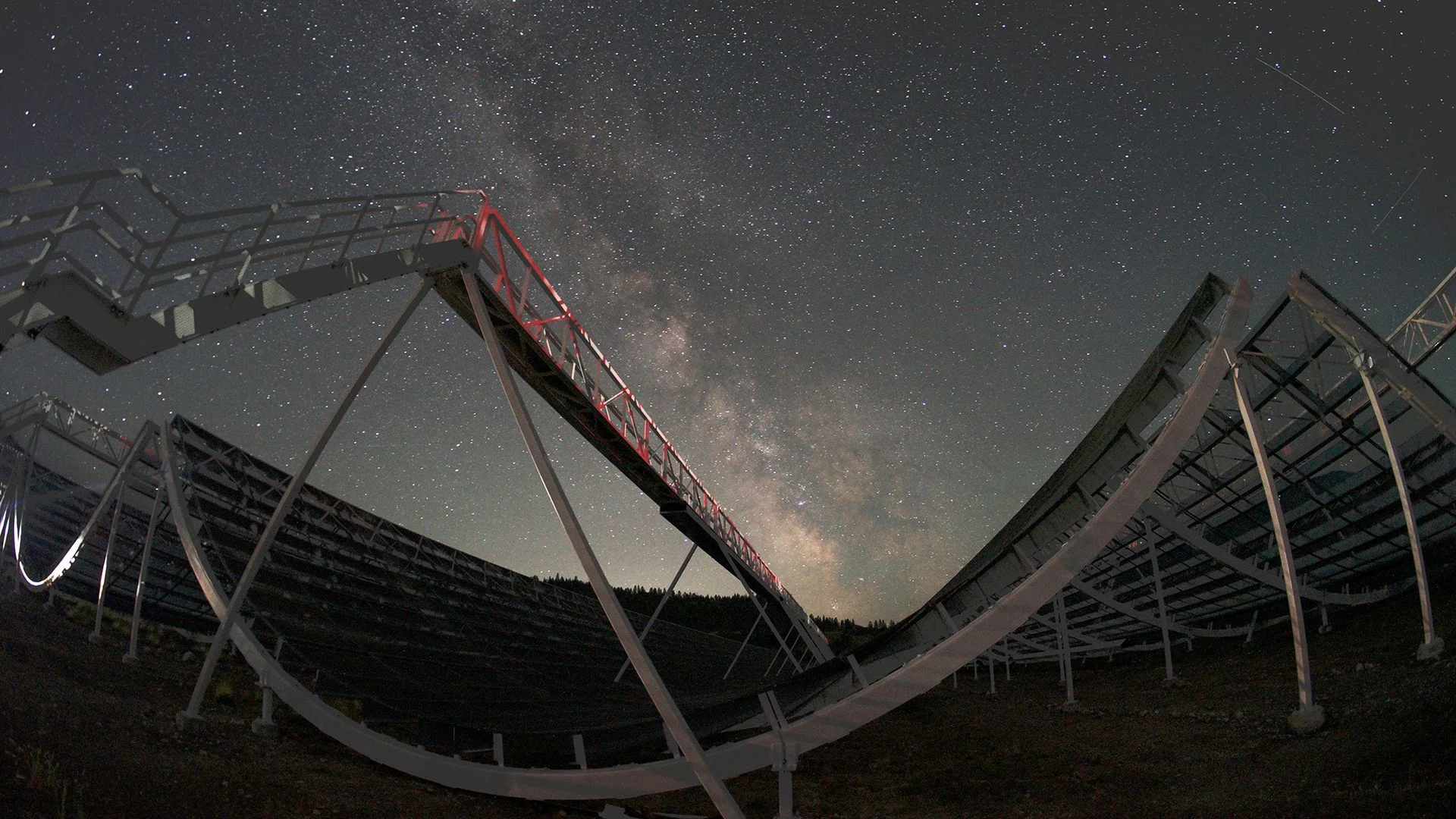
Positioned near Penticton, British Columbia, CHIME consists of a network of radio telescopes that daily map the northern sky. Previously, CHIME's findings required confirmation through data from other telescopes, which was often a lengthy and costly undertaking. That said, the facility's independent observations provide a significant time-saving advantage that can lead to faster discoveries. By capturing its own observations of ancient hydrogen, CHIME has established a reliable independent measurement source. This operational breakthrough allows researchers to pursue projects that would have been prohibitively expensive or cumbersome due to the interdependence on multiple data sets.
Data Behind the Discovery
The paper’s conclusions are grounded in 94 nights of observations collected in 2019, each thoroughly validated before publication. With the capacity to detect signals from as far back as 3 billion years post-Big Bang, CHIME provides a unique window into the early universe. This extensive observational data may show how the universe's expansion has evolved, revealing correlations between hydrogen density and cosmic structures. Furthermore, the findings could enable theories that link cosmic phenomena with dark energy, broadening the scope of current astrophysical models.
Confidence and Collaboration
“We worked hard to ensure that what we were detecting wasn’t just noise,” added Chakraborty. “The consistent signal confirmed that we were observing real hydrogen from the distant cosmos.” The rigorous validation process involved across multiple data parameters highlights the collaborative nature of modern astrophysics, where peer verification is essential for credibility. Achieving confidence in one's findings is paramount in a field often clouded by instrumental noise and data variability.
Future Directions
An accompanying study in The Astrophysical Journal details the prevalence of hydrogen types in the universe, suggesting that around 2% exists as "neutrally atomic," which corroborates data from other telescopes, according to co-author Shabbir Shaikh from Arizona State University. This sort of corroborative finding serves as an anchor for a discipline that thrives on precision and repeatability. Investigating hydrogen's distribution across cosmic history may provide vital clues about the universe’s expansion. What this means for you, especially if you're working in this space, is that the groundwork is being laid for new models that could redefine our approaches to cosmic phenomena.
The CHIME team plans to analyze its additional seven years of observational data to enhance understanding of hydrogen’s role in cosmic phenomena. With such a treasure trove of information on the horizon, we might expect new theories that not only question existing paradigms but could also reshape how we think about the universe itself. (And this is the part most people overlook.) As the project matures, it could also pave the way for future telescopes to refine and expand upon CHIME’s pioneering methodologies, continuing the quest for knowledge in the vastness of space.
Implications and Future Outlook
This research opens up innovative pathways in astrophysical studies. The implications of CHIME's findings might stretch into fields beyond astronomy, including materials science and technology development. For instance, understanding gas dynamics on a cosmic scale could influence advancements in energy sources or climate science. While the excitement among the scientific community is palpable, skepticism should also be applied as conclusions drawn from initial findings could lead to misinterpretations without further comprehensive analysis. The future is bright for CHIME and its potential contributions to our understanding of not just the universe but also fundamental physics. The next steps in this journey demand not only enthusiasm but also careful consideration of how discoveries align with or challenge established scientific knowledge.
Discussion
Sign in to join the discussion.