CT scans of Jeremy Bentham's preserved head show missing teeth and advanced jaw arthritis, shedding light on the pain he lived with before his death in 1832.
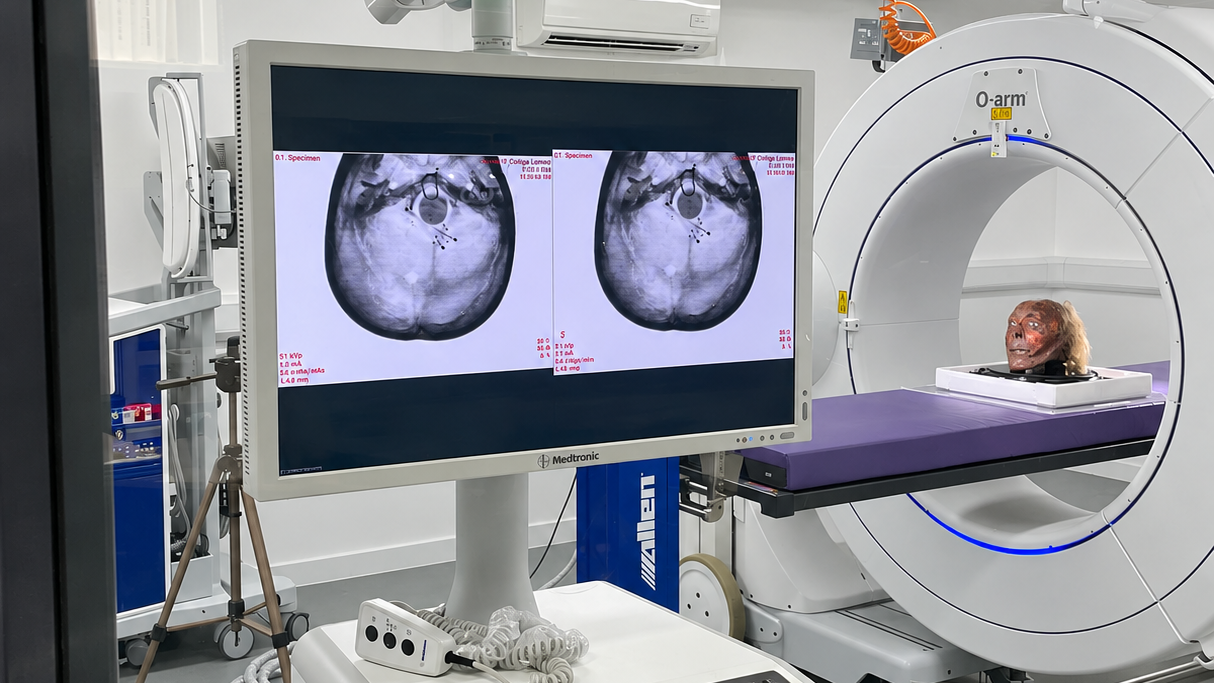
Jeremy Bentham's head has become an unlikely source of medical history. CT scans of the preserved head show a man who had lost many of his teeth and lived with advanced arthritis in his lower jaw. Bentham, the philosopher who called himself an "unbeliever" and was called "godless" by his critics, was probably in real pain for much of his later life.
The scans were made with CT (computed tomography) equipment, which produced a digital 3D model of the head. The project was tied to University College London's 200th anniversary, and it gave the university a way to put Bentham's long presence on campus under a new kind of scrutiny.
Bentham died of natural causes at 84, and the scans show what his mouth and jaw looked like near the end. Tannis Davidson, curator of UCL's Grant Museum of Zoology and the project's leader, saw how thin the jawbone had become. "He must have been in excruciating pain," she said.
Bentham's utilitarian philosophy helped shape UCL itself. The institution was founded as London University in 1826 and opened to students in 1828, making it the third university in England after Oxford and Cambridge.
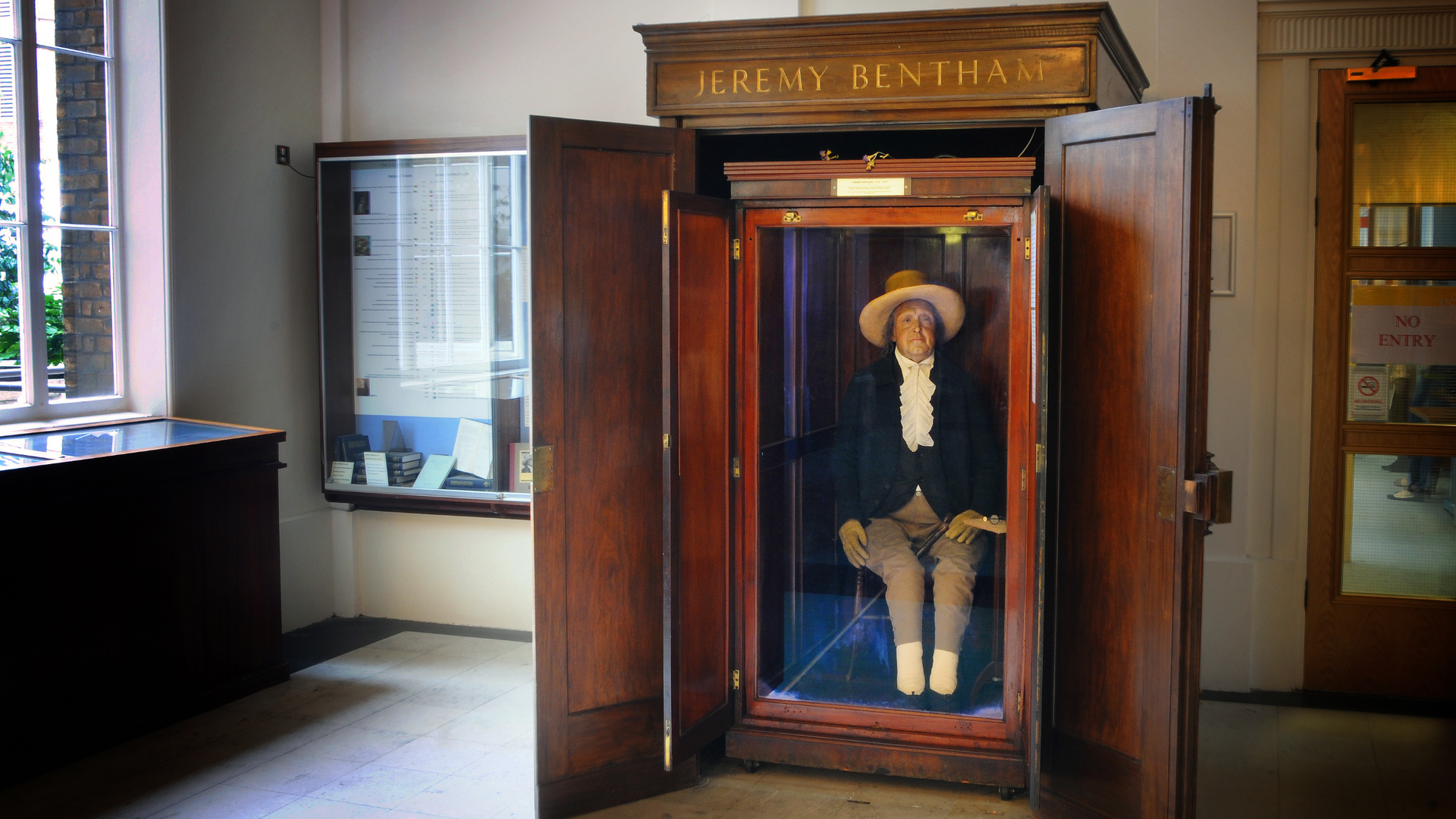
Bentham's afterlife plan was the more radical part. As a young man, he said he would donate his body to science. In Britain at the time, dissection was viewed with suspicion even when it served research, and it was mostly reserved for the worst criminals. After Bentham died in 1832, his remains were turned into an "auto-icon," a stand-in for the man himself, which Davidson describes as a kind of tombstone. Apart from brief trips around Europe and a stop at the Met Breuer in New York City, it has been in a display case at UCL since the 1850s, where students pass it daily.
Brainless auto-icon
Making the auto-icon, which is not a mummy, started with dissection. Bentham's body was dissected and studied, and the skeleton was then dressed in his clothes, padded with straw. An attempt to preserve the severed head with sulfuric acid badly disfigured it, so a wax head, modeled on paintings and death masks, went onto the body.
The real head sits at the feet of the clothed figure. Its eyes were replaced with detailed glass eyes, which are visible in the scans. UCL lore holds that the head was stolen in 1975 and held for ransom for a few days by rivals from King's College London. It was then locked away.
Bentham coined the term "auto-icon," meaning "self-representation," and he seems to have wanted to set an example. "He imagined a future where people were making auto-icons to keep their dead relatives around," Davidson said.
The scans also show that the brain had been removed before preservation, though some of the dura mater, the connective tissue that covers the brain and spinal cord, survived. Davidson said the brain extraction followed Bentham's instructions that his head be mummified the way Māori heads were, since those had their brains removed too. The scanning process is documented in a short film, Bentham Revealed.
"Godless" philosopher
Bentham wrote about his dental problems several times, but it isn't clear he understood that the arthritis in his lower jaw was making the trouble with his teeth far worse. Dentistry hadn't caught up to modern ideas about tooth care in his era, either. "Dentistry 200 years ago was a very different kettle of fish than it is today," Davidson said.
Bentham was a polymath who wanted to improve ordinary people's lives through reform. He wrote on law, economics, education and animal rights. His core conviction was that legislation could engineer better outcomes if society measured "utility" objectively.
His best-known proposal was the panopticon, a ring-shaped prison from 1791 with a single warden watching every inmate. Bentham pitched it as a humane alternative to Australia's penal colonies. Today it's more often cited as a symbol of state control and surveillance. He also devised a "felicific calculus" that scored any action by its intensity, duration, certainty, purity and extent.
His views put him at odds with the established Church of England. That conflict may have shaped what he wanted done with his remains. Davidson suggested the auto-icon could have been a way to avoid a traditional Anglican burial. "Maybe this was a way he could 'stick it to them' a little bit," she said.
The scans don't reveal what Bentham felt in his final years, but they put his suffering on record. For a philosopher obsessed with measuring outcomes, that's a fitting footnote: the pain he lived with is now visible in the bone.
Discussion
Sign in to join the discussion.