A gilded bronze leg pulled from a Scottish bog in 1820 points to a towering statue of Antoninus Pius, and its careful removal raises fresh questions.
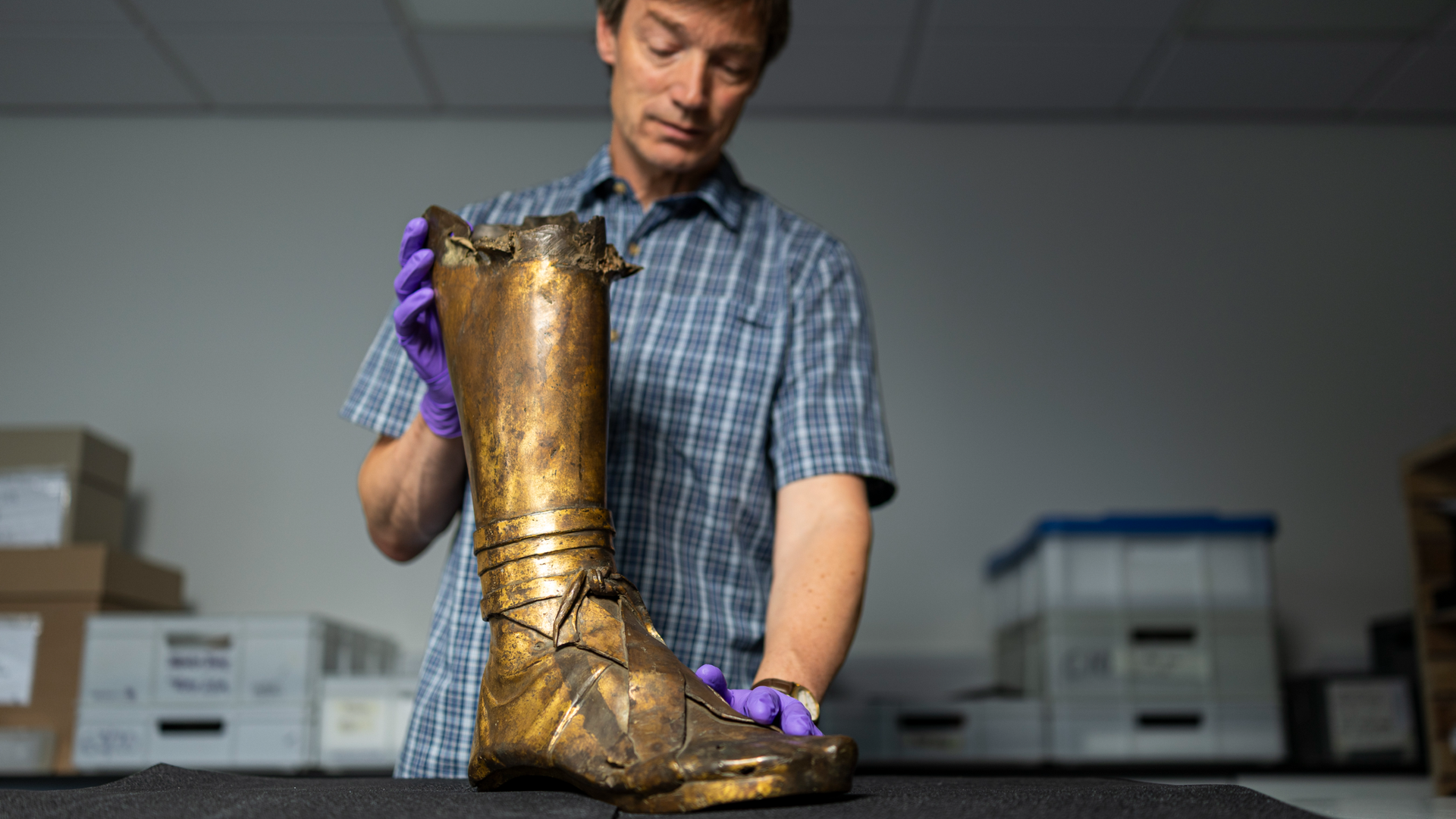
The most telling detail about the Milsington leg isn't the gold or the bronze. It's the lack of damage. The foot and calf show no cut marks, and that changes how archaeologists read the disappearance of one of Rome's few monumental statues in Scotland.
I've read enough museum announcements to be wary of the word "rare," but this one earns it. Monumental Roman sculpture tends to survive far from the core provinces only in fragments, and those fragments are usually broken, melted or reused. A bronze limb with its surface intact is a different kind of evidence. It's worth slowing down to see what it can and can't tell us.
A Leg From the Wrong Place
The fragment turned up in a bog in 1820. For a long time, researchers assumed it had been looted from York, the city the Romans founded in A.D. 71 as Eboracum. That made sense until frontier research matured. Equestrian statues were regularly set up in forts along the edge of the Roman Empire, and that's where this leg now seems to belong.
The York theory was attractive for a simple reason. York was a major Roman center, and it's easy to imagine imperial imagery ending up there. Scotland, by contrast, sits at the far margin of the empire's reach, and most people wouldn't expect a monumental emperor to have stood there at all. Once the frontier got its own serious attention, the assumption looked weaker. Sometimes the simplest explanation is the one nobody checked.
According to National Museums Scotland, the leg most likely came from a horse-mounted statue of Emperor Antoninus Pius, modeled on the famous bronze of Marcus Aurelius in Rome. The museum dates the piece to around A.D. 140, and it's the only monumental Roman emperor statue ever found in Scotland. That last point is what makes the find stand out. Plenty of Roman material has turned up north of the old frontiers, but a life-size imperial portrait is a different category of object altogether.
Bogs deserve more credit here than they usually get. Waterlogged ground slows the corrosion and scavenging that destroy so much metal, and it can hold onto objects for centuries until someone digs them up. (And this is the part most people overlook.) The bog didn't just hide the leg. It kept the surface detail legible enough for researchers to work with, which is why a single limb can carry so much of the argument.
Why Antoninus Pius Mattered in Scotland
Antoninus Pius ruled from A.D. 138 to 161 and followed Hadrian, who had built his enormous wall to hold the northern edge of the empire. Antoninus took a different tack. He directed the imperial governor of Roman Britain to push north, invade southern Scotland and build a second barrier, the Antonine Wall.
Think about what that decision implies. Hadrian's approach was to hold a line. Antoninus's was to move the line, and that's a much bolder political claim. An emperor who wants to be seen as expanding the frontier needs visible proof that he's in charge, and a statue of him on horseback is about as visible as proof gets. If you're trying to understand why a commission like this existed, the answer is less about art and more about messaging.
That ambition didn't last. After Antoninus died, the wall was left without the same commitment, and Rome pulled back from Scotland. A statue of this scale would have been a loud declaration of imperial power in a region the empire had just tried to claim. Here's the thing: a monument like that was a political object as much as an artistic one. It was meant to be seen, and in a place where Rome's hold was still shaky, that visibility was the point.
Taken Down, Not Smashed
The removal may be the real story. Statues were often destroyed in ways that left obvious evidence, whether after a battle, after an emperor's memory was condemned, or when bronze was cut up for scrap. The Milsington leg bears none of those signs. National Museums Scotland suggests the Romans may have dismantled their valuable statues during the withdrawal, removing them with care rather than hacking them apart.
That's a deliberate-sounding choice. Someone decided the bronze was worth carrying away, and the leg's loss suggests the rest of the figure never made it back to Rome or anywhere else. I find that more interesting than a dramatic destruction story would be. A careful removal implies planning, labor and a clear sense of value, and that's not what you'd expect from a rushed retreat. Whether the leg was lost in transit, left behind by accident or hidden on purpose is still unclear.
Each of those explanations says something different about the withdrawal. A lost piece suggests chaos at the edges of the operation. A hidden piece suggests someone expected to come back for it. Neither can be confirmed from a single limb, and I'd be wary of any account that claims otherwise until more evidence turns up.
Where Is the Rest?
Fraser Hunter, principal curator of prehistoric art and Roman archaeology at National Museums Scotland, says the find forces a rethink. "This really turns on its head our understanding of Rome's second attempt at conquering Scotland," he said. "This was a big deal for the Emperor, something which was worth celebrating."
That quote does more work than it first appears to. Hunter isn't just describing a surprising object. He's arguing that a whole chapter of the Scottish frontier story needs revising, and that's a much bigger claim than "we found a leg." Museum curators rarely talk about their finds this way unless they think the implications reach beyond one display case.
That leaves the obvious question. Hunter wants to know where the rest of the statue went. Until someone finds more of it, the bog-dug leg will have to carry the story on its own. Single fragments are good at raising questions and bad at settling them, and this one is no exception.
The fragment goes on display from Nov. 14 in the exhibition "Roman Scotland: Life on the Edge of Empire" at the National Museum of Scotland, alongside the Inveresk Mithras altars and other Roman-period finds. Putting the leg next to other material from the same period is a smart move. It lets visitors see the statue as part of a broader military and religious world rather than as an isolated curiosity.
What This Means Going Forward
The immediate significance is interpretive. If the leg belongs to an emperor's equestrian statue in Scotland, then the Antonine campaign looks more ambitious than many older accounts suggested. That shifts how historians weigh Rome's presence in the north, and it gives museums a stronger reason to rethink how they present the frontier to the public.
For researchers, the bigger lesson is about method. Objects that were once filed as looted or misplaced can change meaning when the surrounding frontier evidence gets better. If you're working in this space, that's a reminder to revisit older finds rather than treating earlier attributions as settled. A label written decades ago may be the weakest part of a collection.
Looking ahead, the open questions are concrete. Are there other fragments of this statue sitting in storage or in unexcavated ground? Did the removal follow a pattern seen at other sites? Those are the questions that would turn an intriguing leg into a fuller picture. Until they're answered, I'd treat the Milsington find as a strong lead rather than a finished story, and that's still a more interesting place to be than where the research stood before it surfaced.
Discussion
Sign in to join the discussion.