Found together in a Romanian grave, the seated clay figures may have represented mourners, a family pair or beings tied to solar worship.
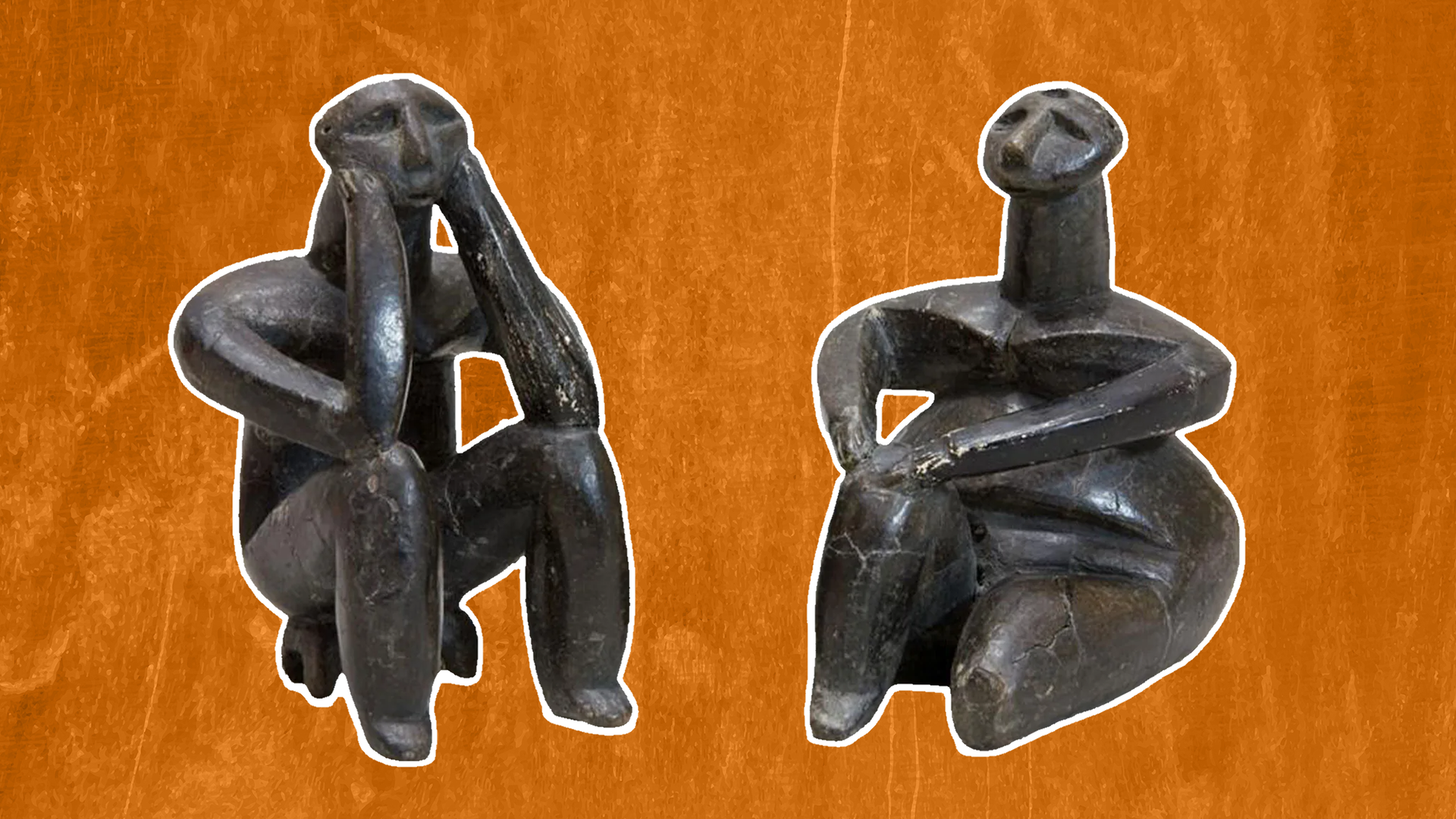
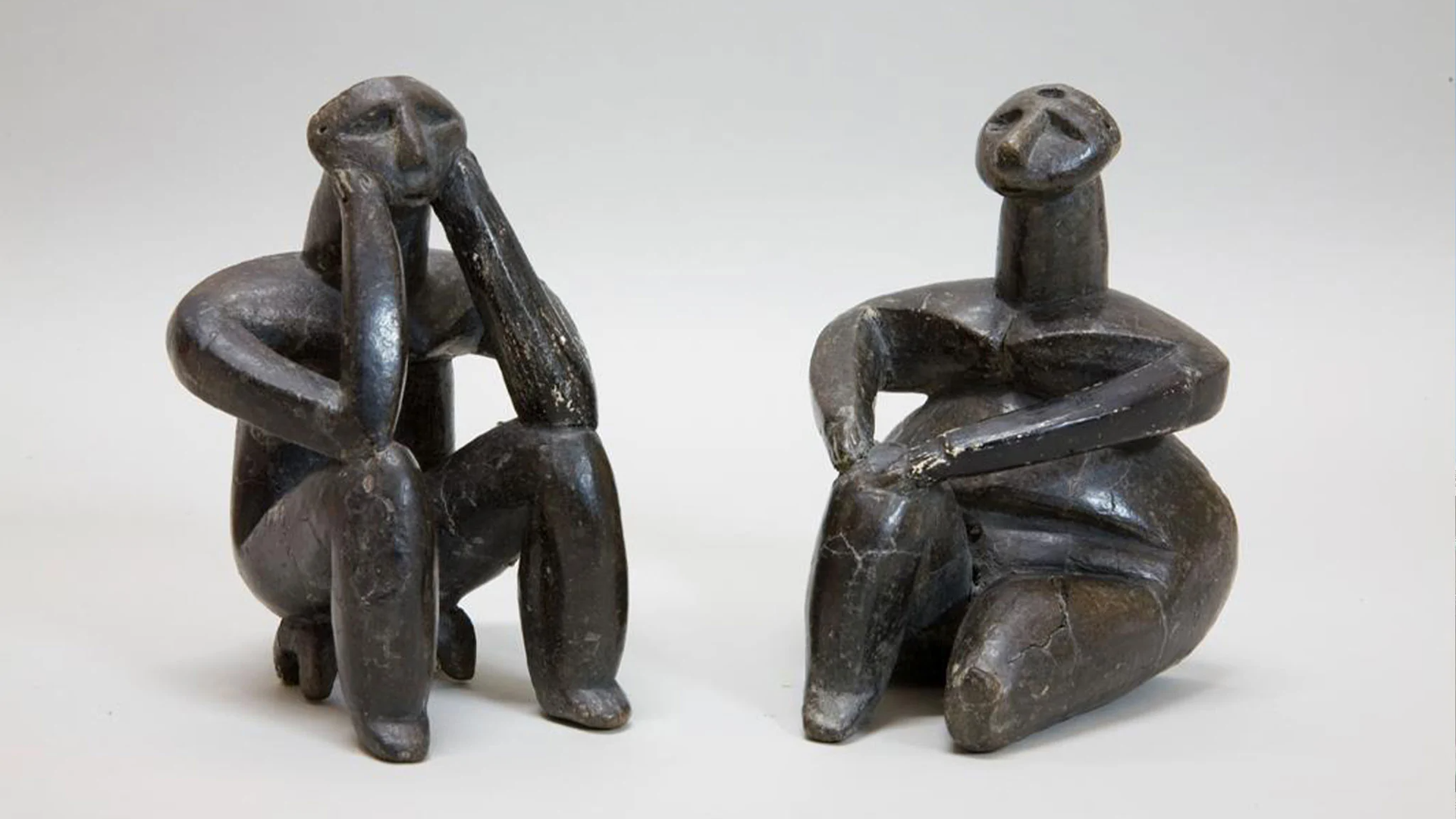
Two small clay figures found in the same grave at Cernavodă, southeastern Romania, stand apart from the many prehistoric figurines known from the region. Both are seated, in poses that invite interpretation while leaving their purpose unresolved. Archaeologists uncovered them in 1956; they date to roughly 5000 B.C. and are associated with the Hamangia culture. The pairing is part of what makes them so arresting: each figure is distinctive on its own, but together they prompt questions about how people in this community represented bodies, relationships and the dead.
A striking seated pair
Known as the Thinker and the Seated Woman, the fired-clay sculptures are about 11.5 centimeters tall and belong to the collection of the National Museum of Romanian History. The museum identifies them as possibly male and female figures. Their small scale makes their carefully composed poses all the more noticeable: these aren’t simply upright human forms, but bodies arranged to suggest particular states or actions.
The Thinker sits on a low stool with four legs. He leans forward, elbows on his knees, and cups his head in his hands. The posture suggests contemplation, and recalls the pose of Auguste Rodin’s sculpture of the same name, created in 1904. That resemblance is a visual association, not evidence of a shared meaning. His companion has a long, bent neck and small face, with pronounced breasts, hips and thighs. One leg is bent, and her hands rest on her knee. The difference between their poses is plain; what that contrast meant to the makers is not.
Hamangia life and competing interpretations
The figures were made by Hamangia communities, whose territory extended between the Danube River and the Black Sea. Archaeologist Dumitru Berciu, who excavated the cemetery, dated the culture to around 5200–4500 B.C. Its people herded sheep and goats, built hilltop settlements with defensive features, and produced spiral-decorated pottery as well as human figures. These objects belong to a wider material record, but the surviving evidence can’t tell us exactly how a particular figurine was understood by the person who made or used it.
Berciu recovered many male and female figurines at Cernavodă, but the seated posture of this pair was unusual. He proposed that their stylized forms might have served a magical or religious role, and considered a connection to sun worship. Solar devotion is documented among later Bronze Age communities in Europe, including through the Nebra sky disc in Germany and an ornate sun chariot from Denmark. Those later objects offer a possible comparison, not proof of what the much earlier figures meant. Similarities between religious practices across long stretches of time can be suggestive, but they don’t establish a direct connection.
The museum has proposed that the sculptures were made as a deliberate pair, perhaps expressing complementary masculine and feminine principles or a Neolithic family unit. Another interpretation sees them as mourners buried with the dead. None of these readings is settled. Here’s the thing: the grave context makes a funerary interpretation plausible, while the figures’ contrasting bodies and poses leave room for other explanations. The evidence supports a set of questions more readily than a single answer.
What the uncertainty tells us
The figures’ original meaning may remain out of reach, but uncertainty doesn’t make them unimportant. It draws attention to the limits of interpreting prehistoric objects, especially when there are no written explanations to accompany them. A posture can look familiar to modern viewers and still have carried a different significance for the people who made it.
This is more significant than it looks. The Thinker now features in the National Museum of Romanian History’s logo, carrying a 7,000-year-old object into Romania’s present-day cultural identity. That modern role gives the figure a meaning we can describe, even as its ancient one remains open. If you’re looking at these sculptures today, you’re seeing both a carefully shaped archaeological object and a symbol whose story has continued to be retold.
And yet. Their stillness resists an easy explanation (and this is the part most people overlook): what survives is not a complete account of Hamangia belief, but a pair of figures that keeps interpretation tied to the evidence at hand.
Discussion
Sign in to join the discussion.