Voyager 1 showed Jupiter and its moons to be a turbulent, active system, discovering the planet’s faint rings and volcanic eruptions on Io.
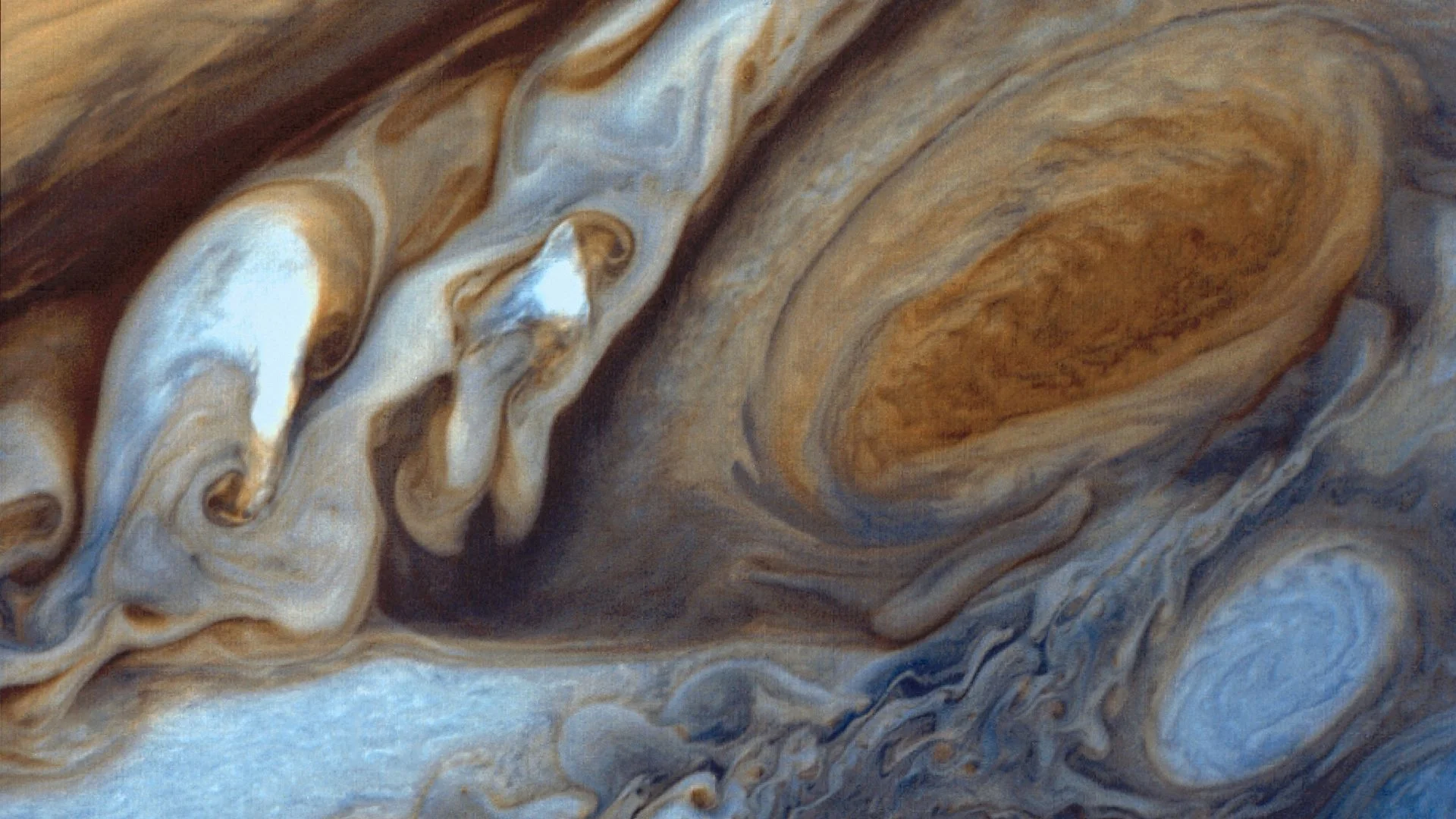
Voyager 1’s 1979 encounter with Jupiter changed the outer solar system from a collection of distant points into a set of active worlds. The probe revealed fast-moving atmospheric bands, a faint ring system and a volcanic eruption on Io. Those observations made Jupiter more than a large planet with several moons: they showed it was a changing system, with activity unfolding across its clouds, rings and satellites.
A closer look at Jupiter’s shifting atmosphere
From January through April 1979, Voyager 1 studied Jupiter and several of its moons. In March, it passed within 174,000 miles (280,000 kilometers) of the planet, according to NASA. As it approached, the spacecraft took an image every 96 seconds, building a time-lapse view that made changes in the cloud tops easier to follow.
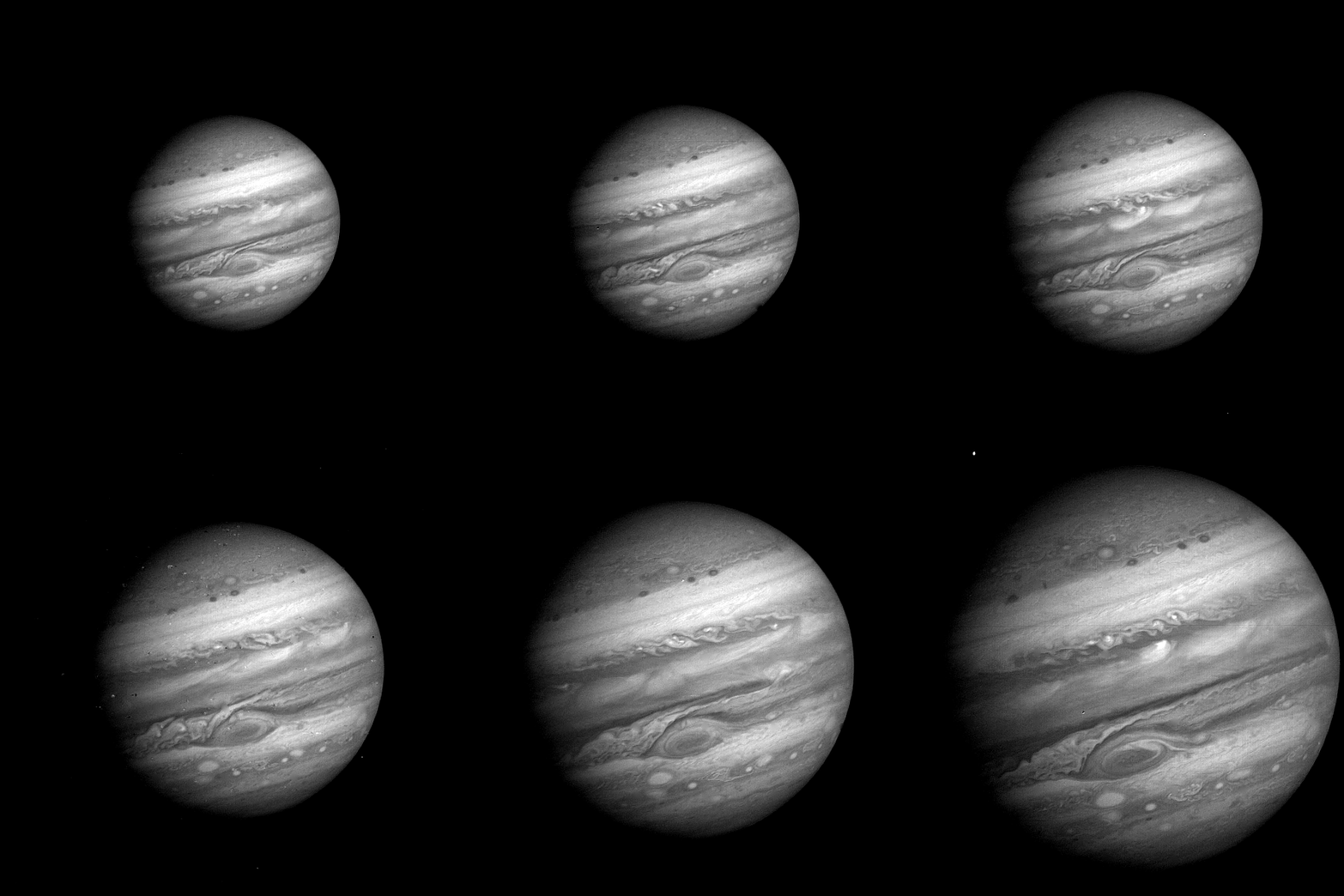
The images showed cloud bands moving at different speeds and in different directions, while vast storms churned across the planet. The sequence covers about 60 Jupiter days; because each lasts roughly 10 Earth hours, the footage compresses about a month of Earth time into a view of Jupiter’s shifting weather. The contrast between banded flows and persistent storms makes clear why a single still image could only offer a partial account of the atmosphere.
That motion matters because it turns cloud patterns from surface decoration into evidence of a dynamic atmosphere. Voyager’s repeated images let observers compare features over time and see that different regions did not move as one. The observations didn’t explain every process behind those patterns, but they gave researchers a much richer starting point for asking how Jupiter’s atmosphere behaves.
Those close-up views extended the work of NASA’s Pioneer 10 and 11, which had visited several years earlier. Together, the observations established that Jupiter’s atmosphere was far more active than astronomers had understood. Voyager’s contribution was partly one of detail: it turned earlier hints into a changing sequence that could be examined, compared and used to frame new questions.
A faint ring and an erupting moon
As Voyager 1 neared Jupiter, it found a thin ring made mostly of dust. The ring became visible when the spacecraft viewed the planet with the Sun behind it, a geometry that helped reveal material too faint for telescopes to detect at the time. That viewing angle was more than a photographic choice; it changed the contrast between the planet and the dust around it, making a previously hidden part of the system detectable.
Ground-based observatories later confirmed the finding, and Voyager 2 returned sharper images during its Jupiter encounter in July 1979. The follow-up mattered because it showed that Voyager 1’s view was not an isolated visual impression. A faint ring is easy to overlook when observations depend on viewing conditions, so confirmation and clearer images helped establish it as a real feature of Jupiter’s system.

Jupiter’s ring discovery added to a broader picture: all four outer planets—Jupiter, Saturn, Uranus and Neptune—have rings. Scientists suspect that dust from Io, Jupiter’s volcanically active moon, helps replenish the planet’s faint ring material. The proposed link connects two discoveries from the same encounter: volcanic activity on a moon may feed dust into the environment around its planet.
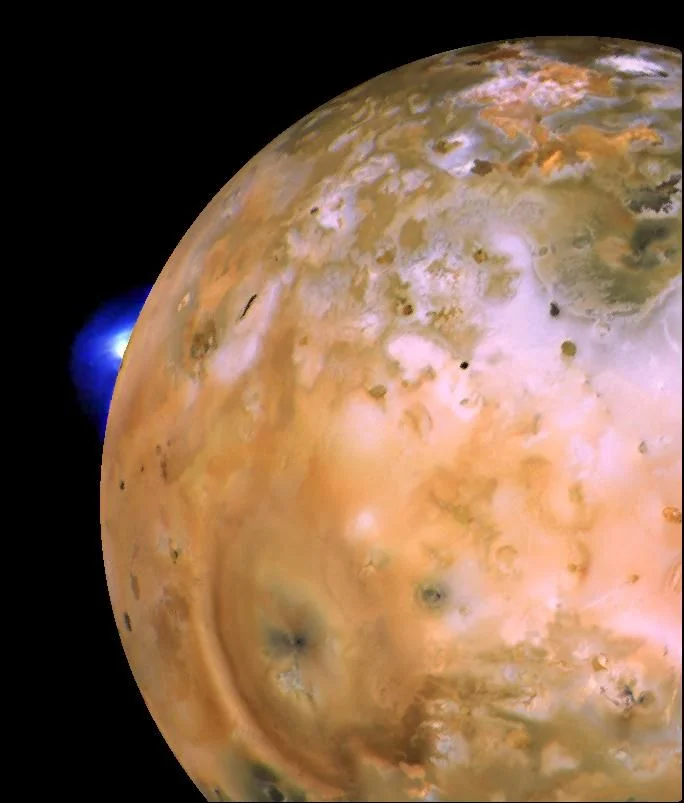
Voyager 1 also saw the first volcanic eruption observed beyond Earth. The eruption came from Io, where the giant Loki Patera measures an estimated 125 miles (200 kilometers) across. That finding changed the scientific picture of moons, which could no longer be treated as passive companions simply because they orbit a planet. Io showed that a moon can be an active world in its own right.
What Voyager changed about planetary exploration
Jupiter’s weather, ring and volcanic moon made a persuasive case for studying a planetary system as a collection of interacting places. The flyby didn’t answer every question, and a brief passage can only sample a moment in a world’s history. Still, it showed how much a spacecraft could reveal by observing a planet and its moons together, rather than treating each as a distant point of light.
Voyager’s images and measurements recast Jupiter and its moons as a complicated, changing system worth exploring in its own right. That shift continues to shape mission ambitions: China’s space agency has announced plans for a mission that would attempt the first landing on a moon in the Jovian system, targeting Callisto. The planned target is a reminder that the moons are not a footnote to Jupiter; they’re destinations with scientific questions of their own. If you're working in planetary science, the lasting lesson is that a close look can overturn assumptions about what counts as an active world.
This is more significant than it looks: a faint ring, an atmosphere in motion and a volcanic eruption each demanded different ways of observing the same system. And this is the part most people overlook: Voyager’s legacy lies as much in the questions its images made possible as in the dramatic scenes themselves. A broader view of Jupiter’s system. That said, future missions will build on a foundation that began with a short flyby, not a sustained study of every moon or atmospheric process.
Voyager 1’s journey beyond Jupiter
Voyager 1, meanwhile, is still operating beyond the solar system. It entered interstellar space in 2012 and now uses magnetic field and plasma detectors to study its surroundings. Its work there is a striking second chapter, but it rests on the same basic strength seen at Jupiter: instruments gathering information from places no human observer can visit directly.
Those are the last two of its 10 science instruments still receiving power, and the probe is expected to run out of power in the 2030s. The remaining measurements offer a limited but valuable view of conditions beyond the solar system. When the spacecraft can no longer operate, its Jupiter encounter will remain an early demonstration of how a robotic flyby can turn a faraway world into a place with weather, geology and a system of its own.
Discussion
Sign in to join the discussion.